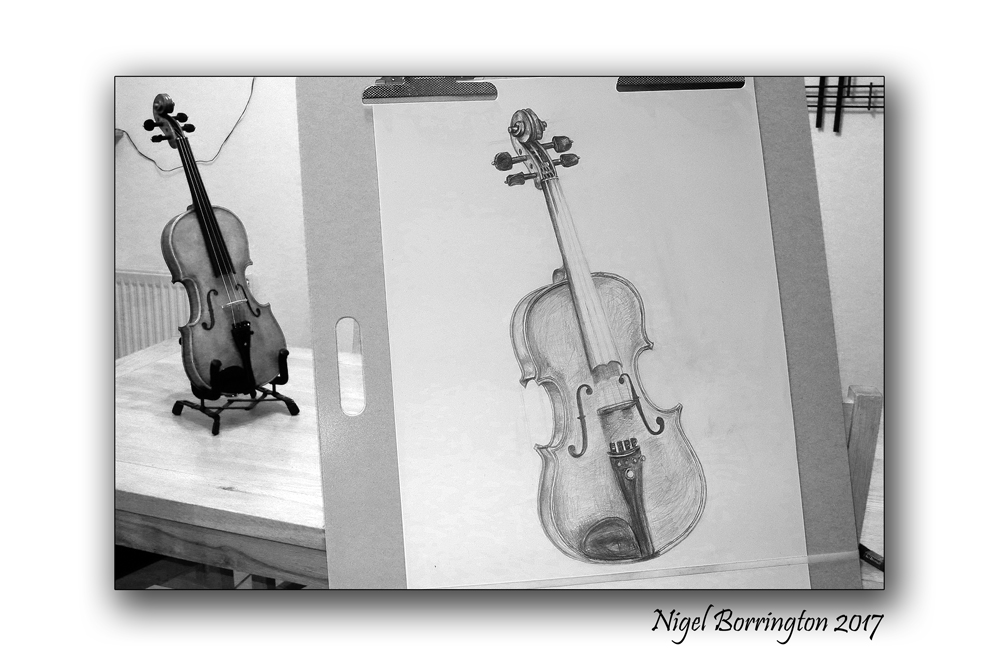
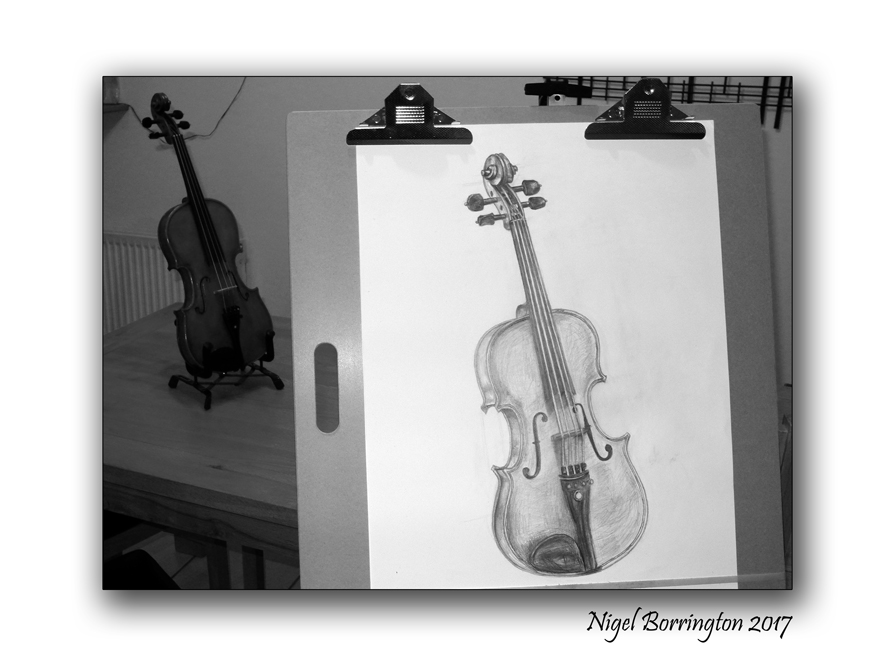
Pencil on paper, Drawing from life – My Violin

My Violin
Drawing from life
Pencil on Paper
Nigel Borrington
I am a big believer that the skills involved in producing any kind of art work come from the base level of being able to represent the world around us, even the most abstract of painting and sculpture has to come from some kind of desire to represent thing in the real world.
So I wanted to before doing any more painting, take a step back into working on basic drawing skills.
The images here are taken over two nights during the week as I started and finished a pencil drawing of my Violin. they show some of the steps as I first worked on the basic outlines of the image and then moved into adding some details and shading.
I am happy with this first effort but will keep working over the next few weeks on different angles of the violin as well as working in different mediums such as pens and ink and charcoal.
Drawing progression


Pencil and Watercolour Sketching, the great outdoors

Watercolour Sketch
County Kilkenny
Ireland
Sketching in the great outdoors
This year I hope to use other forms of recording the landscape that I find around me other than photography alone, I love creating images using my camera but I want to dig in a little deeper and spent a lot more time at each location.
There are so many art based media that can be used to create a sketch, such as (Pastels, pens, pencils, charcoal and paint).
Personally I love using Pencils and Waterolour paints, both are very simple to use and very easy to carry around. Pencil is the most direct and very easy to always have with you in a bag. Watercolour paints requires you to have a supply of water and a palette for mixing colours, both simple to have available and easy to use. A monotone Watercolour sketch is a great way to make use of this medium, used to capture all the tones that you can see in the landscape in-front of you and a lot faster than using a pencil to record the lights and dark’s in your image.
I find that the process of starting and finishing a sketch outside to be the perfect way of relaxing, its very hard to think about anything else on your mind from the moment you start working and by the time you have finished, your mind is filled with little else other than how you can use you finished sketch later for a painting or more detailed drawing.
Add your sketch to some photographs you took and you have the perfect set of images available to create larger works in oil or acrylic paints.
The sketches here are a small sample of some work produced during an art course I completed a while back …..


Making plans and getting projects ready for 2017

Abstract Sunset
Nigel Borrington
So then 🙂 , this is my first blog post of 2017 – Happy belated New year to everyone 🙂
We returned home to Ireland a couple of days ago , following a wonderful Christmas spent with my sister and family in Manchester. It was a great time catching up sharing time, out side walking and visiting museums and art galleries, talking lots and watching the odd movie or two.
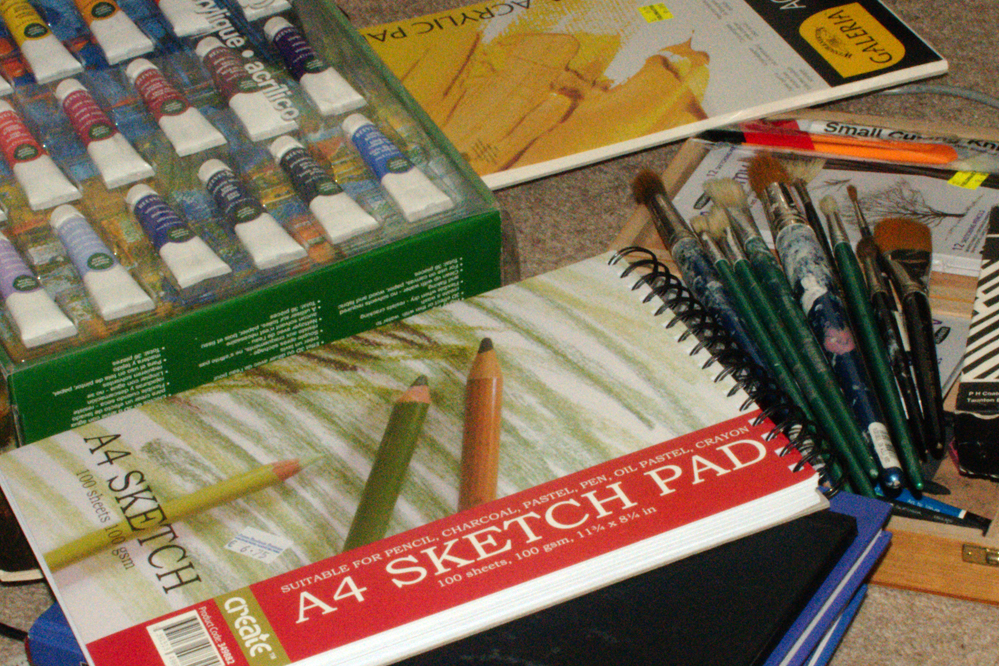
Today I spent sometime organizing my studio room and then shopping, I needed to get some new art supplies , including paint, brushes and sketch pads. Towards the end of last year I worked mainly with digital media for both photography and art work, however in 2017 I want to add real media including pencils , charcoal and acrylic paint to my work.
I am approaching this year in the form of a set of projects that I want to work on and complete by the end of the year. My main aim is to spend as much time as possible developing real skills and end up with a developed portfolio of work that records all the small steps involved with anything I do.

I feel strongly that art of all forms (including photography, drawing and painting) is a skill that involves development. This development needs in some way to be captured/recorded so that you can look back on the steps taken.
So I hope to find a method to record my year ahead, in the form of recorded steps that involve (notebooks, sketches, photos, poems, painting etc…) that all in all build towards finished works.
Above all I am looking forward very much to just getting going and being on a path again 🙂 🙂
Some work from 2016 …..
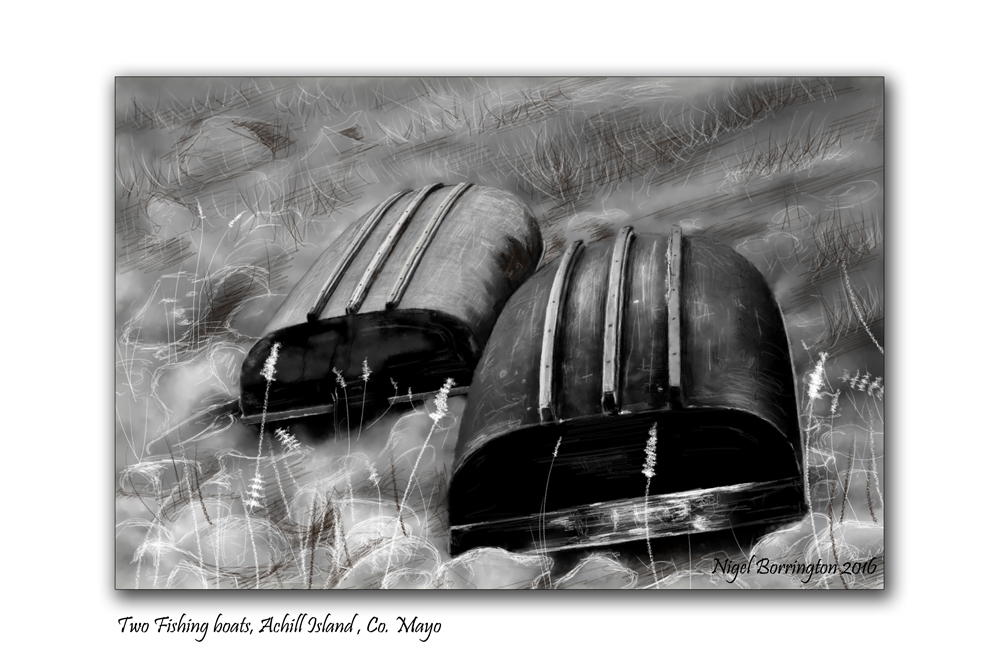
Two fishing boat
Keem Strand
Achill Island
County Mayo
Landscape art and Painters , Artist: Fred Cuming

Landscape painter
Fred cuming
Landscape painting and photography
Painting as an art form for myself feels very much like a natural progression from the art of landscape photography which is the act of recording a representation of the view you find yourself located in.
I often find myself asking what it was about an image I capture with my camera or in a sketch / painting that I liked so much that I went to the effort of working with that location in different forms and media.
This is a quote from one of my favourite landscape painters Fred Cuming, Talking about his paintings Cuming says: ‘I am not interested in pure representation. My work is about responses to the moods and atmospheres generated by landscape’
Although there are many forms of landscape art all as valid as each other, Contemporary landscape painting tends to fall into the areas of semi abstracted to completely abstract, in that each work is making an effort to extract from the selected landscape location a sense of atmosphere or a mood. This mood and atmosphere can involve colour or light or texture, or all of these things and more.
This artistic process, from pure representation or abstraction can in a completely valid way start with photography and in fact many current artists have replaced the sketch book with the film/digital camera. The question as to if this is the best thing or not will continue for a long time, some feeling that a photo simply cannot capture a good enough sense of the location or at least not in the same way as spending time in that location with a sketch book can.
Personally I feel photographs are a very important tool and can in a very valid way capture the mood and sense of a place. However I feel that you need to spend a good amount of time with your camera exploring as much as you can while your on site, walking around and finding all the different views and angles along with all the small details you can find. The aim is to return home with as complete a memory of your landscape as you can.
Here are some details of Fred Cuming as an artist along with some more of his painting…..
Artist: Fred Cuming
Fred Cuming is a painter of International standing. Born in 1930 he studied Art at Sidcup School of Art from 1945 to 1949. After completing his National Service he studied at the Royal College of Art from 1951 to 1955 where he gained a Rome Scholarship and an Abbey Minor Scholarship.
Fred was elected a Royal Academician in 1974. He has also been a member of the New English Art Club since 1960 and is the recipient of many art awards including: the Grand Prix Fine Art (1977); the Royal Academy’s House & Garden Award and the Sir Brinsley Ford Prize (New English Art Club, 1986).
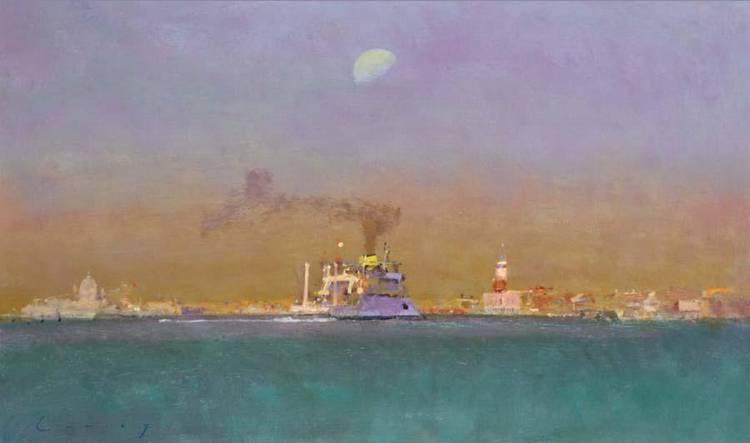
Fred Cuming has exhibited his contemporary paintings world wide. His paintings feature in many private and public modern art collections. These include: Montecarlo Museum; Royal Academy of Arts; and the Guinness Collection.
Fred Cuming paintings offer a moment for reflection. Cuming creates a relationship with nature and light – inducing observers to appreciate the calming atmosphere and realisation of the beauty around us. Many of his paintings feature the counties of Kent and Sussex where the Fred Cuming artist studio is located.
Talking about his paintings Cuming says: ‘I am not interested in pure representation. My work is about responses to the moods and atmospheres generated by landscape, still life or interior. My philosophy is that the more I work the more I discover. Drawing is essential as a tool of discovery; skill and mastery of technique are also essential, but only as a vocabulary and a means towards an idea. I struggle to keep an open mind.’

Fred Cuming has exhibited at other leading British Art Galleries. In 2001 Cuming was the featured artist at the Royal Academy Summer Exhibition with an entire gallery dedicated to his art work.In 2004 he was awarded an honourary doctorate from the University of Kent.Like all Red Rag British art and Contemporary art Fred Cuming purchases can be shipped worldwide.

Digital Art work – A December Sunset – Callan, county Kilkenny

Kilkenny Sunset
December 2016
Nigel Borrington
A December Sunset – Callan, county Kilkenny
Often when out for an evening walk at this time of year the sunsets across our local fields can be just amazing to view, the sun is low in the sky all day long in December when compared to a mid summers day. With out getting to detailed this changes the angle of the sun and it seems to make the last few moments of day light last longer. This along with the mist and early frosts that can sit of the fields, haging above the hedgerows is just great to see 🙂
This painting is created using a PC application called mypaint, I have spent the last few weeks doing my best to get up to speed with how to make the best use of it, at first just using some of the drawing tools and ink pens but as you can see – I hope that I am now getting more use to the painting and colour tools..
The paint is posted the moment I feel its finished , I very much like the idea of this as it helps me to close the processes involved and to stop me coming back and over working anything. Its a little hard to describe but its a great feeling to start and finish a painting in one session and then be able to learn when you feel that you have finished !!!
Abandoned Farmhouse, Poem By Ted Kooser

Abansoned Farmhouse
Chalk sketch
Nigel Borrington
Abandoned Farmhouse
By Ted Kooser
He was a big man, says the size of his shoes
on a pile of broken dishes by the house;
a tall man too, says the length of the bed
in an upstairs room; and a good, God-fearing man,
says the Bible with a broken back
on the floor below the window, dusty with sun;
but not a man for farming, say the fields
cluttered with boulders and the leaky barn.
A woman lived with him, says the bedroom wall
papered with lilacs and the kitchen shelves
covered with oilcloth, and they had a child,
says the sandbox made from a tractor tire.
Money was scarce, say the jars of plum preserves
and canned tomatoes sealed in the cellar hole.
And the winters cold, say the rags in the window frames.
It was lonely here, says the narrow country road.
Something went wrong, says the empty house
in the weed-choked yard. Stones in the fields
say he was not a farmer; the still-sealed jars
in the cellar say she left in a nervous haste.
And the child? Its toys are strewn in the yard
like branches after a storm—a rubber cow,
a rusty tractor with a broken plow,
a doll in overalls. Something went wrong, they say.
Friday Art and Artists : British Artist Edward Bawden

650 0072
Friday Art reviews
Back in the Summer I did a weeks worth of posts that related to some of the artists I like the most. I really enjoyed doing the research behind these posts and so I want to start looking at some more artists and their work , In the long term I am planning to put each Friday aside for these posts, this December however I may post a lot more than one day per week, as I want to dig a lot deeper into the subject of landscape and cityscape art and artists ……
Artist Edward Bawden
British Artist Edward Bawden, one of a group of artists associated with a community of artists that existed around Great Bardfield in Essex, England during the middle years of the 20th century.
Great Bardfield :
is a village in north west Essex, England. The principal artists who lived there between 1930 and 1970 were John Aldridge RA, Edward Bawden CBE RA, George Chapman, Stanley Clifford-Smith, Audrey Cruddas, Walter Hoyle (principally a printmaker, who ran the printing workshops at Cambridge Art School when I was there, and taught me to do linocuts in the style of Bawden and himself), Eric Ravilious, Sheila Robinson, Michael Rothenstein, Kenneth Rowntree and Marianne Straub. Other artists associated with the group include Duffy Ayers, John Bolam (who taught me painting at Cambridge Art School, and later became the Principal of the school), Bernard Cheese, Tirzah Garwood, Joan Glass, David Low and Laurence Scarfe. Great Bardfield Artists were diverse in style but shared a love for figurative art, making the group distinct from the better known St Ives art community in Cornwall, who, after the war, were chiefly dominated by abstractionists.
Edward Bawden (1903 – 1989)
can be seen as a key artist in the Bardfield group. His long career spanned most of the twentieth century, and comfortably straddled boundaries and borders between the fine and applied arts, boundaries which are seen as so immovable today. Even before his appointment as an Official War Artist in 1940, Bawden had established a reputation as a designer, illustrator and painter. As well as these areas his output over the years include murals, posters, designs for wallpaper, ceramics, lithographic prints and watercolours.
Edward Bawden was born in Braintree, Essex in 1903, and was perhaps more firmly rooted in Essex than any other artist represented in the North West Essex Collection. Bawden attended the Friends’ School in Saffron Walden. At the age of eleven he strained his heart and was excused participation in sports. This may have allowed him to devote more time to drawing, and his portraits and caricatures attracted the attention of his tutors who arranged for him to spend a day a week at the Cambridge School of Art. The school, now part of Anglia Ruskin University, had been founded to comply with the Ruskinian philosophies of improving design for industry, and encouraging amateur aspirations. Bawden fitted perfectly.
Before long, he had gained entry to the Royal College of Art. Here he was taught by Paul Nash (a lasting influence on Bawden and his contemporaries), and the popular E. W. Tristram. It was at the RCA that Bawden first met his ‘kindred spirit’, Eric Ravilious, the two quickly becoming firm friends, though entirely different in temperament. Shortly after leaving the college, the pair gained a prestigious commission to paint a mural for the refreshment room of Morley College in London. He first rented half of Brick House, the imposing Georgian house in Great Bardfield in the mid-1920s with Ravilious, and after his father purchased the whole house for him on his marriage to Charlotte Epton in 1932, he continued to live there until moving to Saffron Walden in 1970 after Charlotte’s death.
On a Personal note …..
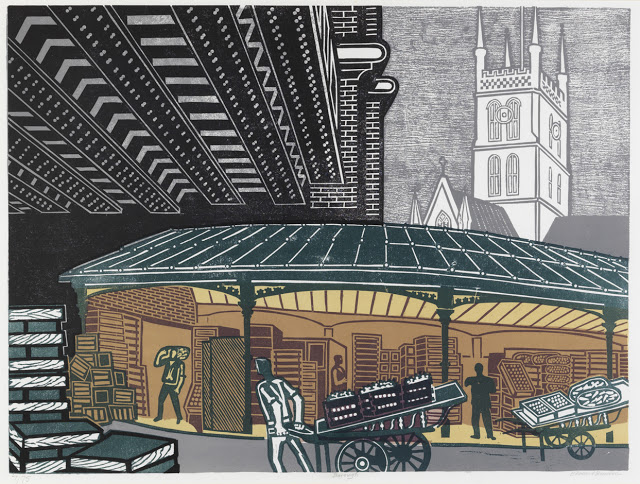
I really like Edwards London market prints, his use of limited colour and strong geometric shapes, to me this is print making at its very best. They are almost poster like yet retain strong connections to art not commercial based prints.
I like very much the sense of movement and activity that he captures from the people he includes in these prints, you can almost hear the noise and imagine the chatter that is taking place, the sound of wheels on the flag stones. The cold in the winter and the heat of the city in the summer.
These prints are full of life and capture London markets in 1967 in an almost timeless way 🙂 🙂
In 1967 Bawden made a series of six prints of London markets, commissioned by Curwen Prints. The markets were Billingsgate, Borough, Covent Garden (2), Leadenhall and Smithfield:

648 0074
646 0076

649 0073

250 0001

647 0070
650 0072
County Kilkenny Landscapes, New digital art works
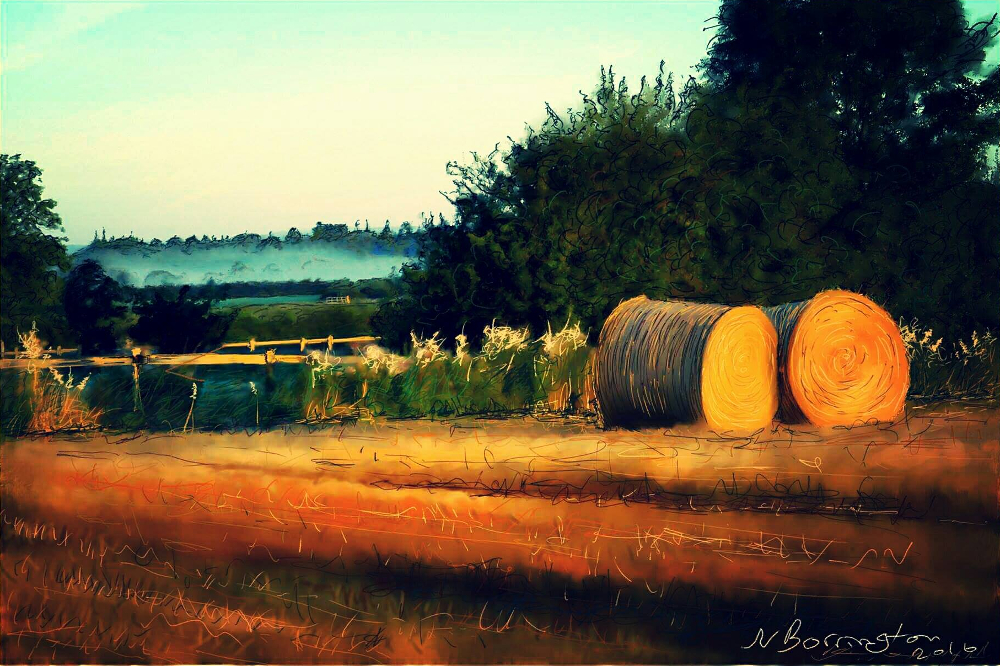
Landscape painting
Straw Bales
County Kilkenny, Ireland
Nigel Borrington
I am continuing to explore the world of digital painting using a Wacom studio art tablet and truly enjoying the creative experience it can offer.
I am planning in the new year to return to real paint and brushes but at the same time I have really taken to using digital media, I will continue to use it both to produce sketch work and finished drawings and painting. The power that digital painting offers to be creative and to be attached with modern social media is hard to escape 🙂 , the next step is to explore how to print onto more traditional papers and canvas in order to present finished work in a more traditional way.
A Sketch of two fishing boats, Keem Strand, Achill Island, Co. Mayo
Two fishing boat
Keem Strand
Achill Island
County Mayo
Landscape Art works : Ancient Rome, engraved by A. Willmore published 1859–61

Artwork details
Artist : After Joseph Mallord William Turner 1775–1851
Title : Ancient Rome, engraved by A. Willmore
Date : Published 1859–61
Medium : Engraving on paper
Collection : Tate
Acquisition: Transferred from the British Museum 1988
Its a good while since I posted here about some of my most loved artists and art work, I want to start again to share some of my most liked works of art over the next weeks.
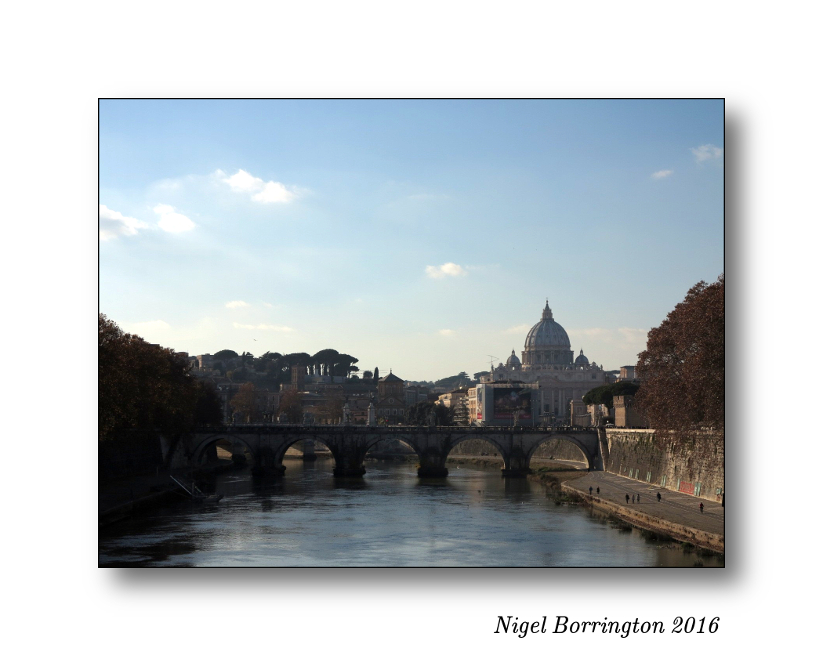
River Tiber
Rome
Nigel Borrington
I last visited Rome in December 2015 and took a few landscape images along the banks of the river Tiber, this river is a great location for photographers and artists alike.
Some years back while I was studying art history, I took a close look at the art work created by many artist who lived in Rome or who had visited this great city and done their best to capture its atmosphere.
Art work such as this great engraving by A. Willmore in the style of J._M._W._Turner, this is a fantastic etching as it captures the river and it location perfectly, live along the river banks.
it is not to hard to imaging this work as a great black and white print in modern terms.
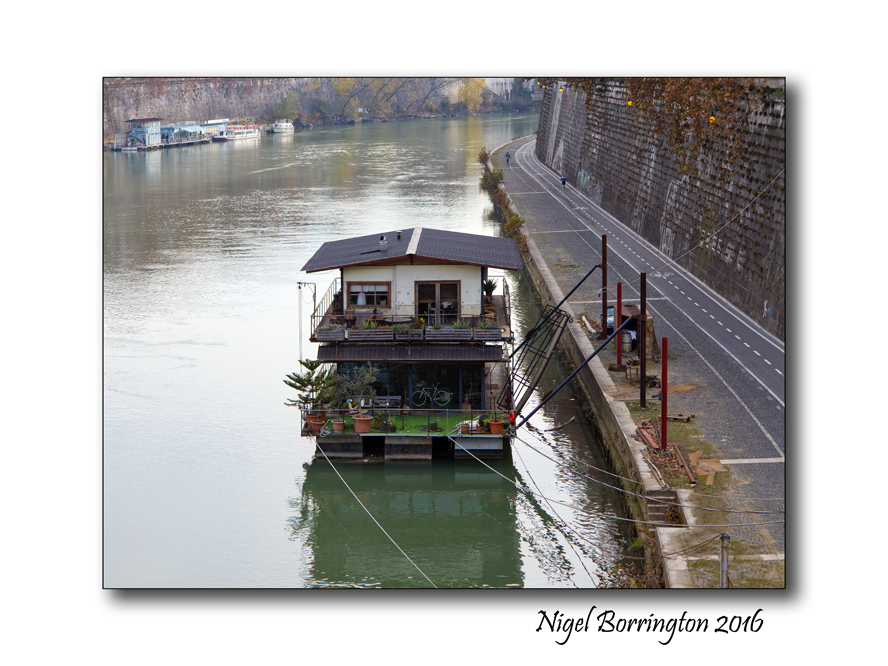
Life along the river bank
River Tiber
Rome
Nigel Borrington
Today the river Tiber is still used in many of the same ways as you can see in this drawing, it is now even the home to many people who live in house boats. the banks are today acting as walking routes and cycle paths.
Fridays Artist : Peter Collis, An Artist who Understands the Irish landscape
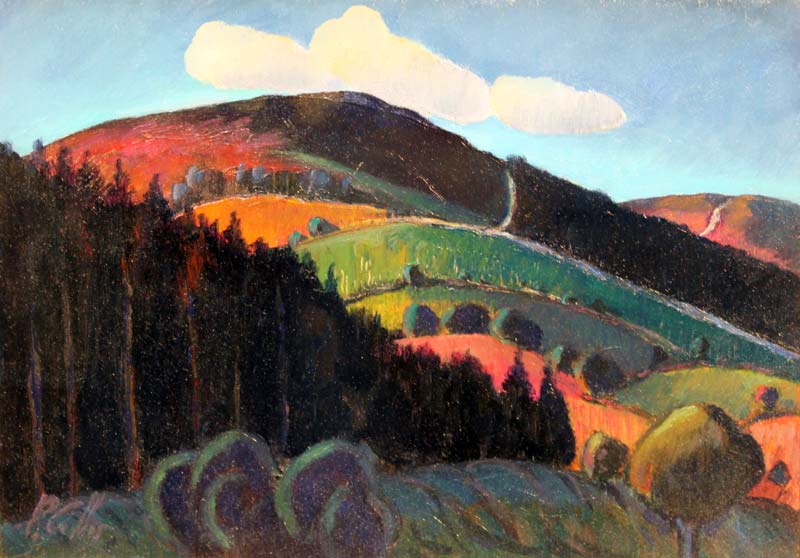
Glencrea Valley
by Peter Collis RHA
I started this week in my blog by saying that I was taking sometime each day to study some of my most loved Artists, I feel that the week has been really valuable to me in this respect and I am very pleased with how it has all worked out. At the same time the week has only scratched the surface of my full aims, being to gain an understanding of how so many great artists have used the landscape of Ireland and the UK in their art work and to define how I can take this as some personal inspiration.
While during the last few years I have taken many more photographs than produced paintings, I have been painting as a form of self-expression for many years. Oddly it was not until I decided to attend art school at Waterford(WIT) that I stopped painting so much, I think many experience this odd effect from current formal art study and art schools.
I don’t want my blog to become completely art and artists based and to move away from my own photography posts, although I personally feel that the two are very closely linked in any-case. So next week I will move a little back towards photographic images, I will however still keep posting some reviews of the artists and art work that I find the most interesting.
Has this week helped to inspired me ? , Absolutely! I feel its time to paint again as well as use my camera !!!
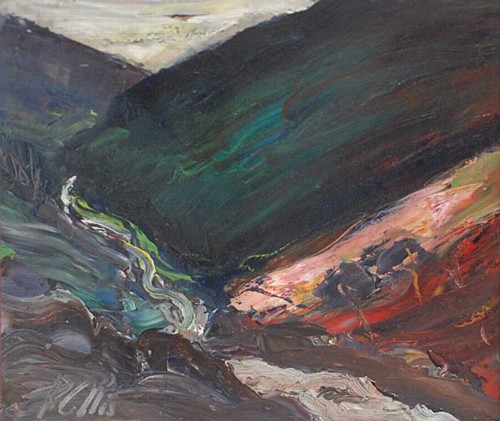
One of these very inspiring artists is Peter Collis the artist I have selected for my Friday Post. I remember visiting the Solomon Gallery, Dublin in 2002 , the first time I got to see any of peters paintings and I very much liked them from the start. I liked his style of painting of the landscapes he painted and very clearly loves, using a limited amount of colours like many artists do, I very much liked the way the movement of his brush can be so clearly viewed in his work, each gesture he made forms a feature in the landscapes he paints and each of these gestures are left alone on the canvas from the very moment they have been made.
I found this great review of Peter in the Irish independent dated 2012 – it says much more Than I can myself !!!
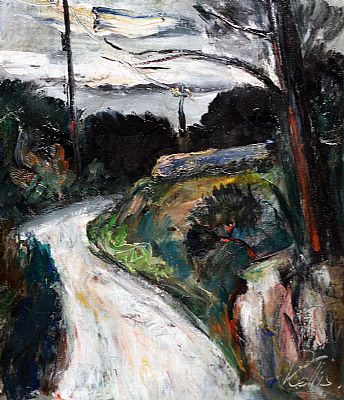
A little about Peter Collis by : Eamon Delaney
A lovely, gentle man’ was how veteran sculptor Imogen Stuart recalled the painter Peter Collis who has passed away at the age of 83. Collis, who was born in England and came to Ireland in 1969, was an acclaimed landscape artist and still life painter who had been a stalwart of the Royal Hibernian Academy. His canvasses are characterised by a powerful and dramatic style under the painterly influence of great masters such as Paul Cezanne, whom he adored, and Maurice de Vlaminck. In contrast to the traditional realistic depictions of the Irish countryside, Collis employed a bold brush and brought a strong expressive energy to his outdoor renderings.
He was particularly fond of Killiney, and its bay, and of the topsy turvy Wicklow countryside. The Sugar Loaf mountain became a familiar motif in his work. He also composed striking still lifes, of groups of green pears and vivid red apples, which evoked a distinctive European quality.
The physical appearance of Peter Collis often belied the rugged intensity of his work, with its rain-drenched hills and wind-bent trees. An unfailingly courteous man, who was widely popular, he wore Savile Row suits and was described by painter Mick O’Dea as possibly “the best dressed artist in the entire Irish arts scene”.

Born in London, he studied drawing and painting at the Epsom College of Art in London between 1949 and 1952. After college, he moved to Ireland where he had discovered a profound connect with the Irish landscape which would shape the course of his painting for the next four decades. Working for the Shell Oil company, Collis would paint in the early mornings from sketches and studies made on sales trips across the country, developing his craft and building a reputation as a painter of exquisite fluency. The critic Desmond McAvock wrote of him: “Like Cezanne he is really more interested in the structure of his scenes than in their transitory appearance . . . he can bind his observation into a cohesive, tightly controlled but always sensitive design.”
According to his longtime companion and fellow painter, John Coyle, Collis “saw things in the Irish countryside which the rest of us might never see”. Being something of an outsider, the Englishman was emboldened by bringing a fresh eye to it all. “He didn’t have the historical or territorial baggage that many Irish would have,” said Coyle, “and saw the landscape for what it was along with the physical, and poetic, possibilities it offered. He pursued the simplification and arrangement of shapes, just like Cezanne.”
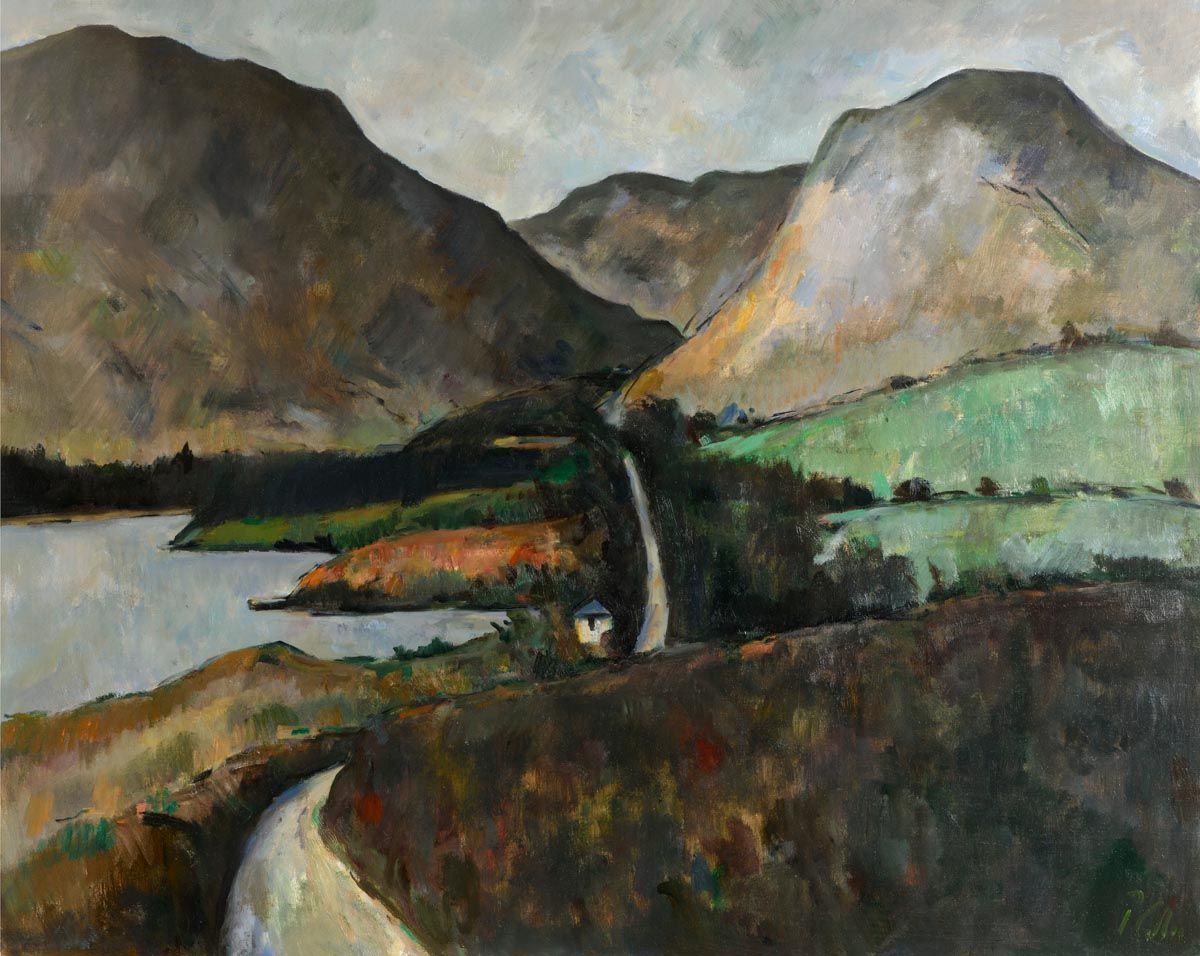
In Dublin, Collis was most recently represented by the Solomon Gallery and only last month had a retrospective exhibition in the John Martin Gallery in London. In 1990, he was elected to full membership in the Royal Hibernian Academy and was actively involved in the activities of that body. In 2002 he was conferred a senior member of the Academy. He received many awards, including the Royal Trust Co. Lt. Award in 1975, the Maurice MacGonigal Landscape Prize of 1981 and the James Adam Salesroom Award, RHA of 1999. His paintings are represented in many public collections, including those of AIB, Bank of Ireland, Limerick University, University College Dublin, and the Office of Public Works. His paintings are also owned by many private collections including Bono, Christy Moore, and Lord Puttnam, the English film maker.
He will be missed by the artistic establishment, but also in the context of the wider artistic understanding of the Irish landscape, which he did so much to further. Most especially, of course, he will be missed by his wife Anne, and daughters, Vanessa, Mandy and Kate, as well as grandchildren. He was sadly predeceased by the untimely passing of two of his children, David and Gail. His funeral service was held in the Parish Church, Monkstown (Church of Ireland) followed by burial in Deansgrange cemetery.
Sunday Independent
Thursdays Artist is a rediscovered source of artistic energy : Joash Woodrow

Four Trees, White Fence by Woodrow, Joash (1927-2006);
I first viewed the brilliant art work of Joash Woodrow in 2005 at the Manchester Art Gallery, I was back in Manchester visiting my sister and went into the city centre for the afternoon. I was not intending to visit the Gallery but it was raining so I wondered inside to see what exhibitions where on display, this was a lucky moment and one I will never forget.
I looked around the galleries permanent exhibitions and then took the stairs to the upper floor for a guest exhibition entitled “Retrospective – Joash Woodrow”, from the very first painting I viewed, I just knew I was going to fall in love with Joash’s drawings and paintings and I have been fascinated with his work and life story ever since.
I love Joash’s work for its very honest style, by this I mean that I feel he used his brush’s and paint’s to capture his world as he found it, there is little to praises or note about how perfect his style of painting or drawing is but so much to fall in love with about how he viewed his surroundings and how well he liked and felt for the people he painted.
This is painting in the RAW, produced by someone who, I feel if you were allowed to get close to him then you would truly like him !!!

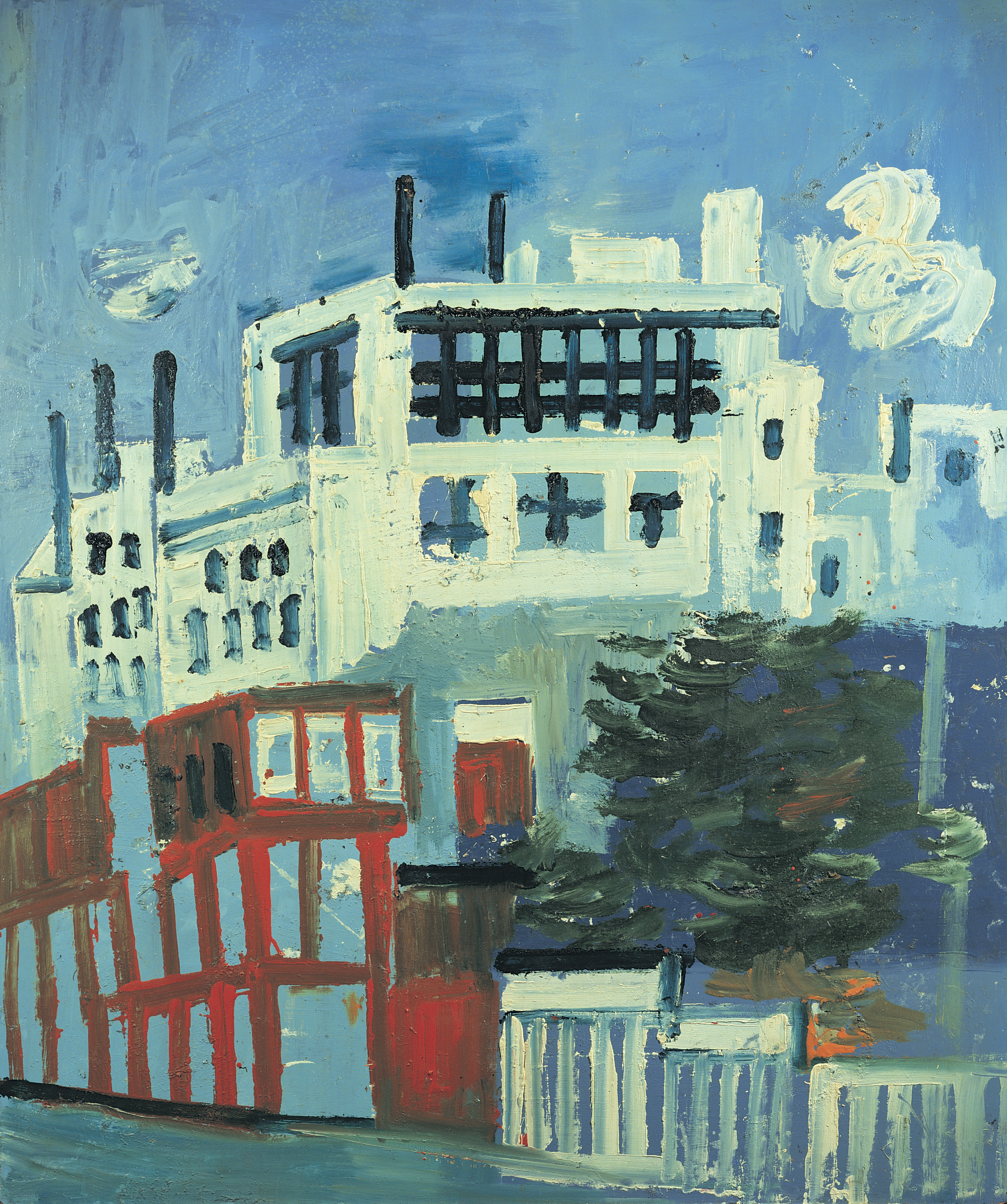
Joash Woodrow (1927-2006) Mr Woodrow’s Shop, Chapeltown Road, Leeds c
About Joash Woodrow, By :Nicholas Usherwood
Joash Woodrow, Reclusive painter whose work provides a significant link between British and European art
The chance discovery in a Harrogate bookshop in 2001, by the painter Christopher P Wood, of six volumes of an engraved Victorian art history, wildly and exuberantly annotated in a series of Picasso-esque drawings and collages by the then completely forgotten painter Joash Woodrow, led directly to the re-emergence of one of the most significant artistic figures in postwar British art. A visit a few days later by the Harrogate dealer Andrew Stewart to a small, semi-detached house in north Leeds, where Woodrow had lived alone for 20 years, uncovered an extraordinary story. The house was filled with some 750 canvases and around 4,000 works on paper, a lifetime’s achievement which a devoted family was none the less contemplating consigning to a skip.
Joash, who has died aged 78, had recently been taken into sheltered accommodation, having nearly set fire to the house, but his work itself had avoided serious damage. In the months that followed, it became apparent that this was no isolated figure at the margins of art history but an artist of sophisticated interests and training.

Born in Leeds, Woodrow was the seventh of nine children in a poor but cultured Jewish family that had escaped the pogroms in eastern Poland of the early 1900s. His father had run a Jewish bookshop in Chapeltown before working in Montague Burton’s factory to provide for a growing family. Joash trained at Leeds School of Art and, in 1950, won a scholarship to the Royal College of Art.
His intense shyness does not seem to have been suited to the competitive atmosphere there, though his tutors’ reports commented that his work already seemed more European in feeling than most of his contemporaries, among them John Bratby, Leon Kossoff and Frank Auerbach. A year or so after leaving the RCA in 1953, he suffered a nervous breakdown and took himself back to Leeds, where, supported financially by his family, he lived and worked for the rest of his life.
Advertisement
Joash Woodrows – Leeds
With his mother and two brothers also living in the two-up, two-down house, working conditions must have been extremely cramped, which almost certainly explains the comparatively small scale of Woodrow’s early work. Mostly portraits and landscapes, their dark tones illumined by flashes of sonorous colour and intense solemnity, they reveal the beginning of a distinctive style, one that in its understanding of the French fauvist Georges Rouault showed Woodrow already looking to European art for inspiration.
This gathered momentum with a number of visits to the huge Picasso exhibition at the Tate in 1960, the crucial impact of which was to give Woodrow an insight into his Jewish heritage, and the understanding that the roots of his art lay outside this country and were essentially European in character.
Looking to the fierce expressionism of Karel Appel, Asger Jorn and the Cobra group, the harsh, raw surfaces of Jean Dubuffet and the Art Brut circle, and the insistence on the quality of mark-making of Nicolas de Staël and the tachistes, Woodrow began to uncover the source of those artistic energies that were to carry him over the next 30 years of intense activity. With the death of his mother in 1961 – and with more room in which to paint – there was a steady increase in the scale and ambition of the work.
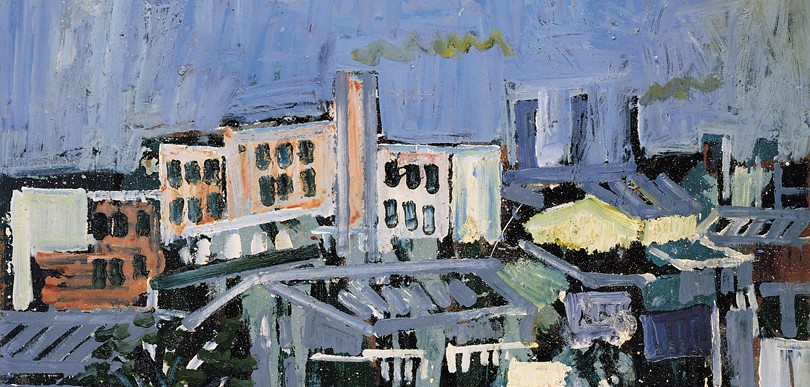
A lack of success in the work he occasionally submitted to large, open competitions like the John Moores, however, encouraged a feeling of isolation, something his reclusiveness only served to emphasise. By the early 1970s, he was living and working with very little thought for anything but the next painting, producing large-scale canvases (anything of up to 5ft x 8ft) with quite extraordinary rapidity. When not painting, he was drawing furiously in the semi-industrial and urban districts of north Leeds those subjects that were to form the basis of some of the most original and experimental works of his later career.
Advertisement
If his personal life was unhappy, there is no sign of it in the power and exuberance of the broad brush strokes, high-pitched colour and boldly flattened picture spaces with which he describes this landscape – an unprepossessing jumble of scruffy allotments, derelict factories and scattered trees.

Gilbert Looking Down, Joash Woodrow
By the early 1990s, Woodrow’s physical and mental health began to decline, and the house was too cluttered with paintings for him to do anything but draw. At the time of the 1999 fire, he seems to have stopped doing even that and, after his removal to sheltered accommodation in Manchester, he lost interest in working altogether.
Nor did he seem very interested in the public recognition that followed, when books and major exhibitions – at Leeds art gallery and then Manchester art gallery, and the Ben Uri and RCA last year – created a wave of interest that looks certain to place him firmly as a significant link between British and European artistic movements in the second half of the 20th century. His brothers Saul, John and Paul survive him.

· Joash Woodrow, artist, born April 7 1927; died February 15 2006
Wednesday’s artist’s work is full of Water and Trees : Trevor Geoghegan

A Winter Boundary by Trevor Geoghegan
Today I want to share the art work of TREVOR GEOGHEGAN he uses a ready made subject near at hand the scenic mountainous area around the upper reaches of the Liffey in county Wicklow. He paints it again and again but not exclusively his present exhibition also includes landscapes from the west Connemara, Doolin etc. However, it all ends up pretty much his own style, with plenty of heather, foaming streams, moorland and woodland.
The vision is conventional, knowing how to relate foreground to middle ground in his work. It is “picturesque” nature, but not picture postcard nature, with a real sense of emotional engagement. The angles of composition are varied The Yellow Field, one of the best pictures in the show, is seen from above and the skies are generally alive, not merely filled in.
I like and has seen lots of Trevor’s paintings overtime and love very much the closeness to the landscape that he paints, it feels very much like he walks deep into the woodlands and forest river banks in order to find his subjects and this shows in his work, I also like very much the closeness to nature that he reflects on, these are real places painted and real moments !!!
A little about : Trevor Geoghegan
Born in London 1946, Trevor studied at Worthing College of Art, Sussex before graduating from Chelsea School of Art, London in 1968. In 1971 he settled in Ireland, moving to Blessington, Co. Wicklow. He lectured at the National College of Art & Design, Dublin from 1978 to 2004 and teaches annually at the Burren School of Art, Co. Clare and also holds annual drawing workshops privately and at the National Gallery of Ireland.

Moonlight, Blessington Lake by Trevor Geoghegan
Trevor has had numerous successful solo shows since 1978, has exhibited at the RHA and his work can be found in many collections worldwide including Aras an Uachtarain, the Arts Council of Ireland, Bank of Ireland, Dail Eireann and the National Self Portrait Collection. His work is also represented in numerous private collections in Ireland, USA, Germany, Japan, Canada and UK.

Tuesdays Artist – Bernadette Kiely

Bernadette Kiely. Gorse
I first came across the drawings and paintings of the county Kilkenny based artist Bernadette Kiely, while attending a two year art course at the Grennan mill craft school.
I liked Bernadette’s art work from the very first time I viewed it, I feel she captures completely the local landscape that surrounds us here in County Kilkenny. The county while not the most spectacular in Ireland varies a lot from low boggy lands and flooded river banks and mountain tops.
A little About, Bernadette Kiely
Bernadette Kiely was born in Carrick on Suir, County Tipperary and grew up beside the river Suir. She graduated from The College of Art and Design at Waterford Institute of Technology with a distinction in Graphic Design and worked in graphic design and architecture in New York and London before taking up painting full time in 1984. She attended the Slade School of Fine Art in London and has been working in her studio beside the river Nore in Thomastown, County Kilkenny since 1992. Her paintings and drawings are based on prolonged observation of specific landscape elements and are characterised by her attention to the close up worlds of bog cotton, gorse, mud, lichen and other natural phenomena including weather and atmospheric conditions on the river Nore and its environs. Bernadette Kiely is a member of Aosdana.
As with yesterday’s artist, I have linked to both web-site and to some on the painting I like the most …


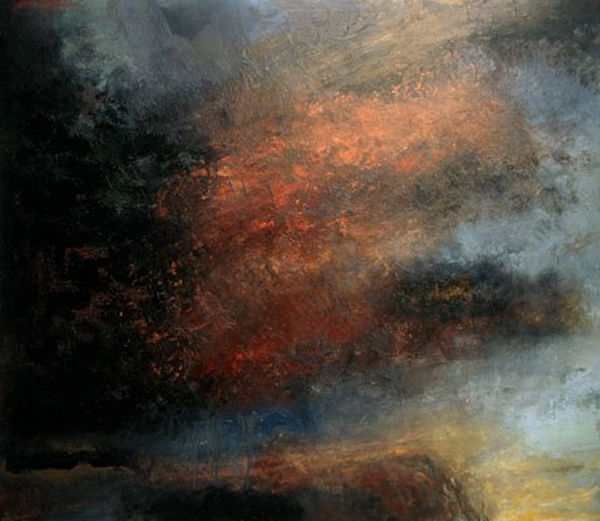
Digital painting and artwork with mydraw

During the weekend, I started to use an application called (my-paint), to help with some of the art work that I am starting to work on again.
I first used this application last year and along with a Wacom tablet , I have its great fun to work with.
I love the drawing control the tablet can give, almost as good as using a real pencil or brush and this combined with the pens and brushes available in my-paint, you can make a great start learning line control and layering of both tone and colour.


Pagan Monday : The Spiral and Nature

The Spiral In the Natural Pagan world
If you have taken many nature photographs or sketched and/or painted outside, you may have noticed just how often you come across one of natures repeating patterns, the Spiral.
From Lichen on rocks to the way the bark grows on some trees, water spinning in a rock pool and the form that galaxy’s take in the night sky.
The last image below was taken at the Local Pagan location of Knickroe, County Kilkenny where most of the stones are marked with the spiral pattern. In this image you can just about make out the form of the Triple Spiral, Possibly representing the : ( “three realms” – Land, Sea and Sky ). Clearly our Pagan ancestors noticed the spiral and give it a significant place in their lives. Today the spiral takes a leading place in Modern Re constructionist Paganism being used in Art and artifacts.
Pre-Christian symbolism
Believed by many people to be an ancient symbol of pre-Celtic and Celtic beliefs, the triple spiral appears in various forms in pre-Celtic and Celtic art, with the earliest examples having been carved on pre-Celtic stone monuments, and later examples found in the Celtic Christian illuminated manuscripts of Insular art. The triple spiral was possibly the precursor to the later triskele design found in the manuscripts.
Christian Celtic symbolism
What the symbol meant to the pagans who built Newgrange and other monuments is unknown; but, as Christianity came into the forefront in Ireland before the 5th century, AD, the triskele took on new meaning, Kidnapped somewhat as a symbol of the Trinity (i.e., Father, Son, and Holy Spirit) and, therefore, also a symbol of eternity. Its popularity continues today as a decorative symbol of faith for Christians of Celtic descent around the world.
The triple spiral
The triple spiral is one of the main symbols of Celtic Reconstructionist Paganism, often standing for the “three realms” – Land, Sea and Sky, or for one of a number of deities who are described in the lore as “threefold” or triadic.[1] The god Manannán is probably most often the one symbolized by the triskele, though some also use it for the goddess Brighid. Some Celtic-inspired Wiccans also use the triple spiral symbol, most often to represent the concept of the triple goddess.
According to Uriel’s Machine by Knight and Lomas (2003), the triple spiral may represent the nine-month period of human pregnancy, since the sun takes a fourth of a year to go from the celestial equator (an equinox) to extreme north or south declination (a solstice), and vice versa. During each three-month period, the sun’s path across the sky appears to form a closely wound quasi-helical shape, which can be likened to a spiral, so that three spirals could represent nine months, providing an explanation for a link between fertility and the triple-spiral symbol.
Natures Spirals


Planning and starting 2015. a Picture board.

Picture Board for 2015
Well I have been a little quite on my blog during the holidays and into the new year, I hope you all had a great holiday period 🙂
To start 2015 here, I just wanted to say a huge thank-you to anyone who has been visiting this blog since I started it about two years ago. Thank you for your many likes and great comments I have enjoyed sharing my images and the places I visited and also enjoyed reading and visiting so many other blogs from around the world 🙂 🙂
Starting a new year is always a challenge, we are all meant to reinvent the wheel and take on life in a new way – aren’t we !!
Maybe however the best plan is to just look at what you have been doing with your life and just build on these areas, I sat down on Monday morning and put a little picture board together of the things I want to build on during the year ahead, these areas are included in the images there.
I am going to start to look at how I can include some new areas in posts here, it could be that I start some new blogs in word-press and then just place links here if the posts are not relating to photography etc ….. ?
Almost all my posts to date have been mainly about the places here in Ireland that I have visited along with some poetry and art that I wanted to share, this year I am going to share the things I am learning or doing a little bit more !
Violin and Music Plans
For the last few years I have been learning and planing the Violin and I want to share a little more about these experiences and the type of music I love playing the most.

I am not an advanced or a professional player but love to play and learn, I feel that music like many things is not about being the finished item but about journeying your way through a learning process and having some great fun along the way !!!

Computer development skills and plans
For a large part of my life I worked in the I.T. industry, starting back in the 1980’s on IBM main frame systems, mainly programming in Cobol/rpg and C++ during my time. I want to start to share a little about some plans I have to get back and then keep in touch with these skills.

This will most likely be a new Blog !!!
I also would like to start to share how I see the current computer industry, when I started training in ( I.T. ) it was not easy to get the skills you needed however it was much easier however to see how you could apply yourself to these skills. Today with the internet and you-tube etc … its must easier to put skills together but less easy to see how these skills can be used, mainly due to the all controlling Microsoft !!!
Over the last three years or so however, there is a growing change in the area of small scale computing and its nothing to do with tablets or phones , it’s in small computers such as the credit card computers or Development boards, systems like the Raspberry Pi here above – have sold well over a million units in a very short time and have been followed by many other single board PC’s like the cubie-truck.
These systems have reset the computer industry back to a time when learning about computer technology was not about Microsoft windows and it many ( problems, virus, its costs, and its latest versions ) but about being able to learn fully and openly what a computer can do and at the cost of the hardware only, these computers use Linux OS – as their operating systems and as such follow almost the entire growing world of none Microsoft based devices such as (Apples OS-x, Android phones, Bare-metal devices(using machine coded applications), Linux based desktop and laptop systems along with internet servers and cloud servers).
I want to share something about this area of modern computing, from a very basic level to a level that shows just how the two systems in the images here the (Raspberry pi and Cubie-truck – boards) can be used both independently and along side a windows based computer, many of the current engineering and science fairs show projects using just these kind of devices !

Photography Plans
I will still be posting lots of images and articles on locations here in Ireland!

One thing I want to do very much is to capture my local landscape as we move from the winter months into spring !

Irish Boglands Art work

Painting of the Irish Bogs
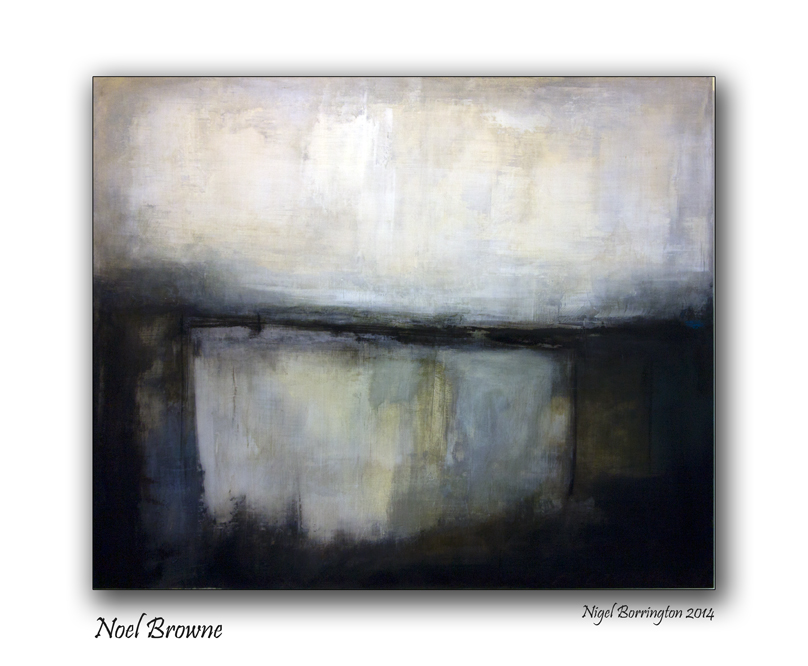
By Artist : Noel Browne
In my earlier post I posted some of my own images of the Bog of Allen, Just one of the Irish Bogs I love visiting. Last year I went to see an Art exhibition that included some painting by, county Kerry based painter Noel Browne.
Some of his paintings I share here.
I feel he has captures the wonderful feel of the Irish Bogs including the vast Landscape they produce, when they have been cut by mechanicall harvesters for Peat production. His painting capture the almost monotone landscapes with deep flooded pits created by these machines.
Paintings


Still life Painting – The Sheeps Skull (Photography and Painting)
Still life Painting – The Sheeps Skull
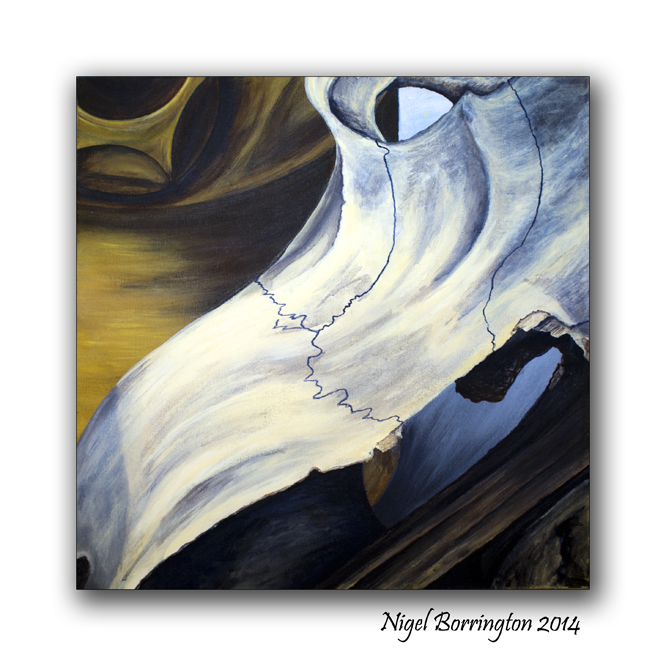
Acrylic painting : Nigel Borrington
The Sheep’s Skull (Using Photography when Painting)
Even though most of my work on my Blog is Photographic, I still paint using Acrylic paints on canvas that I stretch and mount to the size I need.
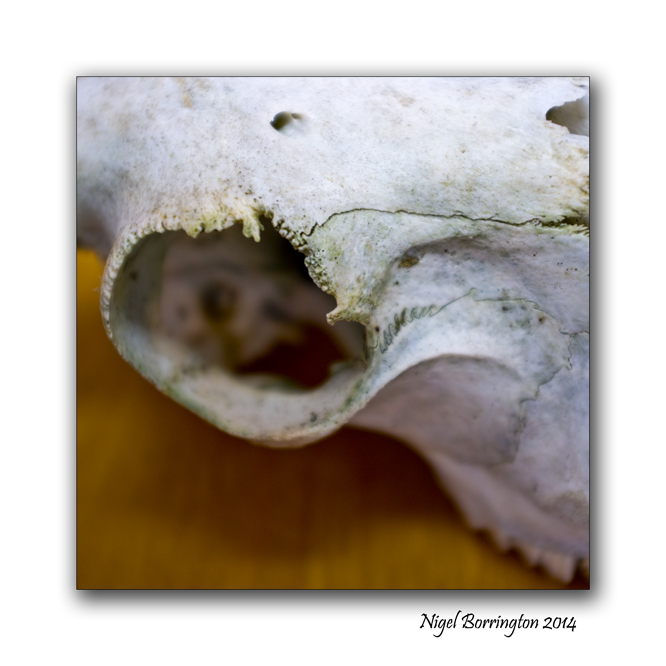
When preparing to paint a still life like the sheep’s head and oil lamp in this painting, I will take some photo’s of the objects first. This help with getting to do a full study of the items selected, here in the photos I could clearly see all the texture of the skull and how its is made up of smaller sections of bone.
You can see all the texture in the bone and how light falls on to it, the oil lamp was photographed separately, I felt that these two item contrasted very well with each other, the gold colour of the brass lamp and bleached white of the bone.
Painting – Source photographs


Peoples Art, Dublin 2014
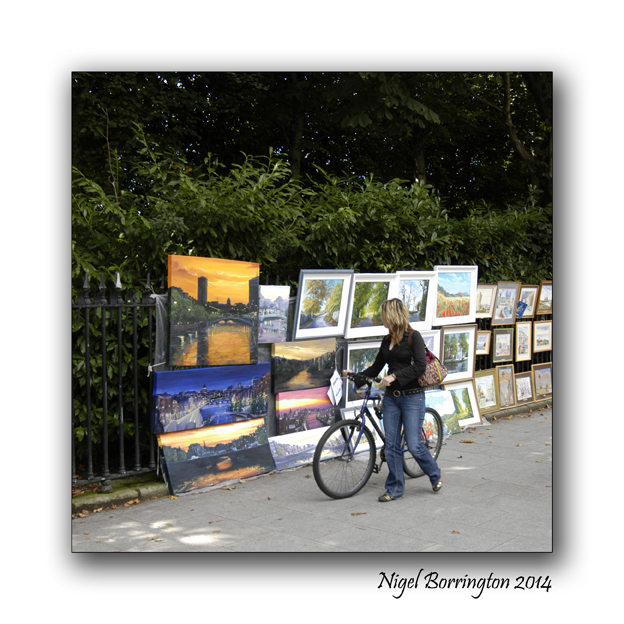
Peoples Art, St, Stephens Green, Dublin
Dublin Street Photography : Nigel Borrington
About Peoples Art
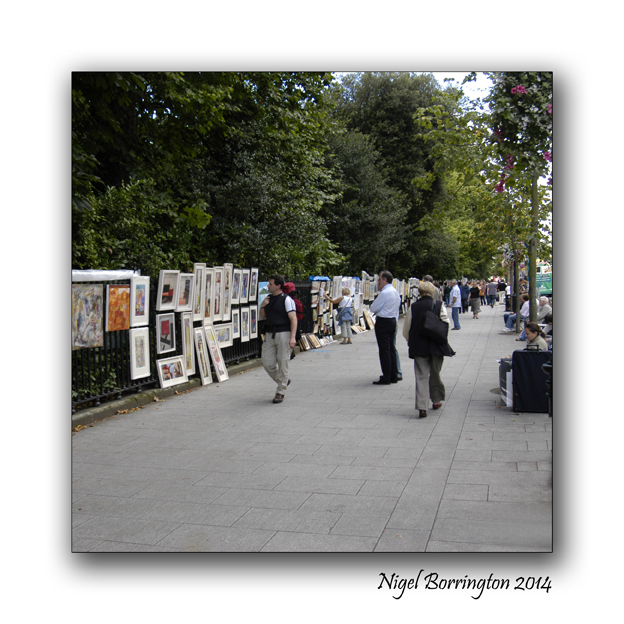
At least once a year I try to visit the Peoples art exhibition and sale at St. Stephen’s Green in Dublin , this is a great day for an art lover as its one of the biggest open air art displays in Europe.
The images posted here are all taken on a very warm summers afternoon and I got lots of great images of the artists and their work along with getting to see some great painting and drawings from Landscapes to portraits.
Official information
People’s Art Dublin is a voluntary, part time, non profit making group, brought together by Dublin City Council to promote the visual arts to the public of Dublin. Each year after expenses are paid, donations are made to various charities.
The co-operation and assistance of Dublin City Council and The Office of Public Works ( OPW ) , which makes these events possible, is gratefully acknowledged by all the artists involved.
Any artist can apply to exhibit but there are some rules that apply, it costs each artist just €25.
Gallery
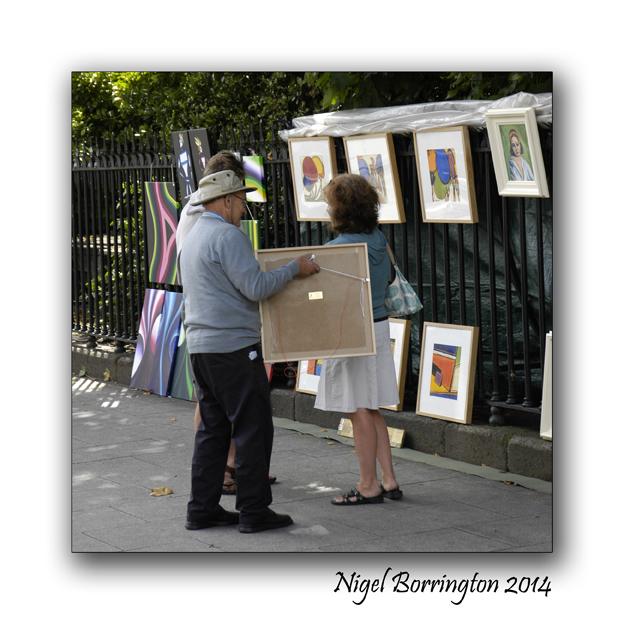
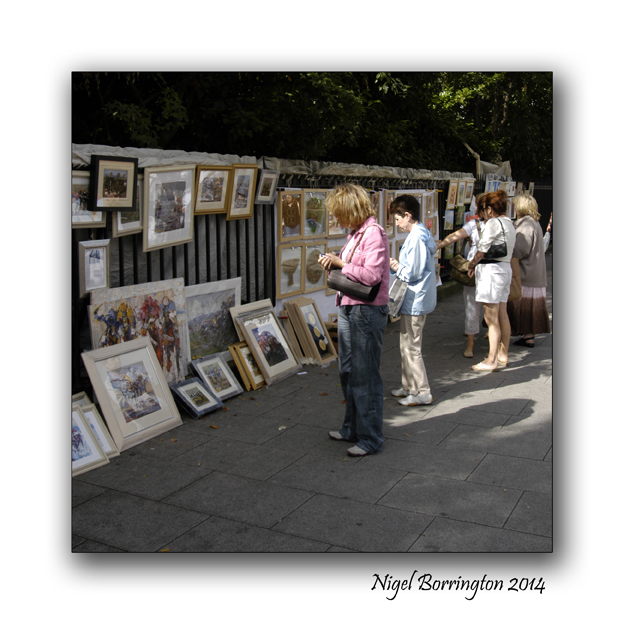
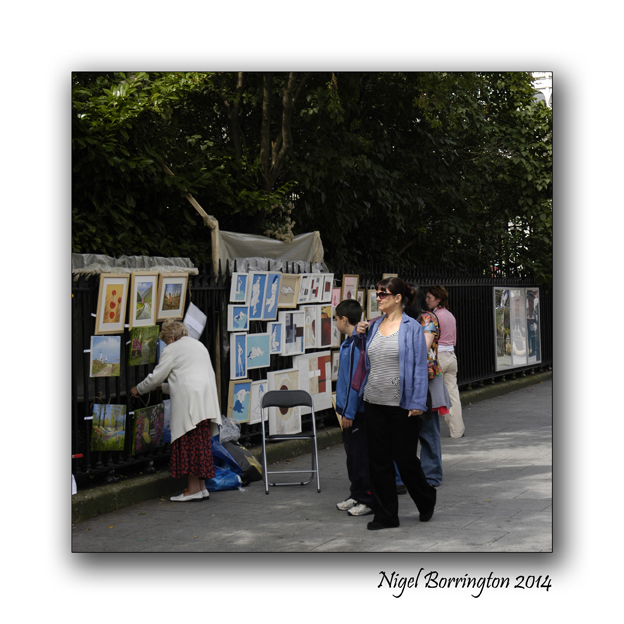
New paintings , Digital art work

Painting from the Irish Bogs.
Digital art work : Nigel Borrington
First paintings for over a year :
Its over a year since I did any painting, I have been working with my photography so much, but as its the start of a new year , I felt a real need to paint again.
This painting is the start of a project I will work on , based on the upland bogs of Kilkenny and Tipperary.
It based on a series of photographic images from these great places.
Beach sculpture at Tramore, Waterford
All images canon G1 x
Art students working a a beach sculpture, Tramore, County Waterford
Photography by : Nigel Borrington
Dragon Sculpture
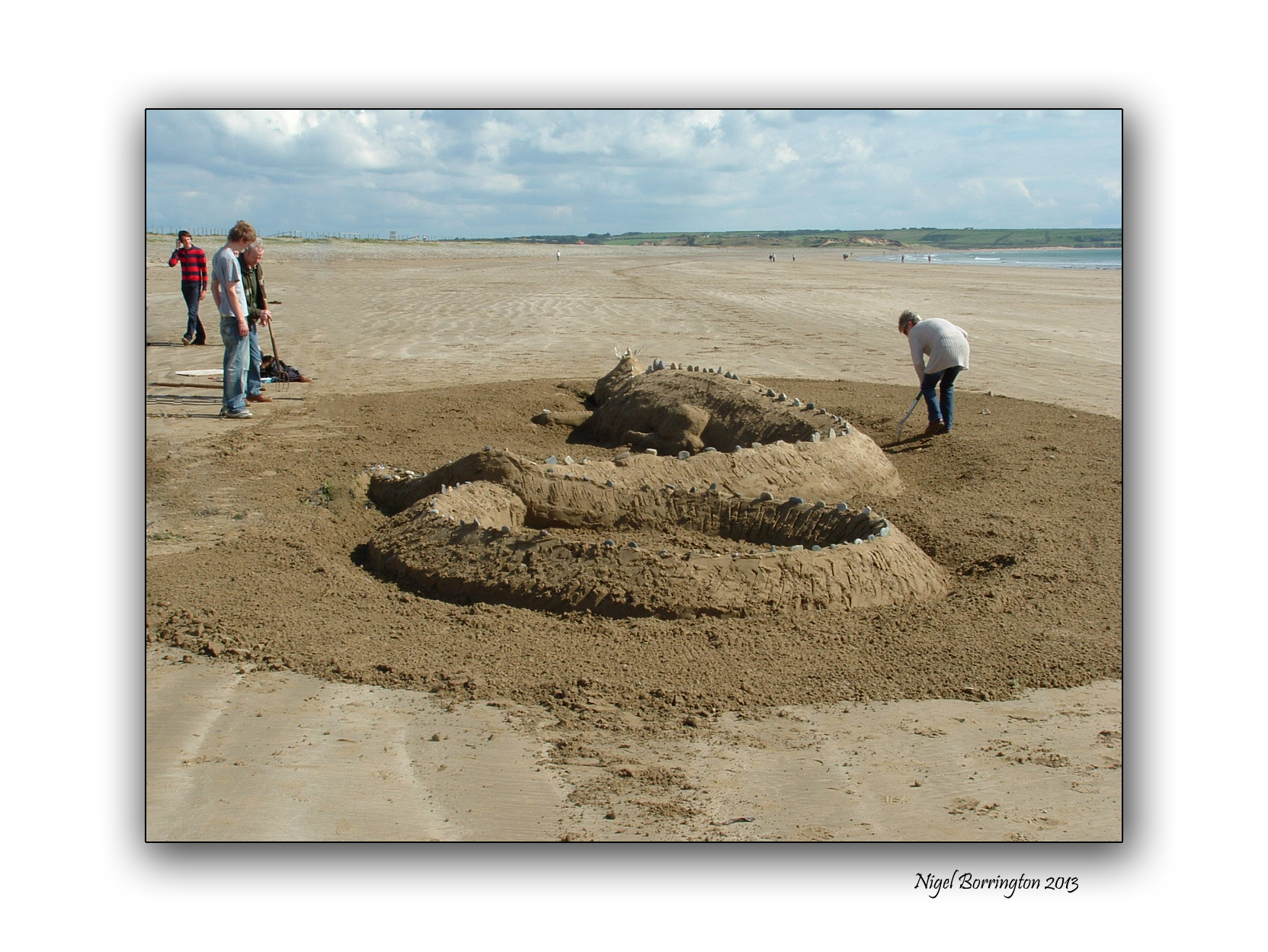
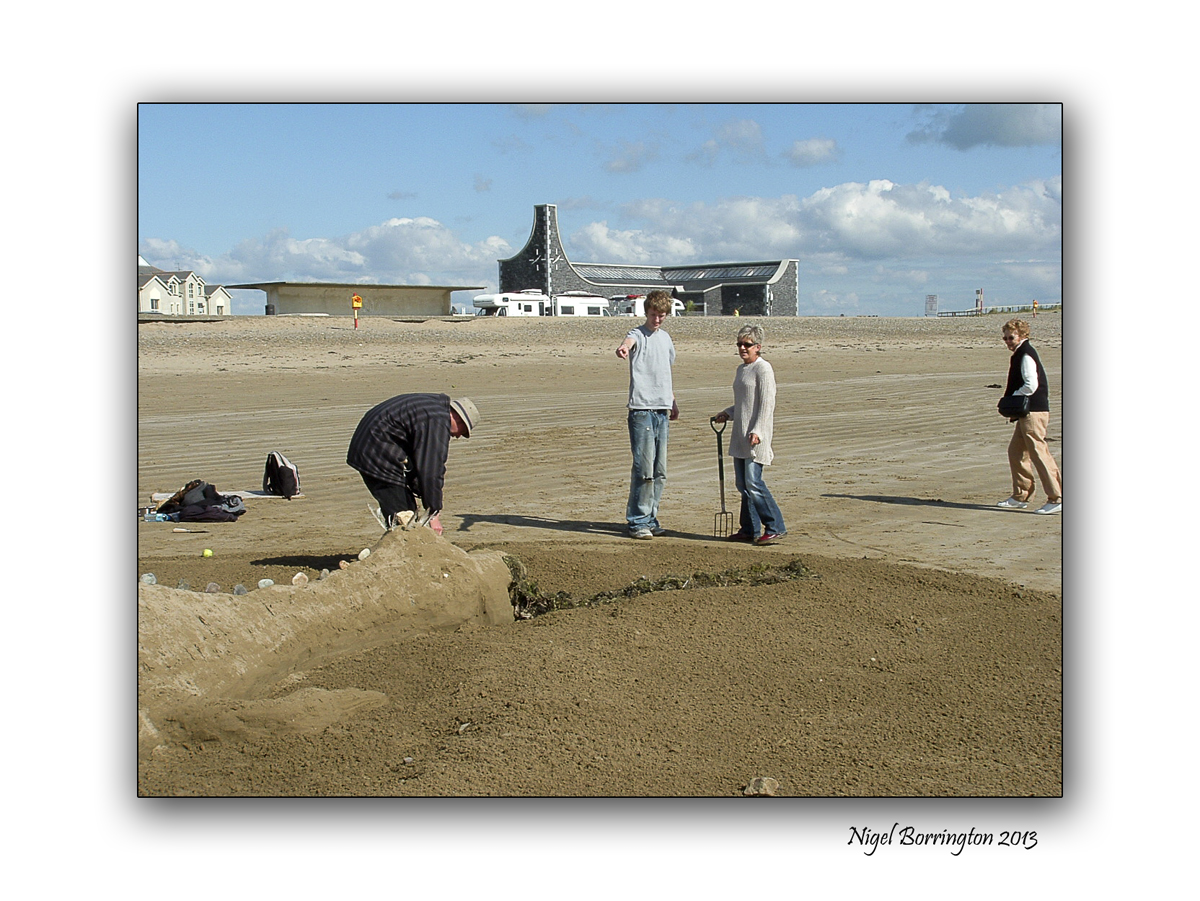
A little while back on a visit to Tramore Beach, County Waterford I photographed these art students working on beach sculpture before a competition the following weekend.
It was amazing to watch them for a while as they practised their projects, the images below are of a dragon that they intended to create on the day.
Gallery


Photoshop : Producing a painting from a photograph

Nikon D7000, 18-200mm lens, iso 100
Grange Crag walk, Co Tipperary
Landscape photography: Nigel Borrington
A very different post today, For many weeks I have just posted photographs and it remains my main interest here but I just wanted for a little time to talk about Abode photo-shop and an application called My-paint.
Art has always been of a big interest to myself and I view all my images as a form of artistic production, some people don’t see photographs as art they are to much of a completed process or they don’t see any artistic process involved in the taking of images using a camera. To a point I do get this view, however I think the speed and directness of a camera can offer results that a painter or an artist with a pencil will not capture.
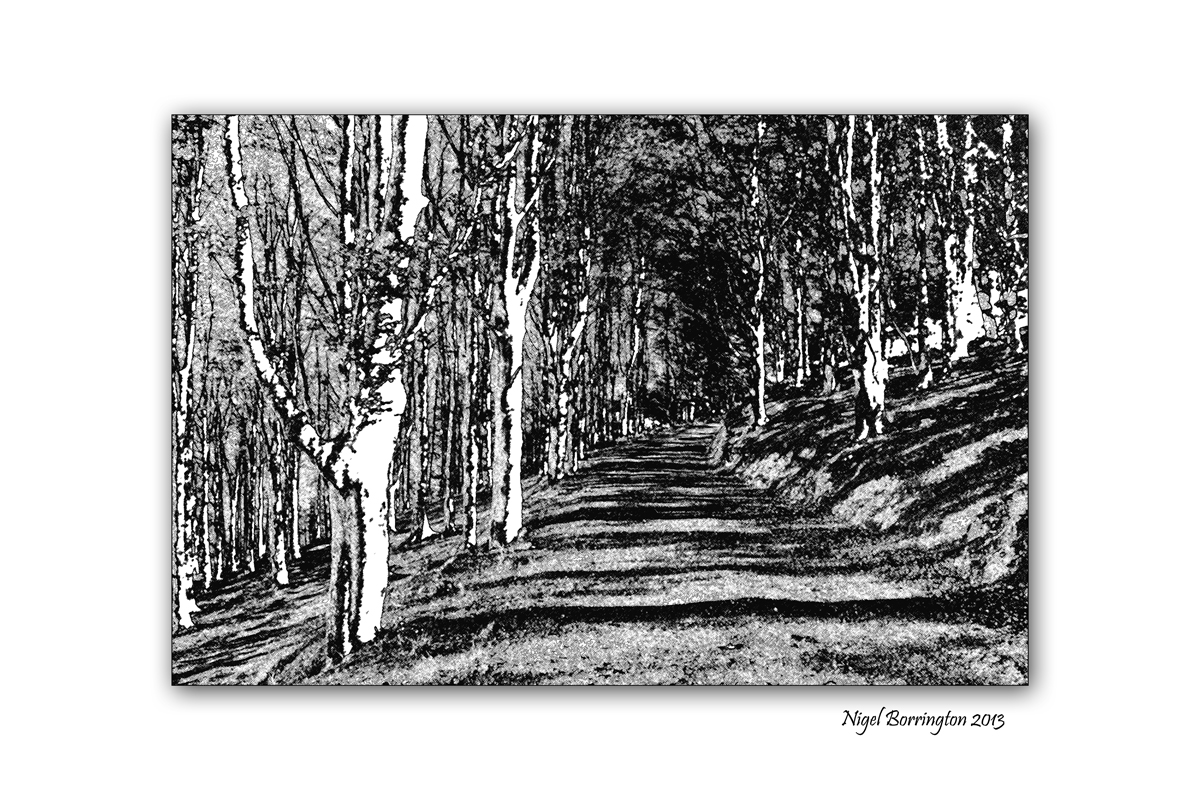
Here I post some result from working with a photograph in adobe camera raw and then photo-shop, in order to produce more developed results. In the first of the images below I have converted the photograph into black and white then using photo-shops levels and curves tools I have increased the brightness and contract until only the outlines of the trees exists.
In the third image down I have taken one of these black and white images and over painted it with photo-shops brush tool adding layers of different colour.
The last image and painting is taken from the second black and white image loading it into an application called My-paint, this is a free painting tool and is packed with great brush and pen tools. Using it I have created lots of layers of different colours and opacities in order to produce the final result.


 Nigel Borrington
Friday Art and Artists : LS Lowry
LS Lowry
Self portrait 1925
At the start of January while I was back in my home town of Manchester in The UK, I spent sometime with family members in visiting the Lowry Gallery in Salford, Manchester, UK.
The Lowry Gallery
Salford
Manchester, UK
Lowry is a much loved English artist, particularly in the North west of the UK, being born in Stretford, Manchester.
Here are some basic details about him,
Laurence Stephen Lowry was born 1 November 1887 in Barrett Street, Stretford. His father, Robert, worked as a clerk in an estate agent’s office. His mother, Elizabeth, was a talented pianist. By 1898 the family were living in Victoria Park, a leafy suburb in south Manchester, but in 1909 financial difficulties necessitated a move to Pendlebury, an industrial area between Manchester and Bolton. Lowry’s mother hated it, and so did Lowry, but, ‘After a year I got used to it. Within a few years I began to be interested and at length I became obsessed by it.’
After leaving school Lowry took a job as a clerk with a Manchester firm of chartered accountants, Thomas Aldred and Son. In 1910, after being made redundant from a second job, he became rent collector and clerk for the Pall Mall Property Company and stayed there until his retirement in 1952.
As a child he had enjoyed drawing, and he used part of his income to pay for private painting lessons with the artists William Fitz and Reginald Barber. In 1905 he began attending evening classes at Manchester Municipal College of Art. His tutor in the life drawing class there was the Frenchman Adolphe Valette, who brought first-hand knowledge of the Impressionists, such as Claude Monet and Camille Pissarro to his classes. ‘I cannot over-estimate the effect on me at that time of the coming into this drab city of Adolphe Valette… He had a freshness and a breadth of experience that exhilarated his students.’
By 1915 Lowry had begun attending evening classes at Salford School of Art, based in the Royal Technical College on the edges of Peel Park. One of his tutors there, Bernard Taylor (art critic for the Manchester Guardian) advised Lowry that his paintings were too dark. In response, Lowry tried painting on a pure white background, a technique he was to retain for the rest of his career.
Peel Park
LS Lowry
Peel Park, and the views across it from the Technical College windows, appear regularly in Lowry’s work. He had begun to see the possibilities of painting what he saw on his doorstep, rather than more conventional landscapes based on the countryside nearby. The best known story Lowry told of how he became interested in the industrial scene described how, after missing a train at Pendlebury station, he saw the Acme Spinning Company’s mill turning out, ‘I watched this scene – which I’d looked at many times without seeing – with rapture.’
A closer study of Lowry
Over the next few days and weeks I want to take a much closer look at the paintings and drawings that Laurence produced, looking at the subjects that he worked with and the technique’s he used to record his world.
As an artist he has been labeled and stereotyped as a naïve “Sunday painter”, based on the way he painted his landscapes and drew people along with animals.
During this visit to the Lowry Gallery however and with the help of the guided tour, it became very clear just what a complete artist Lowry was. Having a chance to see a collection of his work from his very early days at night school, until the final works of art he produce has helped to show me just how diverse and skilled an artist he was.
The areas of his work I want to study can be seen in his work I have selected below, including (Life drawing, pencil sketches, oil paints, landscape and city scape work), I will enjoy very much looking at his art work and I hope to learn a great deal from him, for my own efforts at drawing and painting.
Art works by LS Lowry
Life drawing
LS Lowry
City-scapes
A Northern Town 1969-70 L.S. Lowry 1887-1976
LS Lowry
Landscapes in Oil
LS Lowry
The Lake
Oil on canvas
Industrial Landscape of Manchester
Share this:
January 20, 2017 | Categories: artists, Comment, LS Lowry, Nigel Borrington | Tags: art, Art History, art review, Art study, artists, Lowry Gallery, LS Lowry, Nigel Borrington | 3 Comments