Bogland – Poem by Seamus Heaney
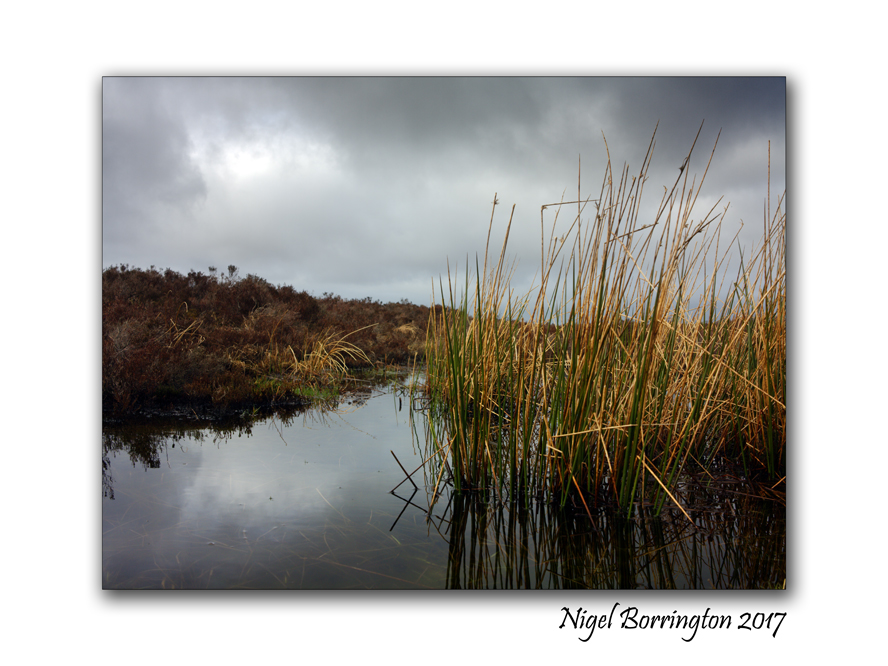
Bogland – Poem by Seamus Heaney
Image – Nigel Borrington
We have no prairies
To slice a big sun at evening–
Everywhere the eye concedes to
Encrouching horizon,
Is wooed into the cyclops’ eye
Of a tarn. Our un-fenced country
Is bog that keeps crusting
Between the sights of the sun.

They’ve taken the skeleton
Of the Great Irish Elk
Out of the peat, set it up
An astounding crate full of air.
Butter sunk under
More than a hundred years
Was recovered salty and white.
The ground itself is kind, black butter
Melting and opening underfoot,
Missing its last definition
By millions of years.
They’ll never dig coal here,
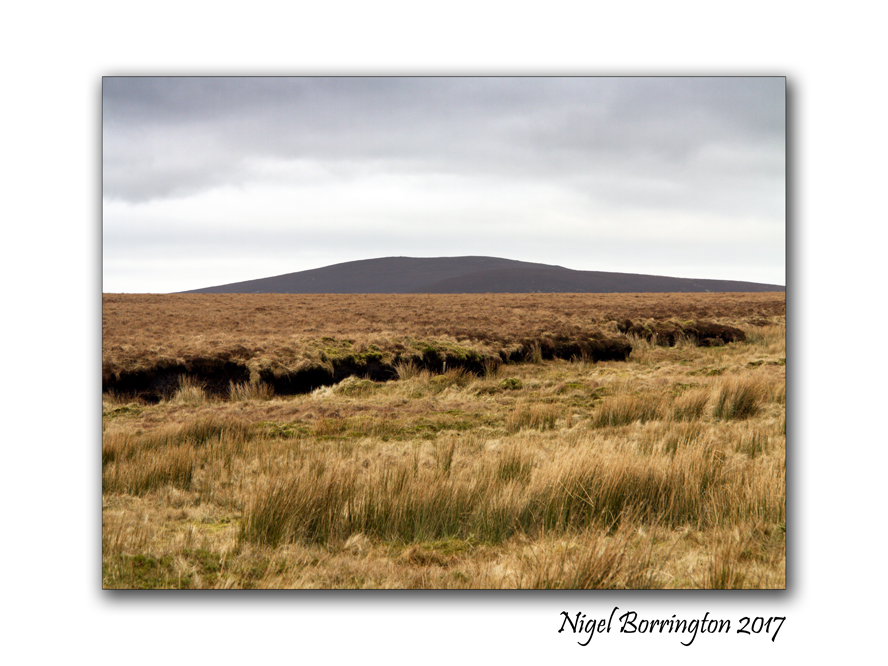
Only the waterlogged trunks
Of great firs, soft as pulp.
Our pioneers keep striking
Inwards and downwards,
Every layer they strip
Seems camped on before.
The bogholes might be Atlantic seepage.
The wet centre is bottomless.
Arley Hall, a country house in the village of Arley, Cheshire, England,
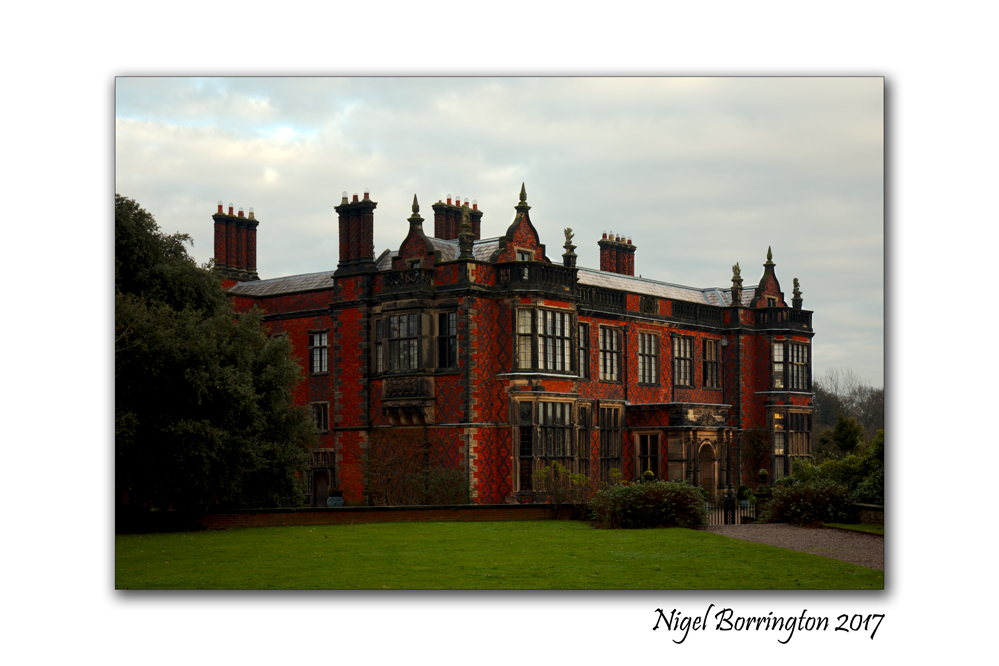
Arley Hall
country house
village of Arley, Cheshire, England,
If you looking for a place to visit in the UK, the county of Chesire has many great country houses and estate lands that you can visit, including Dunham Massey Hall, Tatton Park and Arley Hall.
Over the Christmas and New year period I visited Arley Hall and its great Gardens
Arley Hall is a country house in the village of Arley, Cheshire, England, about 4 miles (6 km) south of Lymm and 5 miles (8 km) north of Northwich. It is home to the owner, Viscount Ashbrook and his family. The house is a Grade II* listed building, as is its adjacent chapel. Formal gardens to the southwest of the hall are also listed at Grade II* on the National Register of Historic Parks and Gardens. In the grounds are more listed buildings, a cruck barn being listed as Grade I, and the other buildings as Grade II.
The hall was built for Rowland Egerton-Warburton between 1832 and 1845, to replace an earlier house on the site. Local architect George Latham designed the house in a style which has become known as Jacobethan, copying elements of Elizabethan architecture. A Gothic Revival chapel designed by Anthony Salvin was subsequently built next to the hall. By the mid-20th century parts of the house were in poor condition and were demolished, to be replaced by five private homes in a matching architectural style.

Arley Hall, Gardens
The present gardens were created in the 1830s, and were developed during the 20th century. The garden’s Herbaceous Border was one of the first of its type in Britain, and remains one of the finest. The house and its gardens have been open to the public since the 1960s, and have also been used as a film location. Stockley Farm, part of the Arley estate, is an additional visitor attraction for children and families.

Burnt out and left in the woods
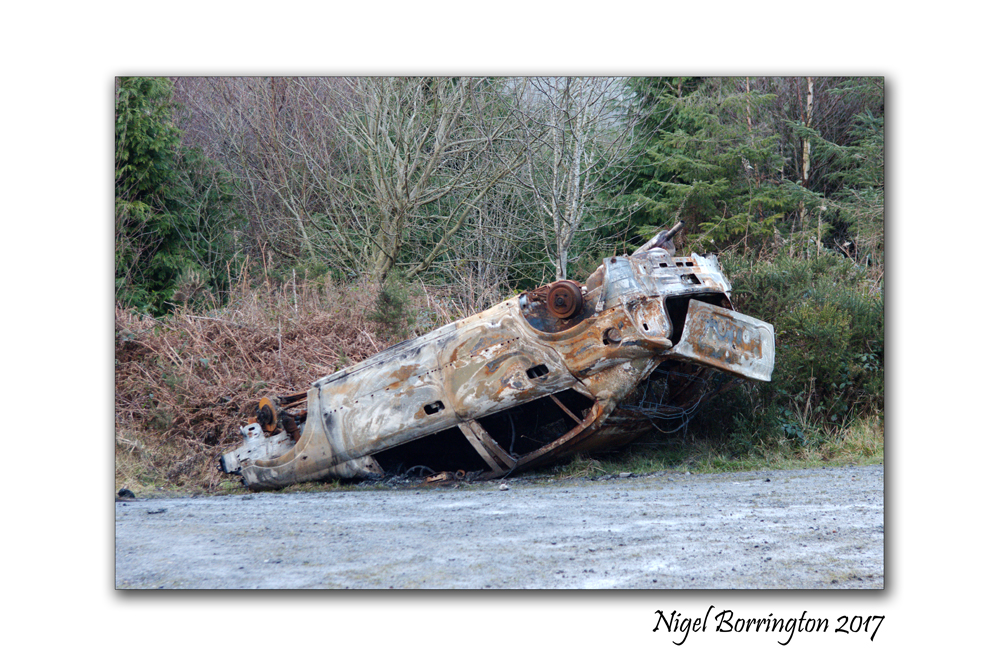
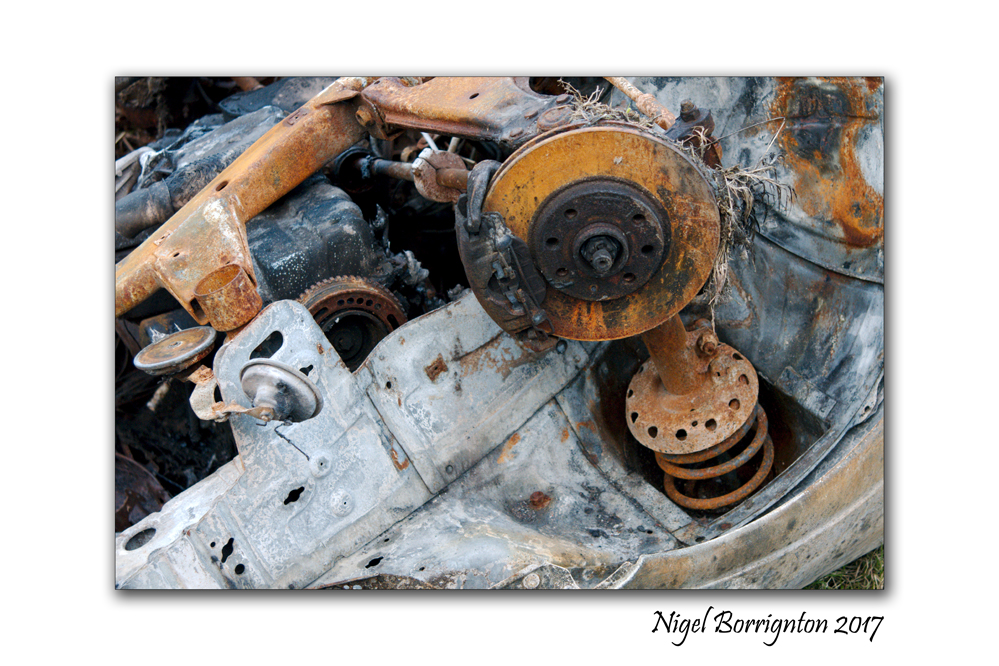
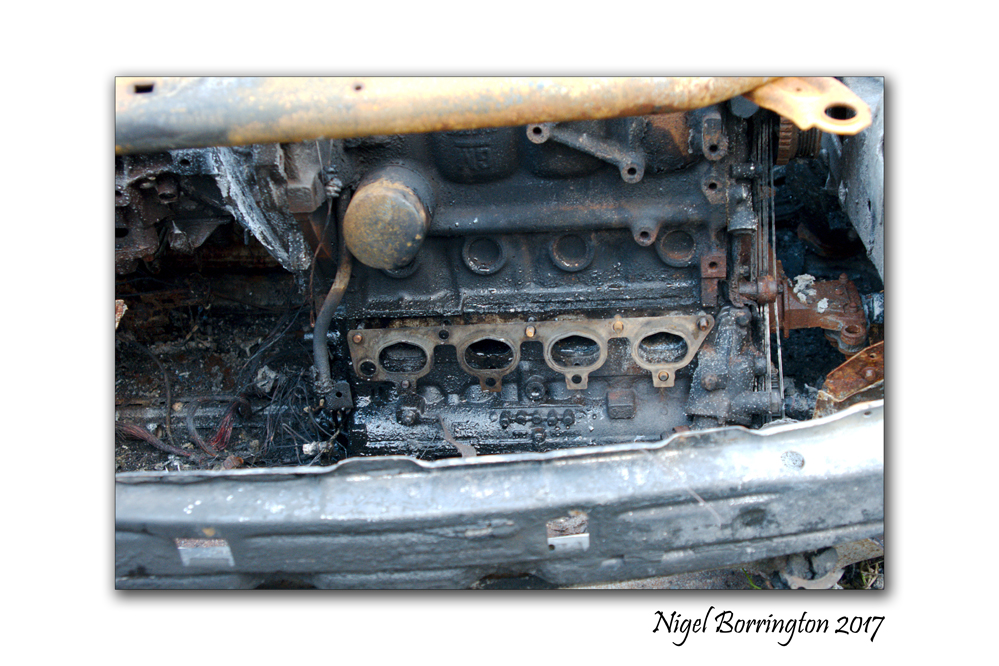
Sometimes when out on a walk you find things that ask questions in your mind, old cookers or TV’s, items long past there use. At the weekend I came across this burnt out car, turned over and then burnt until all that remains is a twisted rusting shell.
I my mind it is most likely stolen but then it has its own story to tell !


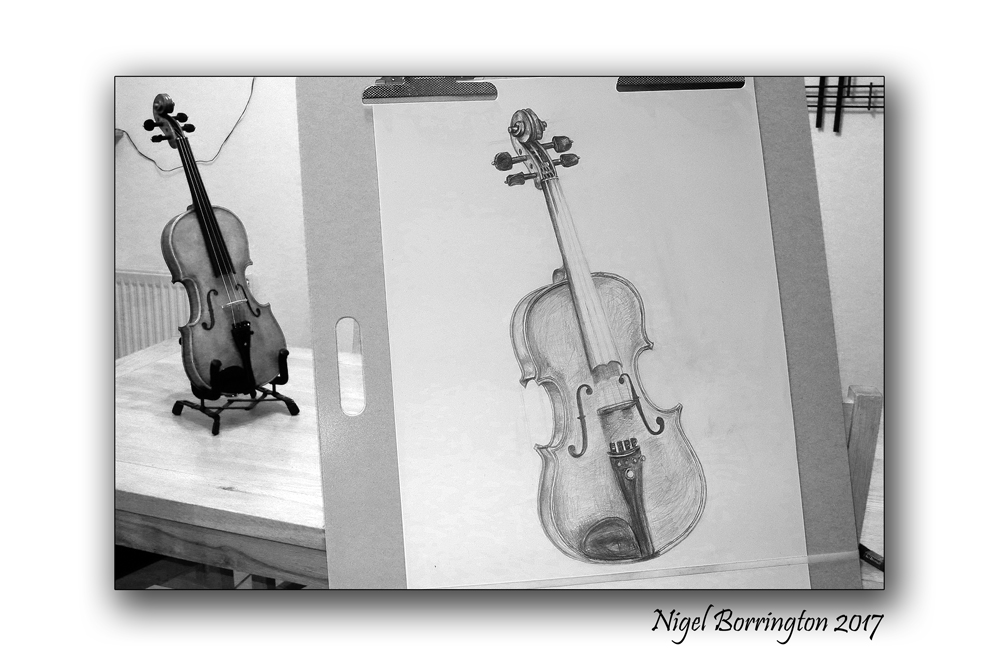
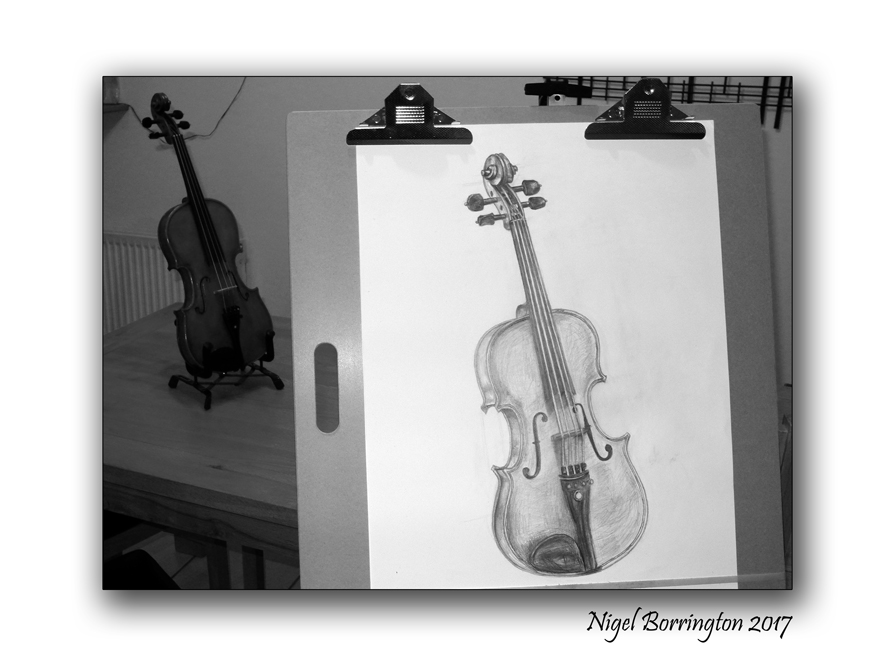
Pencil on paper, Drawing from life – My Violin

My Violin
Drawing from life
Pencil on Paper
Nigel Borrington
I am a big believer that the skills involved in producing any kind of art work come from the base level of being able to represent the world around us, even the most abstract of painting and sculpture has to come from some kind of desire to represent thing in the real world.
So I wanted to before doing any more painting, take a step back into working on basic drawing skills.
The images here are taken over two nights during the week as I started and finished a pencil drawing of my Violin. they show some of the steps as I first worked on the basic outlines of the image and then moved into adding some details and shading.
I am happy with this first effort but will keep working over the next few weeks on different angles of the violin as well as working in different mediums such as pens and ink and charcoal.
Drawing progression


The House on the Hill, By : Edwin Arlington Robinson

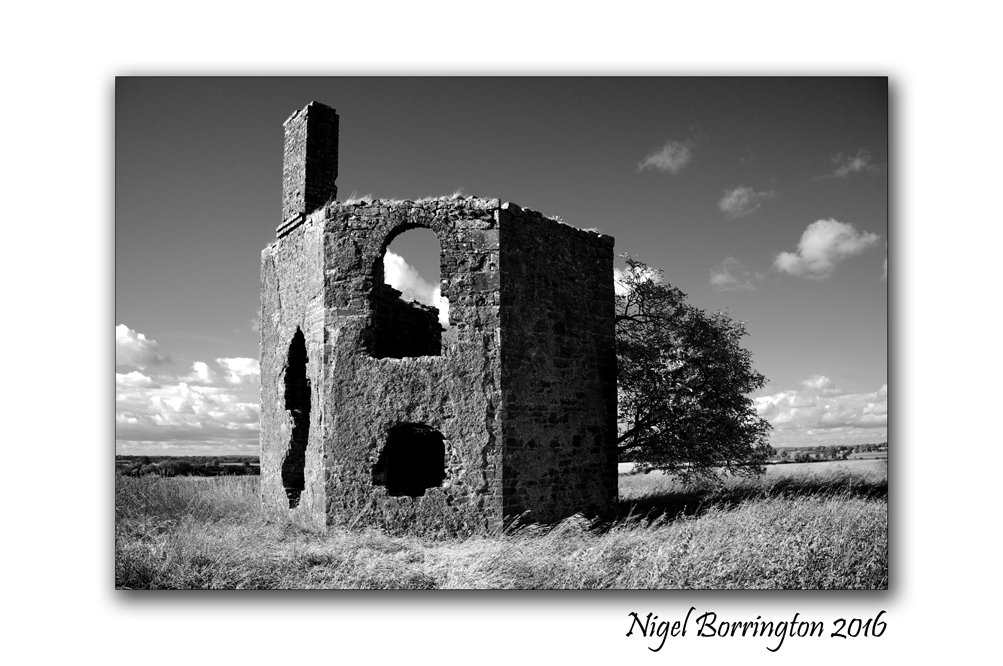
The Old house on the hill
County Kilkenny
Ireland
Nigel Borrington
The House on the Hill
Edwin Arlington Robinson
They are all gone away,
The House is shut and still,
There is nothing more to say.
Through broken walls and gray
The winds blow bleak and shrill:
They are all gone away.
Nor is there one to-day
To speak them good or ill:
There is nothing more to say.
Why is it then we stray
Around the sunken sill?
They are all gone away,
And our poor fancy-play
For them is wasted skill:
There is nothing more to say.
There is ruin and decay
In the House on the Hill:
They are all gone away,
There is nothing more to say.
Pencil and Watercolour Sketching, the great outdoors

Watercolour Sketch
County Kilkenny
Ireland
Sketching in the great outdoors
This year I hope to use other forms of recording the landscape that I find around me other than photography alone, I love creating images using my camera but I want to dig in a little deeper and spent a lot more time at each location.
There are so many art based media that can be used to create a sketch, such as (Pastels, pens, pencils, charcoal and paint).
Personally I love using Pencils and Waterolour paints, both are very simple to use and very easy to carry around. Pencil is the most direct and very easy to always have with you in a bag. Watercolour paints requires you to have a supply of water and a palette for mixing colours, both simple to have available and easy to use. A monotone Watercolour sketch is a great way to make use of this medium, used to capture all the tones that you can see in the landscape in-front of you and a lot faster than using a pencil to record the lights and dark’s in your image.
I find that the process of starting and finishing a sketch outside to be the perfect way of relaxing, its very hard to think about anything else on your mind from the moment you start working and by the time you have finished, your mind is filled with little else other than how you can use you finished sketch later for a painting or more detailed drawing.
Add your sketch to some photographs you took and you have the perfect set of images available to create larger works in oil or acrylic paints.
The sketches here are a small sample of some work produced during an art course I completed a while back …..


Making plans and getting projects ready for 2017

Abstract Sunset
Nigel Borrington
So then 🙂 , this is my first blog post of 2017 – Happy belated New year to everyone 🙂
We returned home to Ireland a couple of days ago , following a wonderful Christmas spent with my sister and family in Manchester. It was a great time catching up sharing time, out side walking and visiting museums and art galleries, talking lots and watching the odd movie or two.
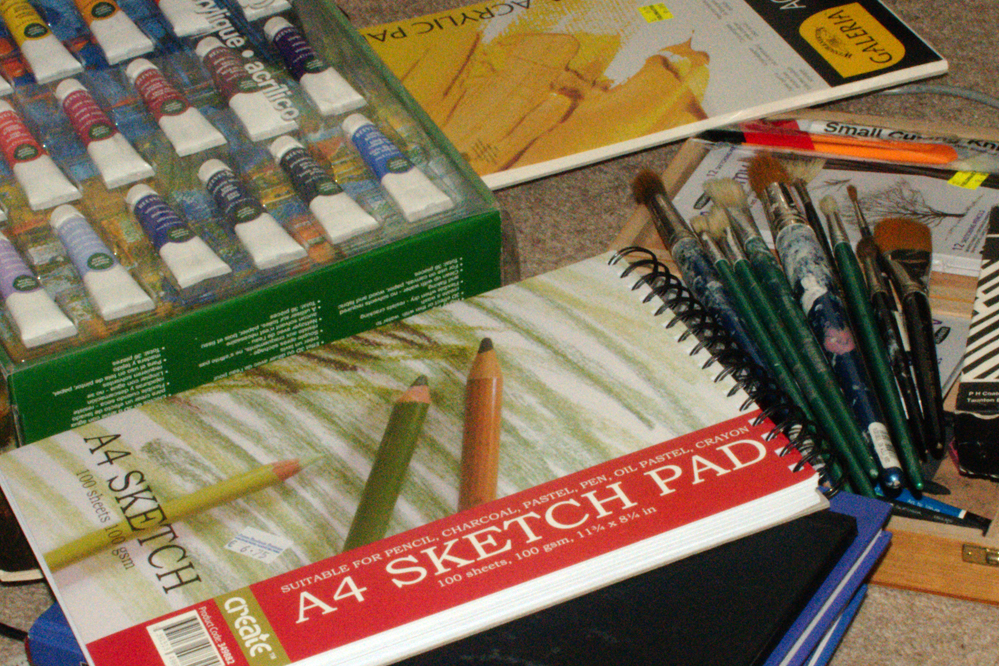
Today I spent sometime organizing my studio room and then shopping, I needed to get some new art supplies , including paint, brushes and sketch pads. Towards the end of last year I worked mainly with digital media for both photography and art work, however in 2017 I want to add real media including pencils , charcoal and acrylic paint to my work.
I am approaching this year in the form of a set of projects that I want to work on and complete by the end of the year. My main aim is to spend as much time as possible developing real skills and end up with a developed portfolio of work that records all the small steps involved with anything I do.

I feel strongly that art of all forms (including photography, drawing and painting) is a skill that involves development. This development needs in some way to be captured/recorded so that you can look back on the steps taken.
So I hope to find a method to record my year ahead, in the form of recorded steps that involve (notebooks, sketches, photos, poems, painting etc…) that all in all build towards finished works.
Above all I am looking forward very much to just getting going and being on a path again 🙂 🙂
Some work from 2016 …..
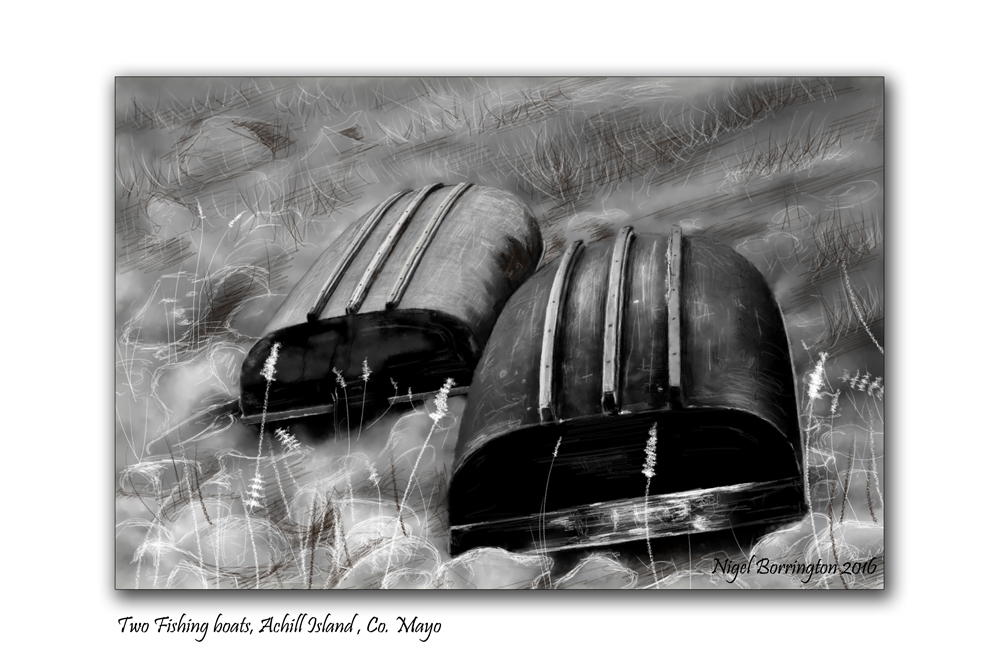
Two fishing boat
Keem Strand
Achill Island
County Mayo
Happy Christmas and New year to everyone ! .. A 2016 Gallery
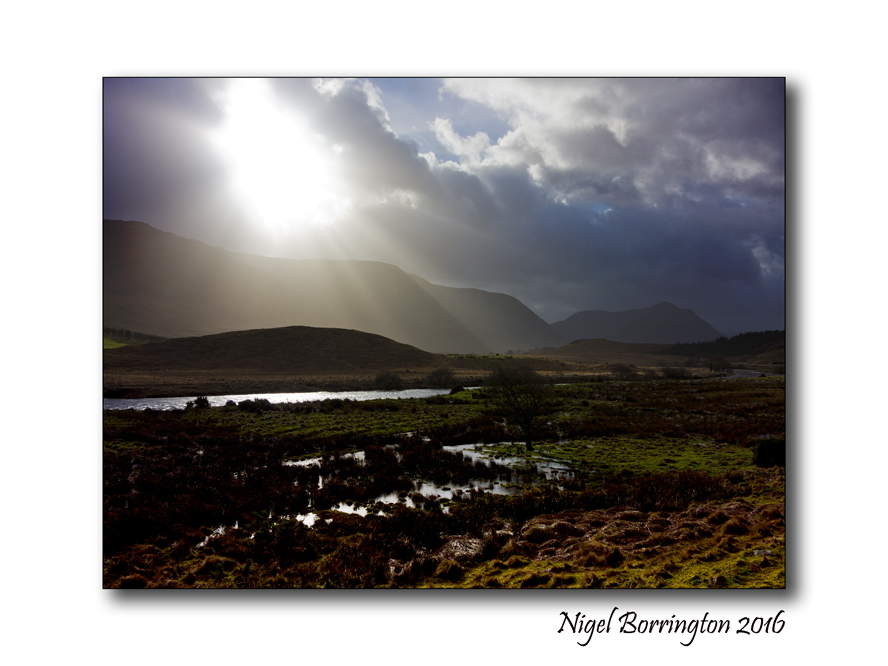
January 2016
Happy Christmas and a happy new year for 2017 to everyone 🙂
Todays post is my last for the year, I want to spend sometime off line with my family for the holidays.
I also want to say a very big thank you for such a great 2016 to everyone here in the word-press community, it has been great fun sharing posts with you all and reading your own posts!!!, its a great thrill to know so many great people and blogger’s here !!
Have a great Christmas time and a wonderful new year period, I look forward to sharing some on-line time with you all again in January 2017 – 🙂 🙂 🙂
A gallery of images from 2016
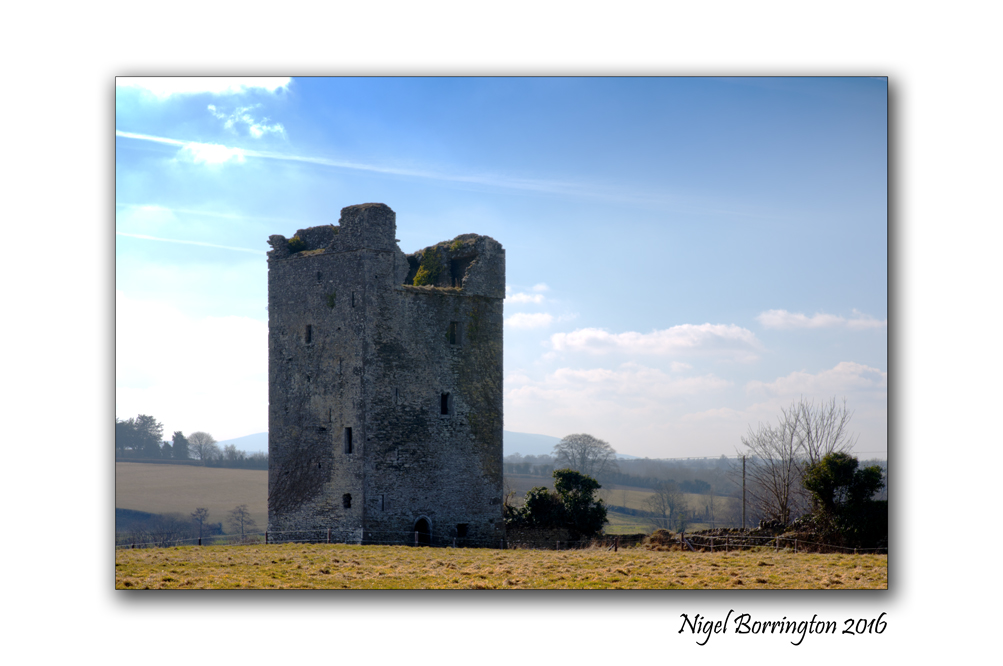
January 2016
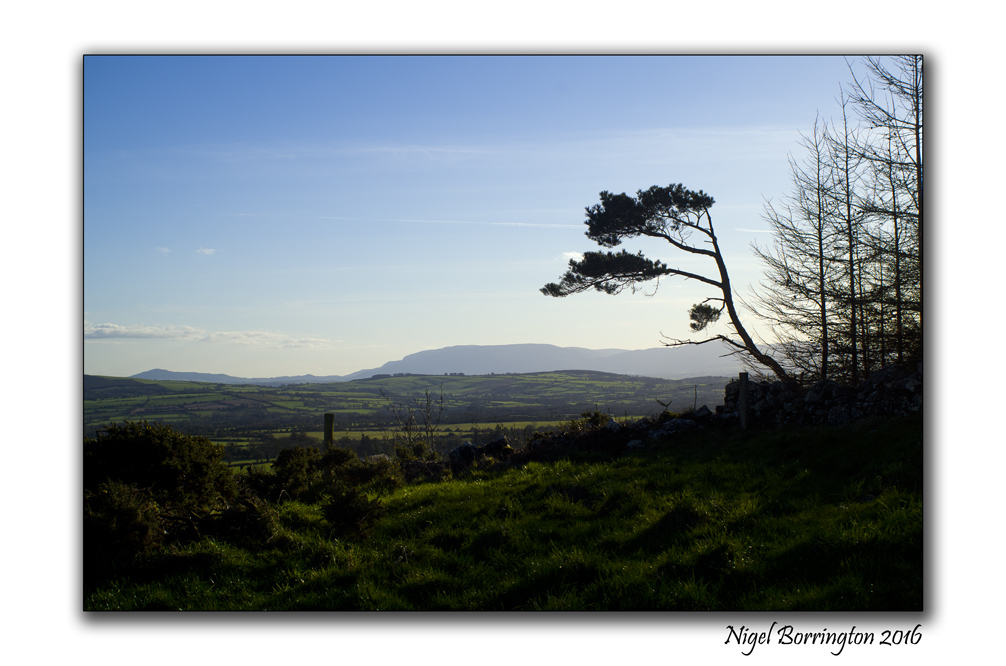
February 2016
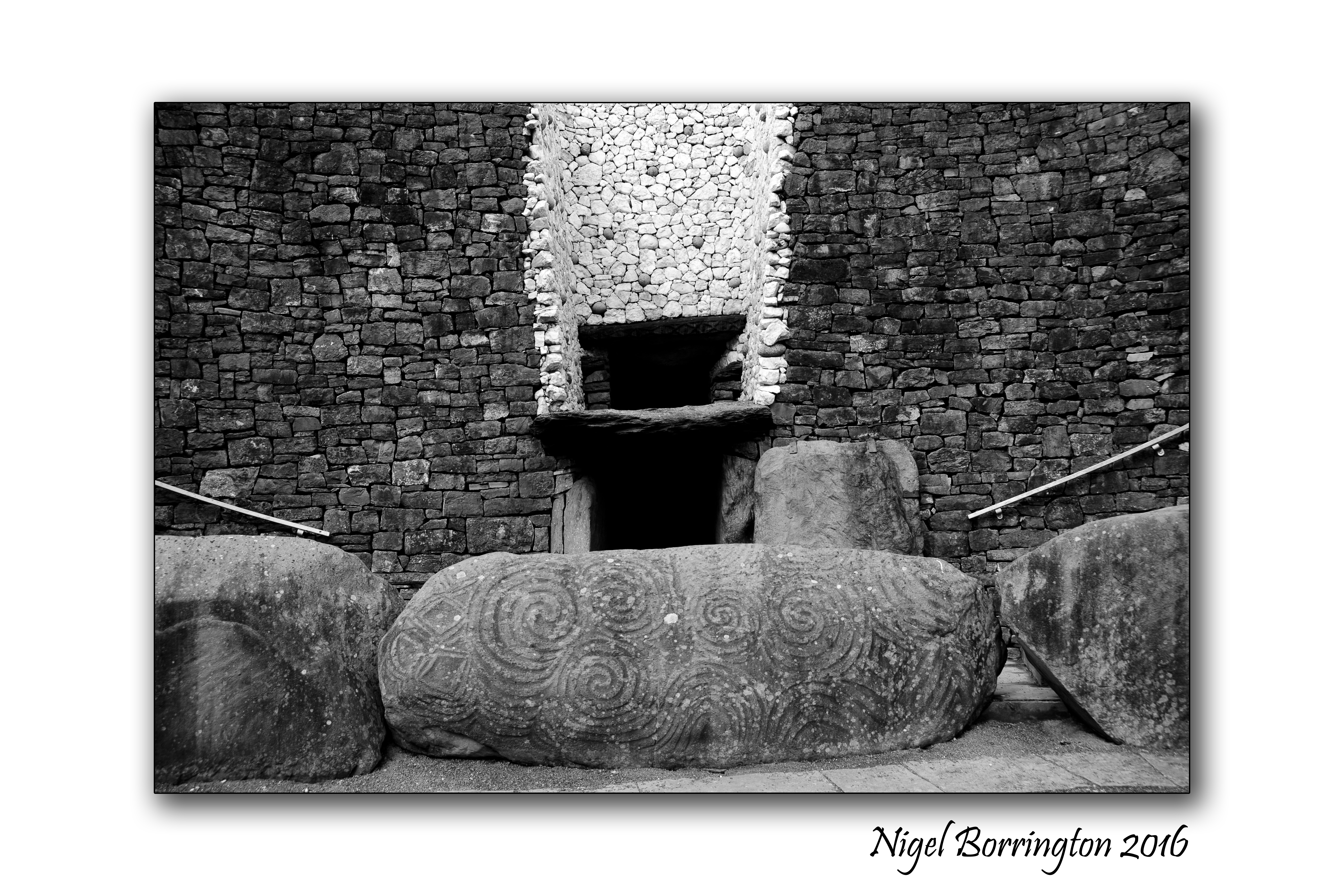
March 2016
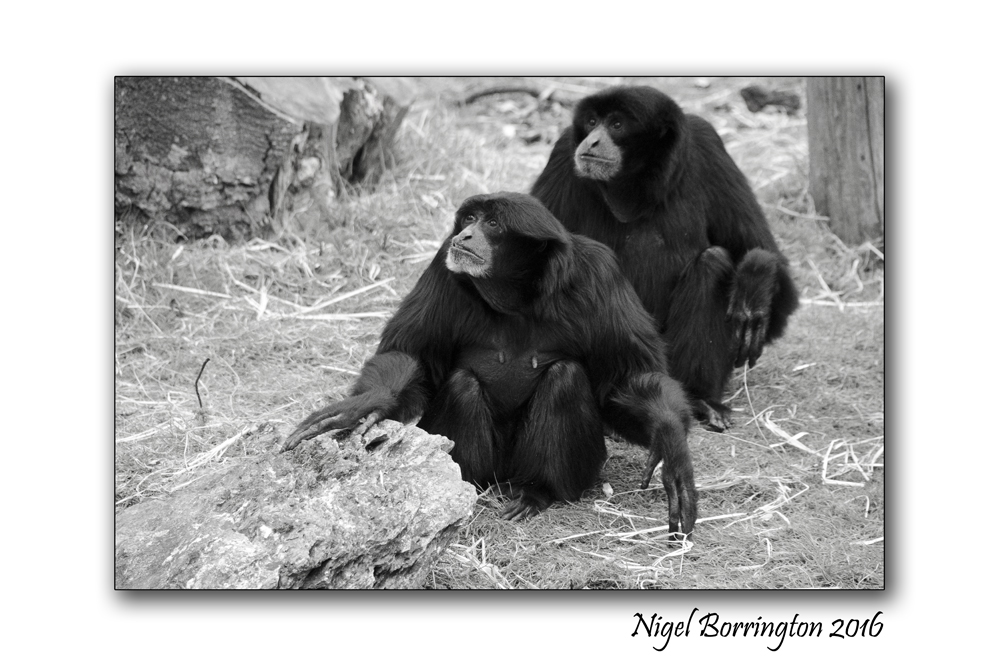
April 2016
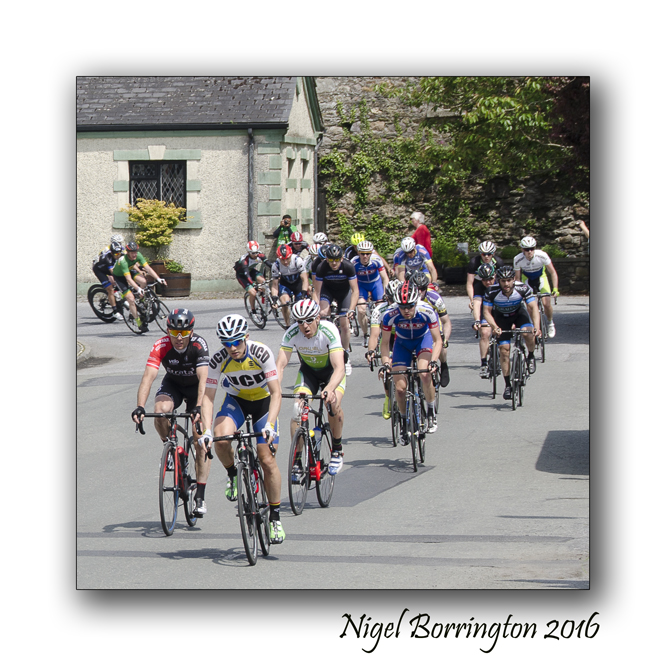
May 2016
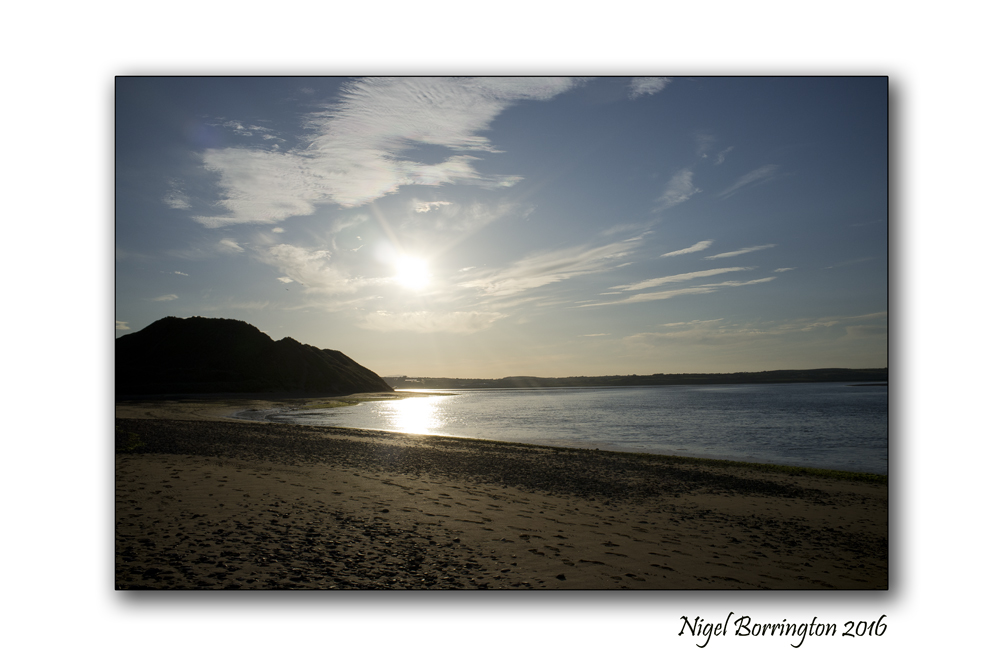
June 2016

July 2016
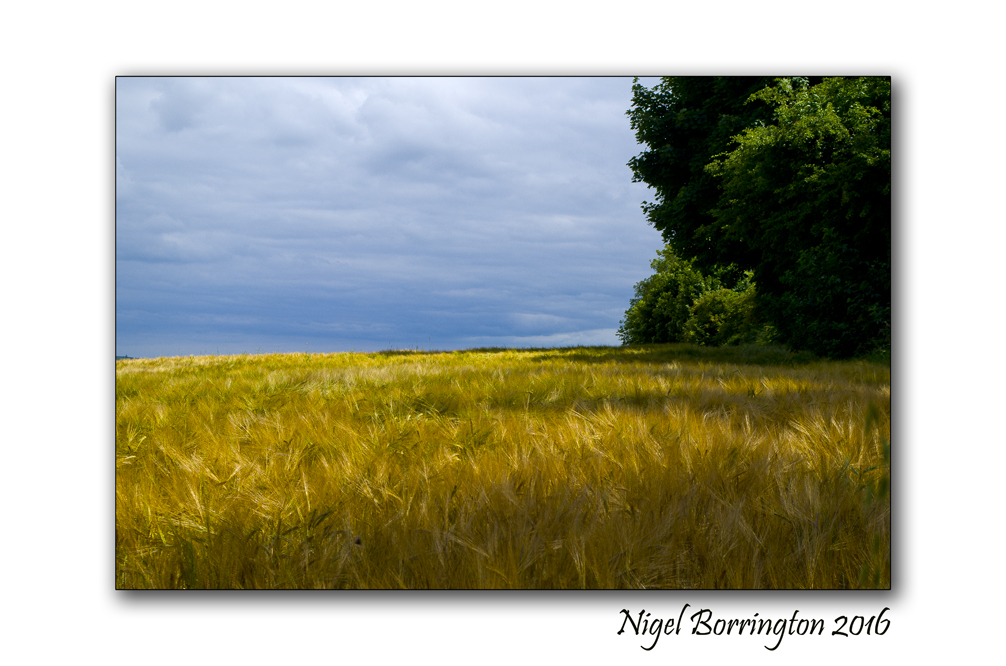
August 2016

September 2016
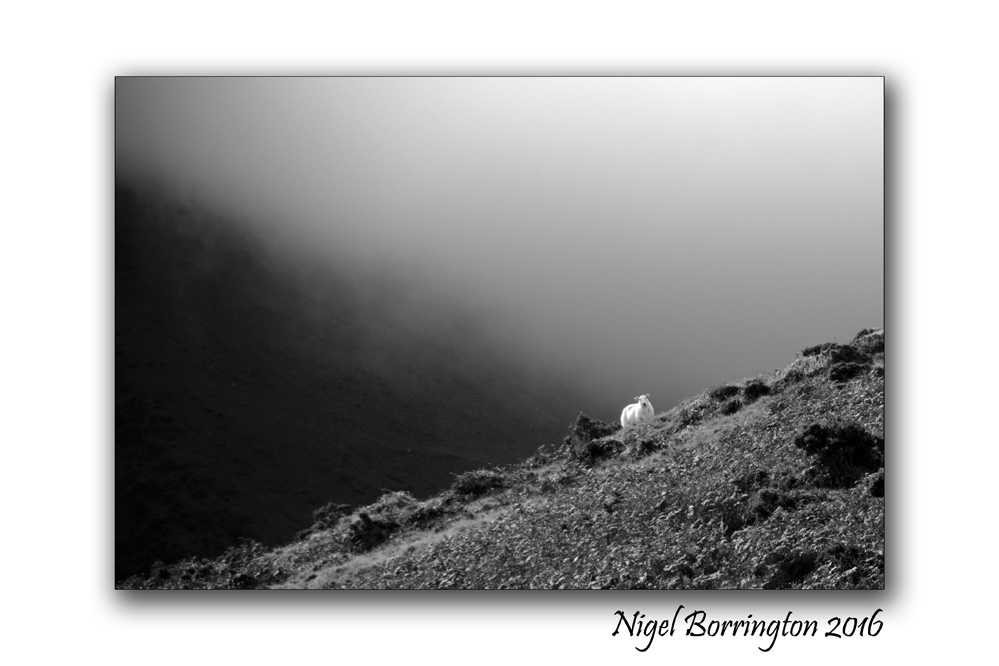
October 2016
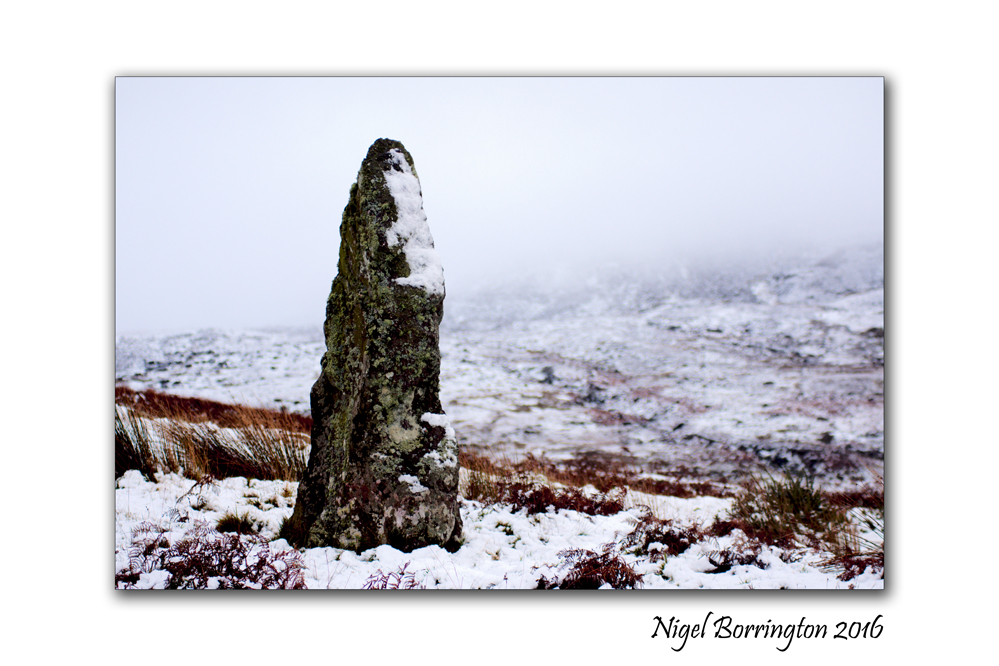
November 2016

December 2016
THE TREE SINGS TO THE RIVER – By Lea Goldberg

The tree sings to the river
Irish landscapes
Nigel Borrington
He who carried my golden autumn,
Swept away my blood with the leaf fall,
He who shall see my spring when it returns
To him with the turning of the year.
My brother, the river, who is forever lost,
New each day and different and one,
My brother the stream between his two shores
Who flows as I do between spring and fall.
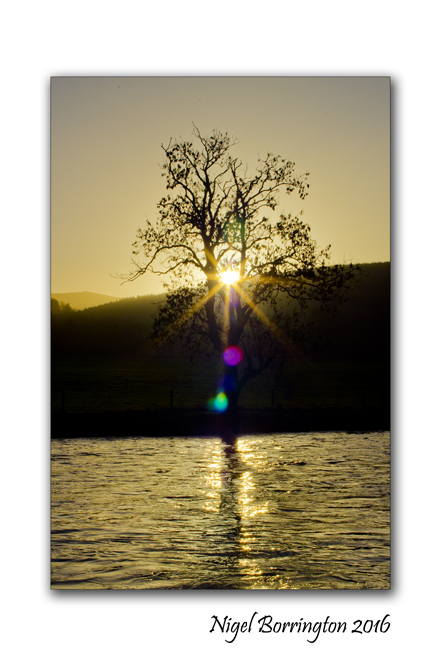
For I am the bud and I am the fruit,
I am my future and I am my past,
I am the solitary tree trunk,
And you — you are my time and my song.
Song of Sunset on the River by Bai Juyi, Image of the river Suir at Sunset
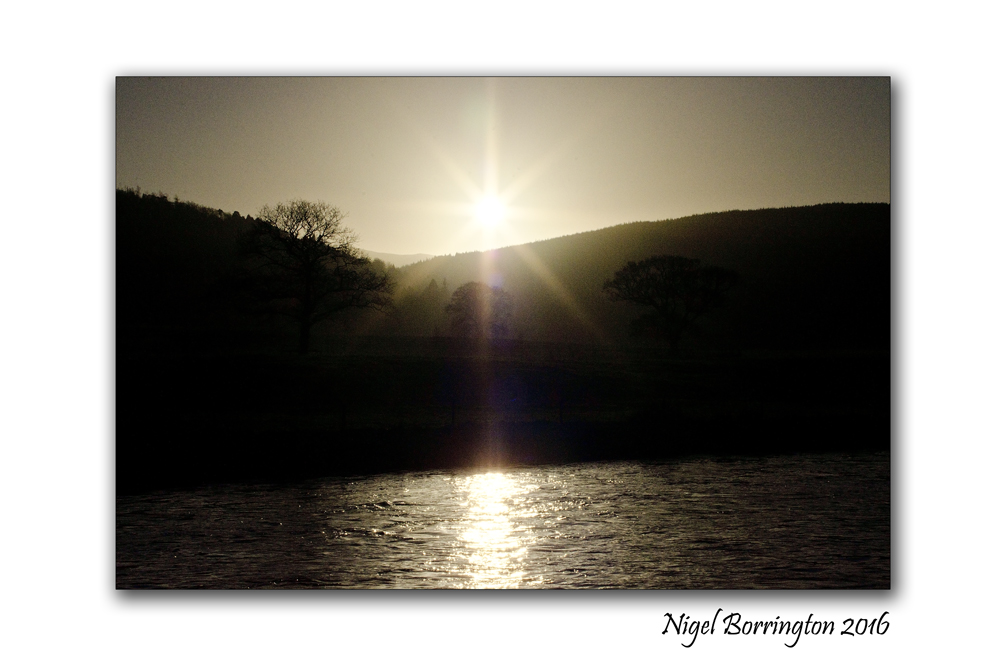
Sunset over the river
River Suir
Tipperary
Song of Sunset on the River
by Bai Juyi
A length setting sun spread water in
Half river emerald half river red
Love ninth month first three night
Dew like pearl moon like bow
A strip of water’s spread in the setting sun,
Half the river’s emerald, half is red.
I love the third night of the ninth month,
The dew is like pearl; the moon like a bow.
A weekend with wildlife, Otters of the river Suir

Wildlife weekend
Otters on the River Suir
County Tipperary
Nigel Borrington
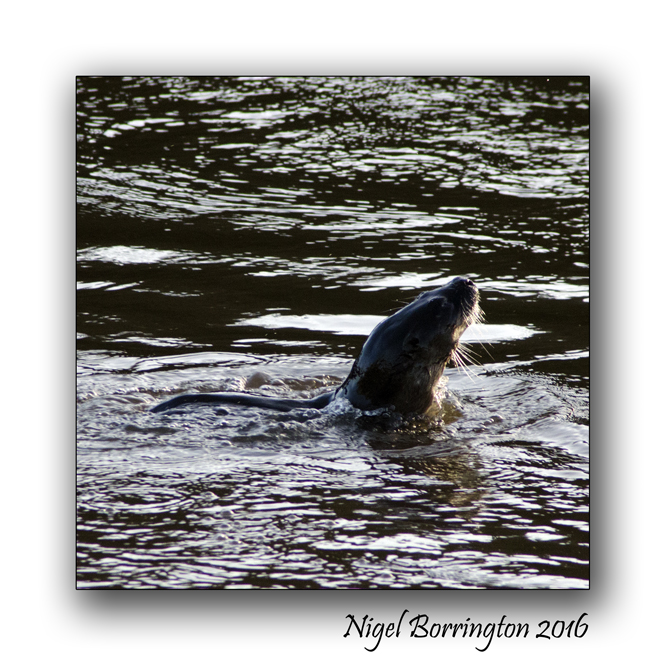
My study of an Otter family on the river Suir, county Tipperary continued today Friday, Each time I visit this family I manage to get closer and closer, today being the most noticeable.
I managed to spend 40min with this one adult Otter as he or she hunted the river for fish, this process involved diving as deep as possible and spending about a minute below the water before coming back up for breath, during the 40 minutes I think two fish in total were retrieved.
I hope to keep returning many times of the winter months to monitor just how they are all doing, ist amazing to be able to get so close and exciting to study such wonderful wild animals.



Irish Landscape images, county Kilkenny : The fog after the rain, a poem

Irish landscape images
County Kilkenny
after the rain
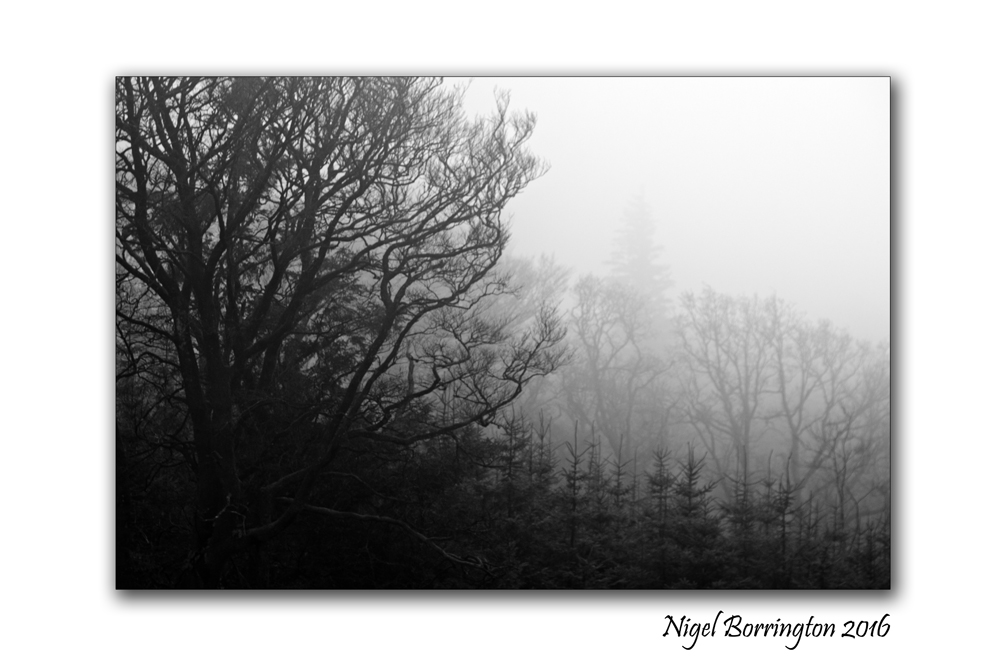
The fog after the rain , a poem
Rain falls all day in the old valley,
All the woodlands swimming underneath the steaming fog.
What peaceful sound I hear,
softly rings out of the sparkling
Woods and fields,
song of a thousand winter birds
announcing the setting sun,
Who sings loudest, after the rains.
In the bleak midwinter – Poem By Christina Rossetti
In the bleak midwinter
By Christina Rossetti
In the bleak midwinter, frosty wind made moan,
Earth stood hard as iron, water like a stone;
Snow had fallen, snow on snow, snow on snow,
In the bleak midwinter, long ago.
Our God, Heaven cannot hold Him, nor earth sustain;
Heaven and earth shall flee away when He comes to reign.
In the bleak midwinter a stable place sufficed
The Lord God Almighty, Jesus Christ.

Enough for Him, whom cherubim, worship night and day,
Breastful of milk, and a mangerful of hay;
Enough for Him, whom angels fall before,
The ox and ass and camel which adore.
Angels and archangels may have gathered there,
Cherubim and seraphim thronged the air;
But His mother only, in her maiden bliss,
Worshipped the beloved with a kiss.

What can I give Him, poor as I am?
If I were a shepherd, I would bring a lamb;
If I were a Wise Man, I would do my part;
Yet what I can I give Him: give my heart.
Landscape art and Painters , Artist: Fred Cuming

Landscape painter
Fred cuming
Landscape painting and photography
Painting as an art form for myself feels very much like a natural progression from the art of landscape photography which is the act of recording a representation of the view you find yourself located in.
I often find myself asking what it was about an image I capture with my camera or in a sketch / painting that I liked so much that I went to the effort of working with that location in different forms and media.
This is a quote from one of my favourite landscape painters Fred Cuming, Talking about his paintings Cuming says: ‘I am not interested in pure representation. My work is about responses to the moods and atmospheres generated by landscape’
Although there are many forms of landscape art all as valid as each other, Contemporary landscape painting tends to fall into the areas of semi abstracted to completely abstract, in that each work is making an effort to extract from the selected landscape location a sense of atmosphere or a mood. This mood and atmosphere can involve colour or light or texture, or all of these things and more.
This artistic process, from pure representation or abstraction can in a completely valid way start with photography and in fact many current artists have replaced the sketch book with the film/digital camera. The question as to if this is the best thing or not will continue for a long time, some feeling that a photo simply cannot capture a good enough sense of the location or at least not in the same way as spending time in that location with a sketch book can.
Personally I feel photographs are a very important tool and can in a very valid way capture the mood and sense of a place. However I feel that you need to spend a good amount of time with your camera exploring as much as you can while your on site, walking around and finding all the different views and angles along with all the small details you can find. The aim is to return home with as complete a memory of your landscape as you can.
Here are some details of Fred Cuming as an artist along with some more of his painting…..
Artist: Fred Cuming
Fred Cuming is a painter of International standing. Born in 1930 he studied Art at Sidcup School of Art from 1945 to 1949. After completing his National Service he studied at the Royal College of Art from 1951 to 1955 where he gained a Rome Scholarship and an Abbey Minor Scholarship.
Fred was elected a Royal Academician in 1974. He has also been a member of the New English Art Club since 1960 and is the recipient of many art awards including: the Grand Prix Fine Art (1977); the Royal Academy’s House & Garden Award and the Sir Brinsley Ford Prize (New English Art Club, 1986).
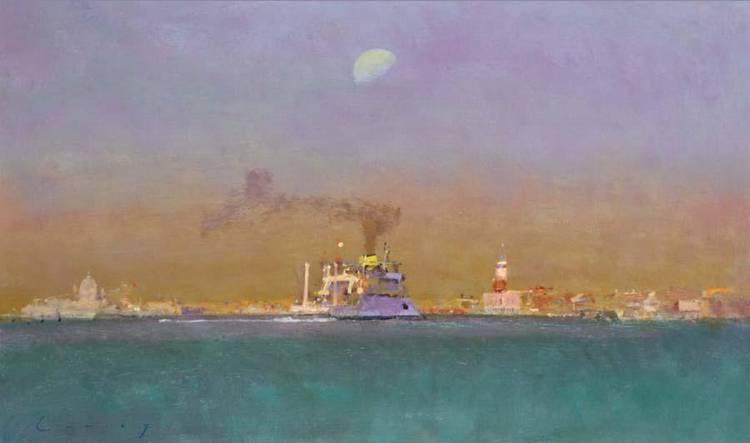
Fred Cuming has exhibited his contemporary paintings world wide. His paintings feature in many private and public modern art collections. These include: Montecarlo Museum; Royal Academy of Arts; and the Guinness Collection.
Fred Cuming paintings offer a moment for reflection. Cuming creates a relationship with nature and light – inducing observers to appreciate the calming atmosphere and realisation of the beauty around us. Many of his paintings feature the counties of Kent and Sussex where the Fred Cuming artist studio is located.
Talking about his paintings Cuming says: ‘I am not interested in pure representation. My work is about responses to the moods and atmospheres generated by landscape, still life or interior. My philosophy is that the more I work the more I discover. Drawing is essential as a tool of discovery; skill and mastery of technique are also essential, but only as a vocabulary and a means towards an idea. I struggle to keep an open mind.’

Fred Cuming has exhibited at other leading British Art Galleries. In 2001 Cuming was the featured artist at the Royal Academy Summer Exhibition with an entire gallery dedicated to his art work.In 2004 he was awarded an honourary doctorate from the University of Kent.Like all Red Rag British art and Contemporary art Fred Cuming purchases can be shipped worldwide.

Otters of the River Suir , County Tipperary

Otters of the River Suir
County Tipperary
Nigel Borrington
Last weekend while on walk between Clonmel and Carrick-on-suir, both in county Tipperary, We came across a family of Otters, they had made one of the rivers contributor’s their home ( A Holt or Couch in otter terms ). We spent about an hour with them watching as two adults and four pups hunted and play in the waters. One of the Pups managed to catch a fish and then share this food with the other three pups on the river bank.
For a long time I have hopped to have an encounter with these otters, I knew they were around this location but had never been in luck when it came to seeing them, so this hour was a truly special time and one I will not forget 🙂 , it changes the way you feel about a river when you have the chance to view its wild life for such a long period of time.
Here are some basic facts about the otter in Ireland …..
Written by Dr Mathieu Lundy
The otter (Lutra lutra) is regarded as one of Ireland’s most charismatic native mammal species.
The otter is highly secretive and although widespread people tend to only get rare glimpses of the species in the wild. Otter populations declined throughout Europe after the 1960s and the species is now very rare or absent from many parts of its former range. The Irish otter population appears to have remained largely stable and is regarded as a European stronghold. In Ireland otters are found in a diverse array of aquatic habitats, from small streams to major rivers, upland lakes to coastal lagoons and sandy beaches. However, otters that live at the coast do need access to some freshwater habitat to bathe. Within these habitats otters feed on a range of both aquatic and terrestrial prey. Much of the information regarding distribution, habitat use and diet comes from spotting otter tracks and signs. Individual otters are highly territorial, using droppings called spraints to mark their home ranges. Favoured locations for leaving spraints are in-stream boulders, bridge footings and grass tussocks, these are called seats. These territorial signs are an ideal way to tell if otters are using an area. Within its territory an otter may have a number of resting sites, called couches and underground denning sites called holts, which can be a considerable distance (up to 1km) from a river, lake or the seashore.

Distribution
The species of otter that occurs in Ireland is called the Eurasian otter and is found in Europe and across Asia to China and Japan. In other regions the otter shares aquatic habitats with species specialised to different habitats such as sea otters, but in Ireland the otters that live at the coast and those that occupy our rivers are the same species.
In Ireland the otter population is geographically widely spread. In local areas its presence will depend on the provision of suitable aquatic habitats, sufficient food and cover for resting and breeding. During different seasons male otters and juvenile otters will disperse and otter signs may be observed in areas where they have not been present hitherto.
Home ranging behaviour
The territories of otters can stretch for several kilometres; the total length of the home range depends on the availability of food. The smallest territories are thought to occur at coastal sites, where territories may be as small as 2km. The longest territories occur in upland streams where an individual may have to range more than 20km to find sufficient food. The territories of males tend to be larger than females and indeed may overlap with a number of female otters. The availability of suitable territories along the coast and inland at lakes and rivers is thought to maintain the otter population of Ireland. The entire population is estimated to be in the region of 10,000 adults.
Within their territories an individual otter may utilise a number of holts. These tend to be natural crevices, associated with the roots of trees growing along river and lake banks. These natural recesses provide the otter with a holt that has multiple entrances from which the otter can escape if disturbed. Whilst individual otters rarely dig their own holts they will use burrows made by other animals such as rabbits and foxes. It is possible to build artificial holts to attract otters to use certain areas. Artificial holts are built to resemble natural holts, with a resting compartment and multiple entrances, these are particularly important where the natural bank side vegetation has been removed.
Other resting sites are also used, frequently in dense vegetation and may be associated with frequently used runs and slides into the water.

Reproduction
Although otters can breed at any time of year most seem do so in spring or early summer. Scent markings by the females signal to male otters that the females are ready to mate. The pregnancy lasts for around two months after which a litter of cubs is born, usually two or three, but as many as five have been seen. The cubs remain in the natal holt for up to two months before venturing out on their own, although the mother may move the cubs between holts within her territory periodically. Unlike other resting sites the natal holts do not tend to be marked with spraints. The juvenile otters remain as a family group for around six months or longer before the young otters disperse to establish their own territories.
Foraging
Otters that live in rivers and lakes tend to be completely nocturnal, described as being crepuscular – activity peaks at dusk and dawn. Foraging at night or in ‘muddy’ water is aided by their highly sensitive whiskers, which detect their prey items. Otters are principally piscivorous, relying predominantly on salmonids (salmon and trout), but also eel and small fish species such as stickleback. However, otters are not limited to fish and feed opportunistically on a range of prey when available: frogs are frequently eaten by otters, and the remains of invertebrates (crayfish), birds and small mammals have also been found in spraints. Otters that forage at the coast may have flexible foraging times linked to the tides. At low tide otters hunt in the exposed rock pools and seaweed covered rocks for fish and invertebrate prey.

Conservation Status
The Irish otter population remains one of the most stable in Europe. There is some evidence to suggest that since initial national surveys in the early 1980s there have been declines in the prevalence of the species. It is hoped that the reasons for these declines will be addressed by the designation of Special Areas of Conservation (SACs), ongoing national assessments and by targeted intensive surveys. The risks to the current otter population are the availability of sufficient food within their habitats and provision of resting and denning sites. This species is protected under the Wildlife Act (1976) and Wildlife (Amendment) Act 2000.
Otters have been found dead in illegal snares, which may not be intended for otters, but which still pose a threat to individual animals. A significant number of otters are also killed on our roads. There is some evidence that the incidence of these accidents increases during periods of flooding when fast flowing rivers at bridge crossing become impassable and otters must venture onto roads to find alternative routes. The occurrence of otters at any site relies on a complex interaction of the characteristics of the wider landscape and local site specific habitat factors. Broad-scale intensive agriculture and urbanisation of catchments reduces the likelihood that otters will occur, along with reduced diversity of river banks and lake shores. Maintaining prey populations and preserving the natural features of rivers, lakes and coasts will benefit the Irish otter population and ensure that the Irish population remains a European stronghold.
Digital Art work – A December Sunset – Callan, county Kilkenny

Kilkenny Sunset
December 2016
Nigel Borrington
A December Sunset – Callan, county Kilkenny
Often when out for an evening walk at this time of year the sunsets across our local fields can be just amazing to view, the sun is low in the sky all day long in December when compared to a mid summers day. With out getting to detailed this changes the angle of the sun and it seems to make the last few moments of day light last longer. This along with the mist and early frosts that can sit of the fields, haging above the hedgerows is just great to see 🙂
This painting is created using a PC application called mypaint, I have spent the last few weeks doing my best to get up to speed with how to make the best use of it, at first just using some of the drawing tools and ink pens but as you can see – I hope that I am now getting more use to the painting and colour tools..
The paint is posted the moment I feel its finished , I very much like the idea of this as it helps me to close the processes involved and to stop me coming back and over working anything. Its a little hard to describe but its a great feeling to start and finish a painting in one session and then be able to learn when you feel that you have finished !!!
A Winters day on the farm …..
WinterFeed in the barn
County Kilkenny
Nigel Borrington
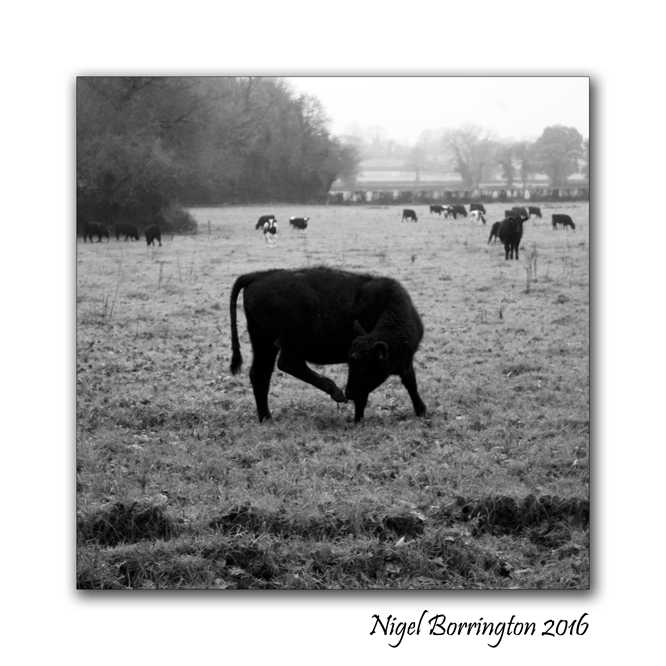
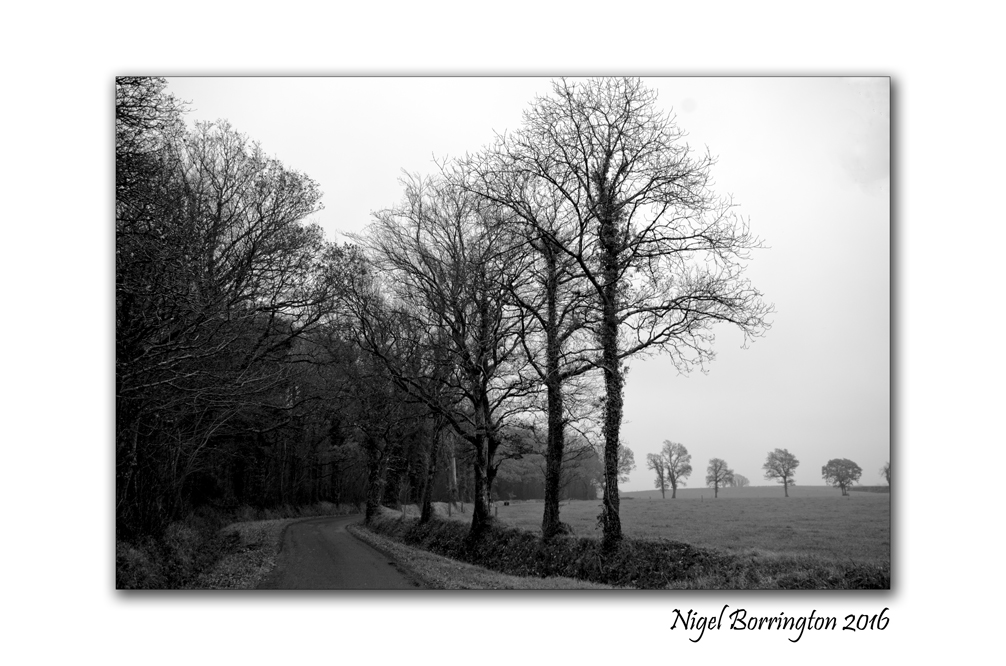
Winters on a farm are a hard time of year, dealing with the weather and the cold, the dark evenings and early mornings. Life as a farmer must have many great moments but its not hard to imagine that there are less of these in the winter months than in the summer.
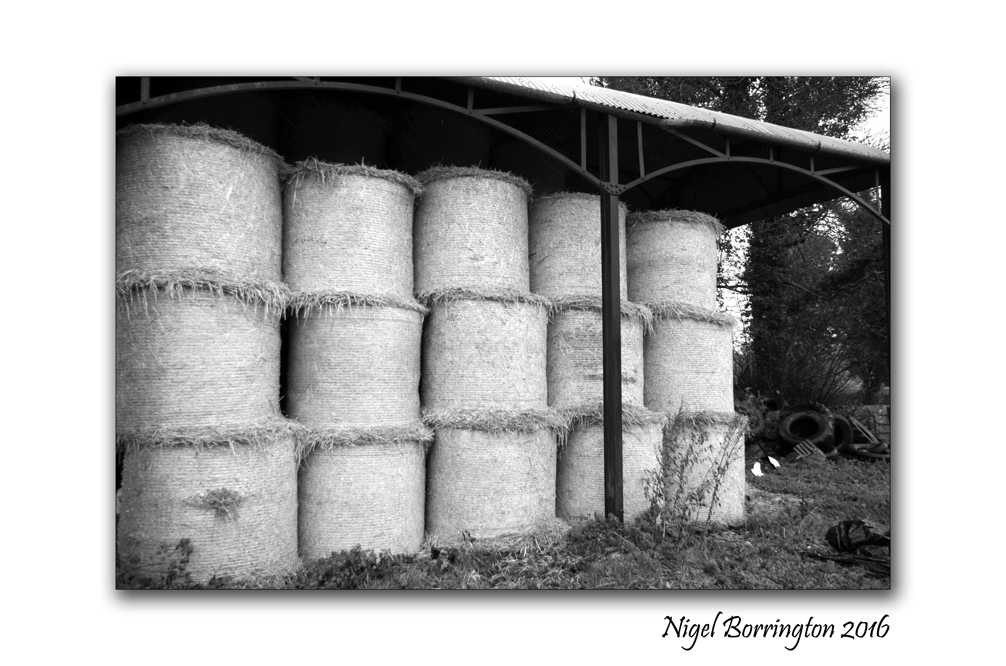
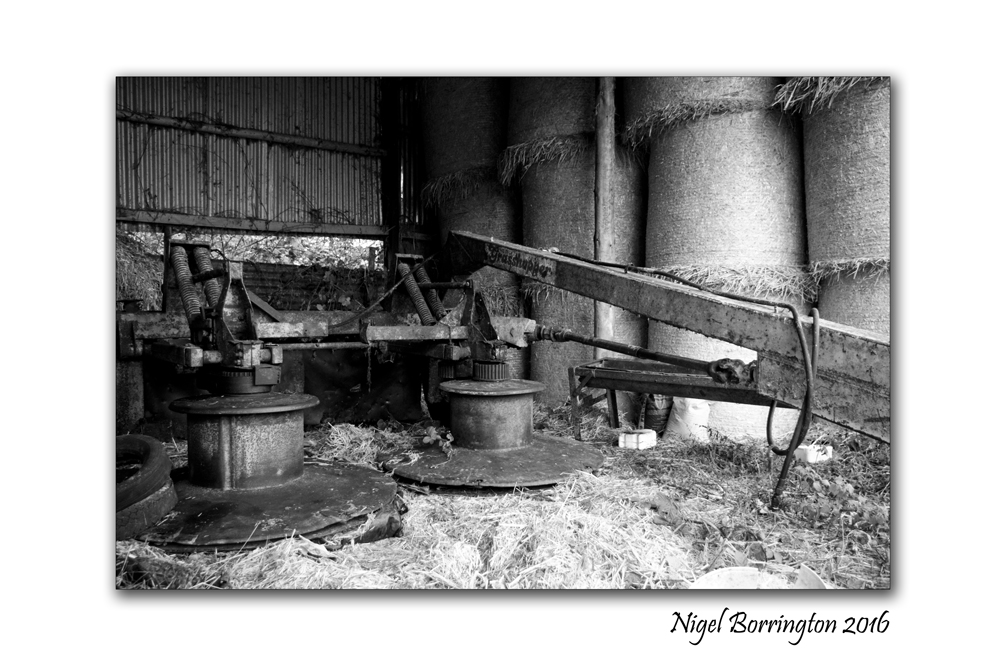
I took these images while out on a walk yesterday and as you can see, on this farm some of the cows are still out in the fields while some have been returned to their winter shed, soon all of them with be inside. In the Barn close by is stored some of the feed that will be used for the cattle over the next few months. In an area of the barn next to the feed is the farmers haybob that would have been used only a few weeks back to help get the hay bales ready.
The next few weeks are all about rest for the land and keeping the live stock warm and health in the sheds, life slows down and less work out in the fields is needed. While welcome in some ways you can imagine that this lack of activity can at times feel a little to slow but this is farm life.
Here in county Kilkenny each year you develop a great sense of the farming seasons and the activities that go along with them.


Abandoned Farmhouse, Poem By Ted Kooser

Abansoned Farmhouse
Chalk sketch
Nigel Borrington
Abandoned Farmhouse
By Ted Kooser
He was a big man, says the size of his shoes
on a pile of broken dishes by the house;
a tall man too, says the length of the bed
in an upstairs room; and a good, God-fearing man,
says the Bible with a broken back
on the floor below the window, dusty with sun;
but not a man for farming, say the fields
cluttered with boulders and the leaky barn.
A woman lived with him, says the bedroom wall
papered with lilacs and the kitchen shelves
covered with oilcloth, and they had a child,
says the sandbox made from a tractor tire.
Money was scarce, say the jars of plum preserves
and canned tomatoes sealed in the cellar hole.
And the winters cold, say the rags in the window frames.
It was lonely here, says the narrow country road.
Something went wrong, says the empty house
in the weed-choked yard. Stones in the fields
say he was not a farmer; the still-sealed jars
in the cellar say she left in a nervous haste.
And the child? Its toys are strewn in the yard
like branches after a storm—a rubber cow,
a rusty tractor with a broken plow,
a doll in overalls. Something went wrong, they say.
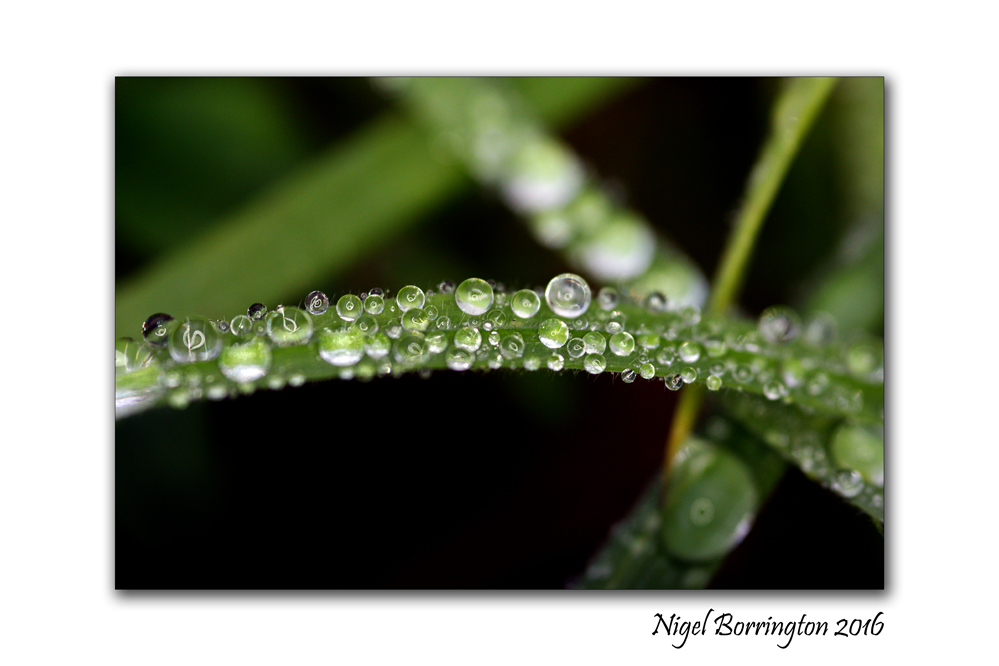
Macro photography in December

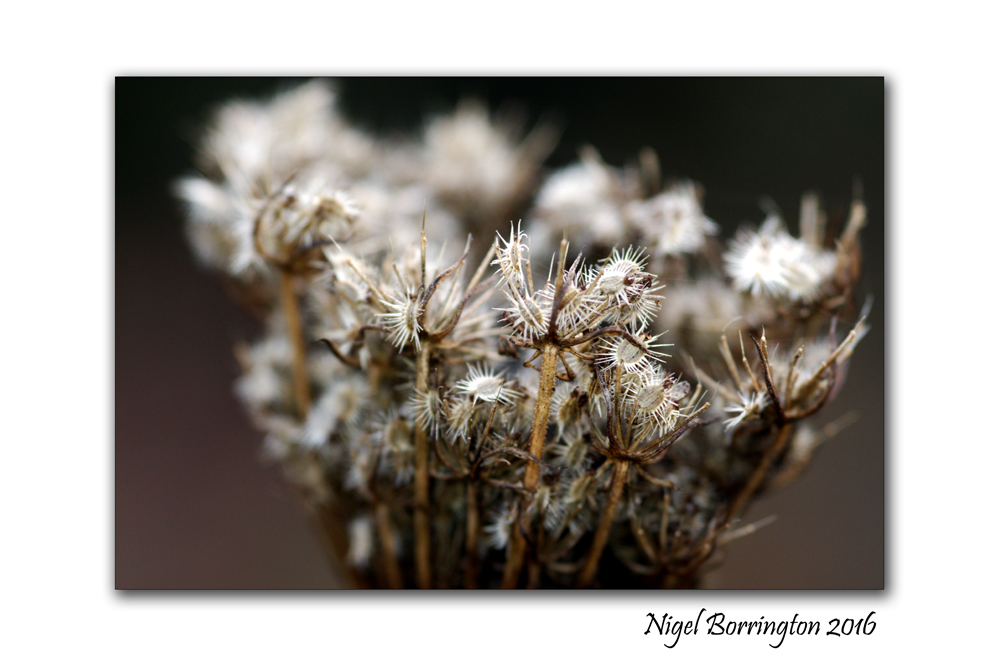
You would think that in the first week of December, it would be hard to find anything interesting in the local landscape nature wise to get good and close to with a Macro lens, however there are still some amazing thing to be seen and captured 🙂
Here are just a few macro images taken this week …….


Friday Art and Artists : British Artist Edward Bawden

650 0072
Friday Art reviews
Back in the Summer I did a weeks worth of posts that related to some of the artists I like the most. I really enjoyed doing the research behind these posts and so I want to start looking at some more artists and their work , In the long term I am planning to put each Friday aside for these posts, this December however I may post a lot more than one day per week, as I want to dig a lot deeper into the subject of landscape and cityscape art and artists ……
Artist Edward Bawden
British Artist Edward Bawden, one of a group of artists associated with a community of artists that existed around Great Bardfield in Essex, England during the middle years of the 20th century.
Great Bardfield :
is a village in north west Essex, England. The principal artists who lived there between 1930 and 1970 were John Aldridge RA, Edward Bawden CBE RA, George Chapman, Stanley Clifford-Smith, Audrey Cruddas, Walter Hoyle (principally a printmaker, who ran the printing workshops at Cambridge Art School when I was there, and taught me to do linocuts in the style of Bawden and himself), Eric Ravilious, Sheila Robinson, Michael Rothenstein, Kenneth Rowntree and Marianne Straub. Other artists associated with the group include Duffy Ayers, John Bolam (who taught me painting at Cambridge Art School, and later became the Principal of the school), Bernard Cheese, Tirzah Garwood, Joan Glass, David Low and Laurence Scarfe. Great Bardfield Artists were diverse in style but shared a love for figurative art, making the group distinct from the better known St Ives art community in Cornwall, who, after the war, were chiefly dominated by abstractionists.
Edward Bawden (1903 – 1989)
can be seen as a key artist in the Bardfield group. His long career spanned most of the twentieth century, and comfortably straddled boundaries and borders between the fine and applied arts, boundaries which are seen as so immovable today. Even before his appointment as an Official War Artist in 1940, Bawden had established a reputation as a designer, illustrator and painter. As well as these areas his output over the years include murals, posters, designs for wallpaper, ceramics, lithographic prints and watercolours.
Edward Bawden was born in Braintree, Essex in 1903, and was perhaps more firmly rooted in Essex than any other artist represented in the North West Essex Collection. Bawden attended the Friends’ School in Saffron Walden. At the age of eleven he strained his heart and was excused participation in sports. This may have allowed him to devote more time to drawing, and his portraits and caricatures attracted the attention of his tutors who arranged for him to spend a day a week at the Cambridge School of Art. The school, now part of Anglia Ruskin University, had been founded to comply with the Ruskinian philosophies of improving design for industry, and encouraging amateur aspirations. Bawden fitted perfectly.
Before long, he had gained entry to the Royal College of Art. Here he was taught by Paul Nash (a lasting influence on Bawden and his contemporaries), and the popular E. W. Tristram. It was at the RCA that Bawden first met his ‘kindred spirit’, Eric Ravilious, the two quickly becoming firm friends, though entirely different in temperament. Shortly after leaving the college, the pair gained a prestigious commission to paint a mural for the refreshment room of Morley College in London. He first rented half of Brick House, the imposing Georgian house in Great Bardfield in the mid-1920s with Ravilious, and after his father purchased the whole house for him on his marriage to Charlotte Epton in 1932, he continued to live there until moving to Saffron Walden in 1970 after Charlotte’s death.
On a Personal note …..
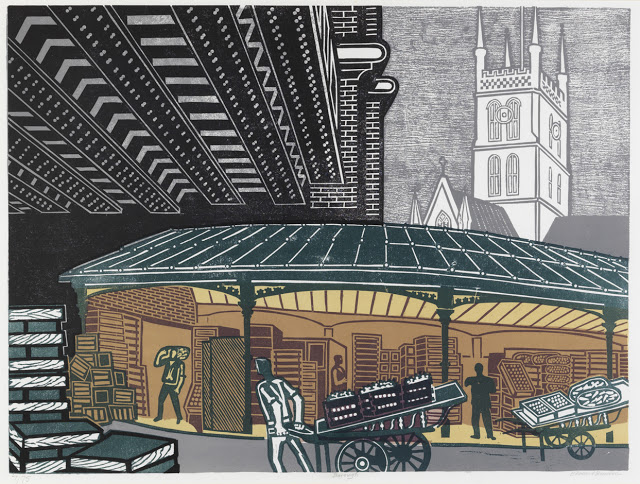
I really like Edwards London market prints, his use of limited colour and strong geometric shapes, to me this is print making at its very best. They are almost poster like yet retain strong connections to art not commercial based prints.
I like very much the sense of movement and activity that he captures from the people he includes in these prints, you can almost hear the noise and imagine the chatter that is taking place, the sound of wheels on the flag stones. The cold in the winter and the heat of the city in the summer.
These prints are full of life and capture London markets in 1967 in an almost timeless way 🙂 🙂
In 1967 Bawden made a series of six prints of London markets, commissioned by Curwen Prints. The markets were Billingsgate, Borough, Covent Garden (2), Leadenhall and Smithfield:

648 0074
646 0076

649 0073

250 0001

647 0070
650 0072
December , the Pagan Meaning of Evergreen & Holly

Evergreen Holly
Pagan Nature
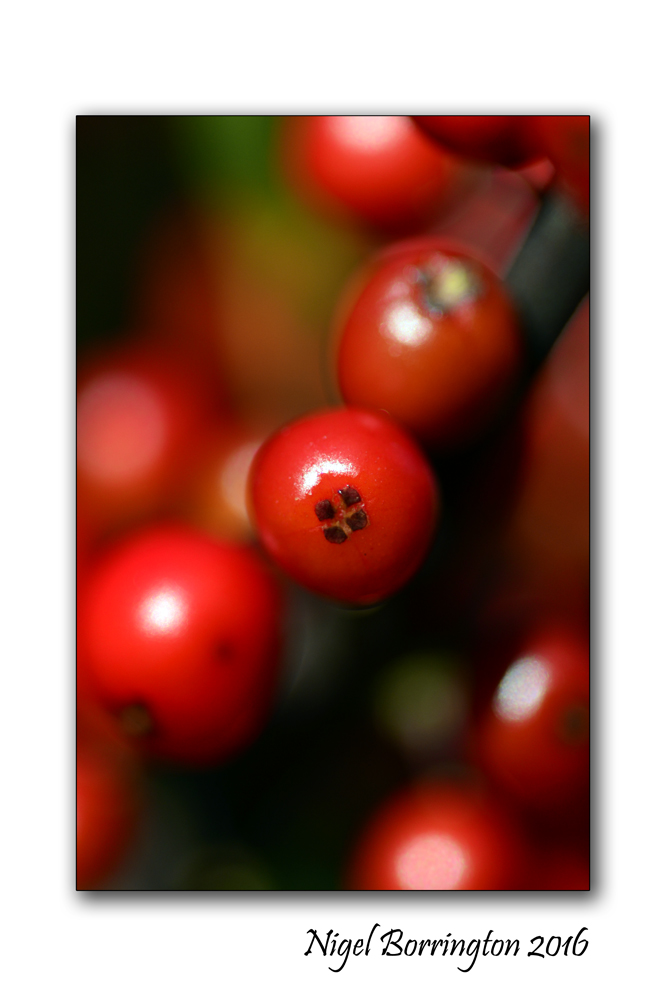
Evergreens and holly (genus Ilex) are traditionally used to decorate during the holidays. Although many simply enjoy the plants for their fragrance and holiday colors, the meaning of these plants goes deeper for others, including pagans. Historically, pagans had — and still have — specific beliefs about the power and symbolism of both evergreens and holly, and some still use the plants as decor in accordance with those beliefs.
Evergreen — Always Green
Evergreens are loosely defined as plants that retain their foliage and remain green year-round. Usually, the term refers to coniferous trees — trees that have needles or needle-like foliage, but it can refer to any plant that stays green all winter long, including holly. Today, evergreens are valued for their practical uses — as windbreaks, hedges and for use as Christmas trees. Pagans used them for more spiritual reasons.
Pagan Meaning of Evergreen
In some countries, it was believed that evergreens would keep evil out of the home — evil spirits and ghosts, and evil in the form of illnesses. For this reason, evergreen boughs were often cut down and hung over doorways and inside the home. Pagans also believed that the green branches represented everlasting life. Druids used evergreen branches to decorate their temples for this very reason, according to History.com. The green of the branches helped people to get through the long winter by having hope in the warmth and food that would come in the spring.
Holly — Pretty and Prickly
Holly plants
vary widely in leaf shape and appearance. Although there are over 400 species (Ilex opaca is the scientific name of American holly), the most popular for use during the holidays are those that produce bright red berries, which historically were seen by pagans as masculine plants even though it is the female plants that produce the fruit. Holly plants are generally hardy in U.S. Department of Agriculture plant hardiness zones 5 through 9, although this can vary by species. Most popular hollies are hardy in USDA zones 7 through 9.

Pagan Meaning of Holly
Holly has a more specific meaning for pagans. Historically, pagans believed that like evergreens, holly wards off evil spirits. They also believed that holly increased fertility. In addition to bringing in holly boughs to decorate the home and increase fertility, holly was also often planted outdoors around the house to keep out evil spirits.
Kilkenny landscape images : Novembers last sunset

Kilkenny Landscapes
Ballykeeffe
Ireland
Nigel Borrington
Its hard to Believe that it is the end of November already !!
These images are of the last sunset, November 2016 🙂

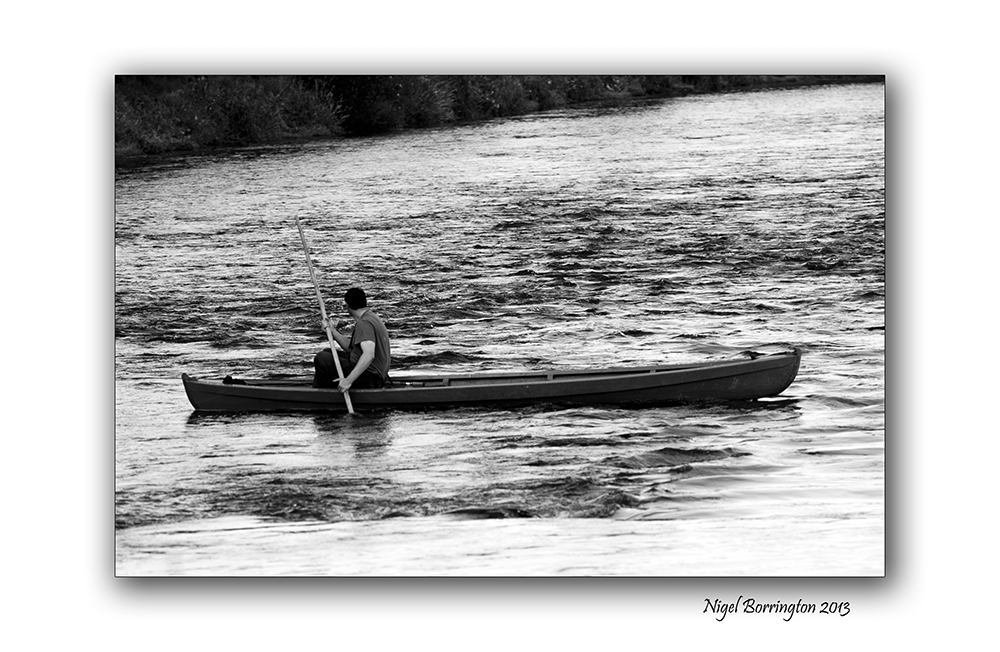
The Boat men of the river Suir

Fishing boat
river Suir
County Tipperary
Fishing on the River suir
The walk along the river Suir, County Tipperary is one of the best river walks in the south east of Ireland. It is currently undergoing an upgrade to a hard surface that will for the first time allow for both walkers and cyclists.
The river is used by many local people during the year but the fisher man are most probably it’s most common visitors, the River is renowned for its game angling, holding both salmon (Salmo salar) and brown trout (Salmo trutta).
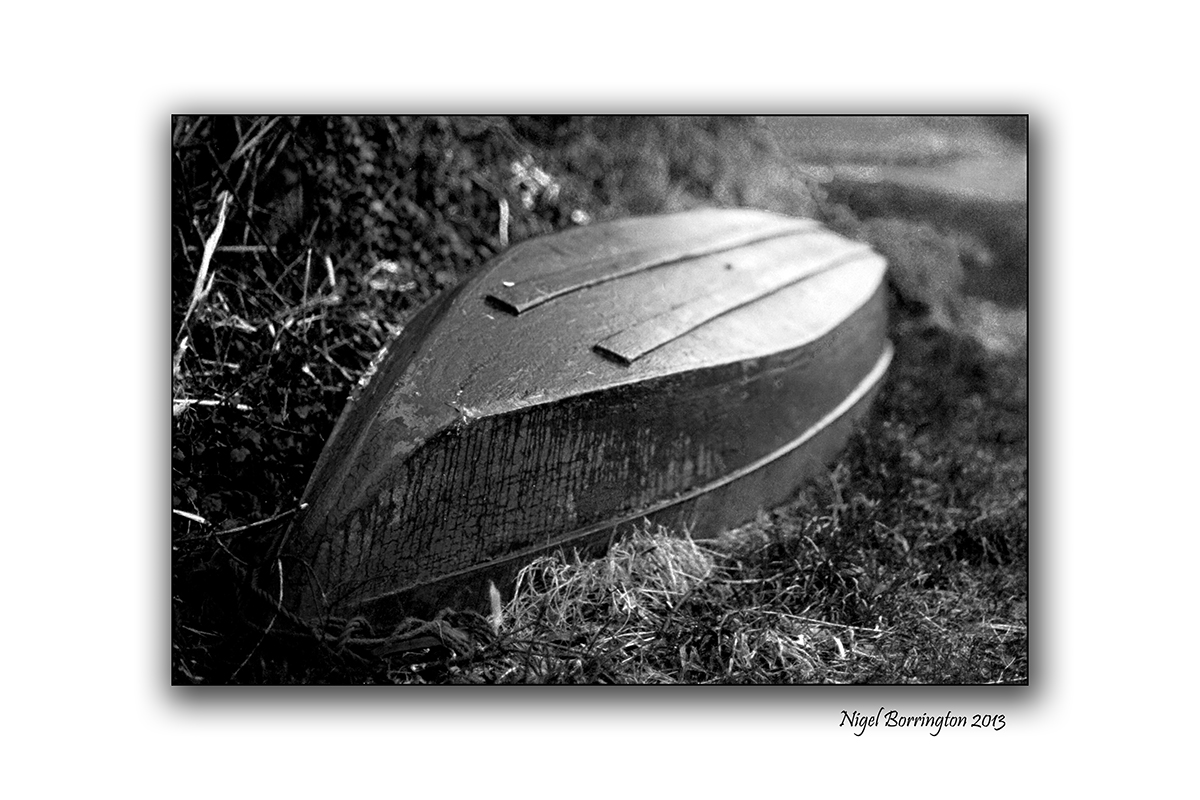
I have taken many photographs of the fishermen here over the years alone with the boats they use for their fishing, these boats ( all made locally ) are used more like punts as the have a completely flat bottom and are moved along the river with a pole.
Fishing in Ireland : CLOCULLY TO CARRICK-ON-SUIR
The River Suir from Clocully to Carrick-on-Suir is a combination of deep pools, fast glides and varying widths and depths.
From Clocully to Ballydonagh, a consortium of private landowners control the angling, these are all private fisheries. This stretch also includes parts of the River Tar and River Nire, which contain good stocks of trout of up to 30 cm.
Fishing on the river Suir : Gallery



 Nigel Borrington
Tamron SP 35-210mm f3.5-f4.2 – Classic lenses
Tarmon SP 35mm-210mm f3.5-4.2
Classic Lenses
Nigel Borrington
Using classic Camera lenses
In the world of Digital photography it feels like a new bit of equipment is released almost every month, new Camera bodies, lenses, flash guns etc….
In the last few years however the image quality of digital cameras has begun to reach such high standards that its hard to see as bigger need than every before to keep upgrading your SLR camera body. I remember so clearly the day I first purchased a digital SLR, it was a Nikon D100, a body that was very closely based on the Nikon F80. I also remember reading sometime later that for a digital Camera to match the print size of 35mm film you would need 24 million pixels, a target that was reached sometime back in the Nikon range and surpassed with the 36mp Nikon D800.
Looking back at Film cameras, most of the end print size and quality came from the type of film you selected to use. The camera bodies themselves offered different levels of capture capabilities, some bodies offered all you needed to take landscape images while other more advanced bodies allowed you to capture fast action activities such as sports.
Once you had the camera body that you needed, for the type of photography you worked with, there was little need to upgrade until you had almost worked your camera into the ground.
Today in 2017, it is a very legitimate question to ask if at last after many years of the megapixel race, have we not now reached the point that you can purchase a camera body and keep it for life or until you finish it off by using it so much ?
What about Lenses ?
In the first years of digital SLR cameras it was not always possible to use all your old lenses with your new wonderful Digital body, Many Cameras would only for example allow you to use the latest Auto-focus lenses.
Over time the manufacturers started to launch bodies at the top end of their range that allowed you to use many older lenses including Manual focus lenses. Once this happened many photographers started to look backwards at the classic lens market, to workout what lenses from the past still offered great performance on modern cameras.
Personally I love using classic lenses and the Tarmon Sp 35mm-210mm F3.5-4.2, is one of the lenses I love using the most, produced by Tamron in Japan in the early 1980’s and only ended production in late 1987, it was available new well into the 1990’s.
This lens is one of the best made Zoom lenses of all time and even includes a Macro mode, offering a close focus of 11.8″ (0.3m), for a zoom lens this is very good. It is also very fast and falls into the professional level of F3.5 at 35mm to F4.2 at 210mm, on a current Digital slr with its low ISO noise this speed is excellent. It also has some amazing Lens flare that when used in video mode is amazing !
For times when I can use manual focus and want a zoom lens that has a great focus distant range and is fast, I am more than happy to have this lens with me. Its sharp at all F-stops, feels just amazing to use and can take any kind of usage in any type of conditions.
I will let the images below do the rest of the talking here, its fair to say however that not all old camera equipment is outdated and not worth using anymore. Great Lenses like these ones, if looked after last for ever.
When new this lens would have cost top money and for a reason!
Lens Gallery
Share this:
January 18, 2017 | Categories: Camera Equipment, Camera reviews, Comment, macro photography, Nigel Borrington | Tags: Camera Equipment, Classic lenses, Lens, Lens review, Nigel Borrington, old lenses, Tamron SP 35mm-210mm f3.5-4.2, using old lenses | 3 Comments