Kilkenny landscape images

Nikon D200, 50mm f1.4 lens, Iso 800
Knockbutton, old cottage window
Kilkenny Landscape photography : Nigel Borrington
I took these shots on a walk around Knockbutton, County Kilkenny, early one Saturday Morning.
I feel that the old Family cottages of County Kilkenny are one of the county’s most striking historic features.
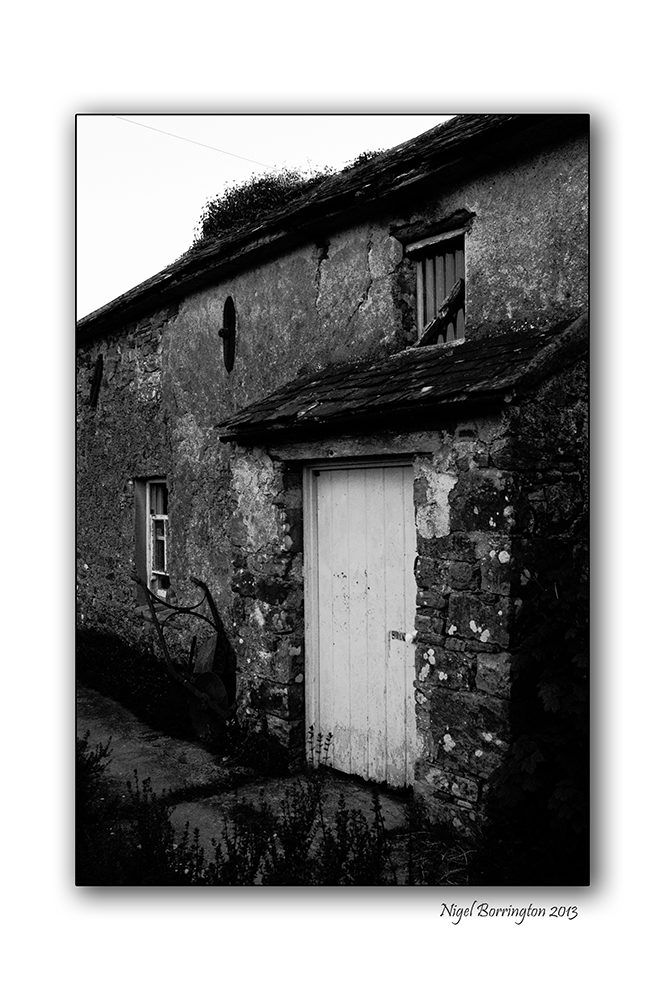
Old Kilkenny farm house

Nikon D200, 50mm f1.4 lens, Iso 800
Old Knockbutton farm house
Landscape photography by: Nigel Borrington
An old Farm house and yard in Knockbutton,County Kilkenny….
Sunday evenings
In your mind ……

Nikon D200
Foothills of Slievenamon,South Tipperary
Landscape photography : Nigel Borrington
Sunday evenings are my favourite time of the week, your mind should be empty at this stage, stripped down, cleared out and ready to go but not yet !
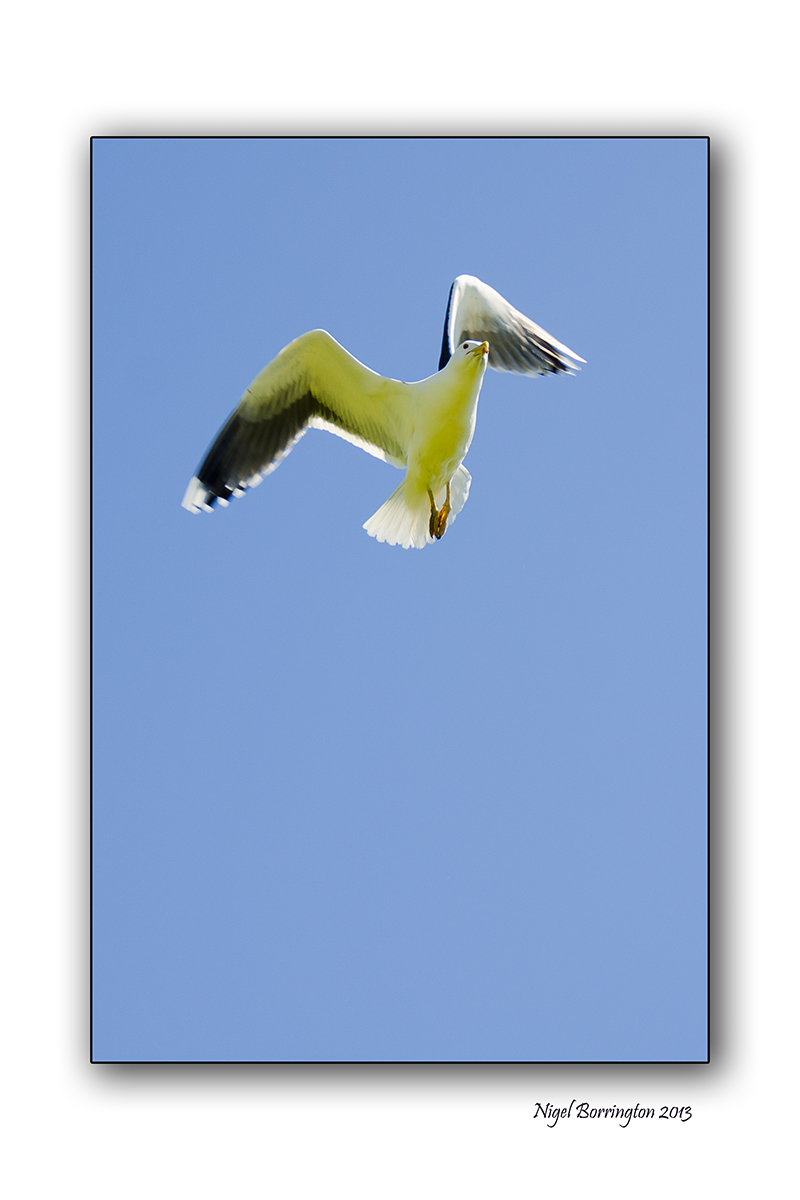
Great Black backed Gull

The photograph in my last post is of the Saltee Islands, County wexford. You can only visit the island via boat and mostly with a wildlife group or on days when the boat is booked with a good amount of people. The island is a wildlife paradise and a photographers dream, you can find almost any position on the cliff tops to setup your camera and the birds will just come to you. However moving to find the type or group of bird is advisable.
The Saltee Islands has over 220 species of birds, these included images are of the Great black backed Gull.
“GREAT BLACK BACKED GULL
Great Black backed Gulls are the lords of the seabird colonies. They choose the highest vantage points to build their nests. The adults are unmistakable because of their size, jet black wings and mantle, measuring two and a half feet with a five foot wingspan. The massive bill is yellow with an orange spot on the lower mandible. If an intruder approaches the parents call anxiously and the young birds “freeze” in the dense cover and are hard to locate. The parents also will also make low swoops at the intruders head, however they seldom strike. Great Black backed Gulls breed on the island, and are in abundance all year.”
You can only stay on the island for a day as you have to leave on the last boat, this is to protect the environment of the island as birds nest on almost a hundred percent of the ground area and no camping would be possible.
I got some three hundred usable images from this day so will keep posting images along with some information on the wildlife involved….

Saltees Island, Gannets
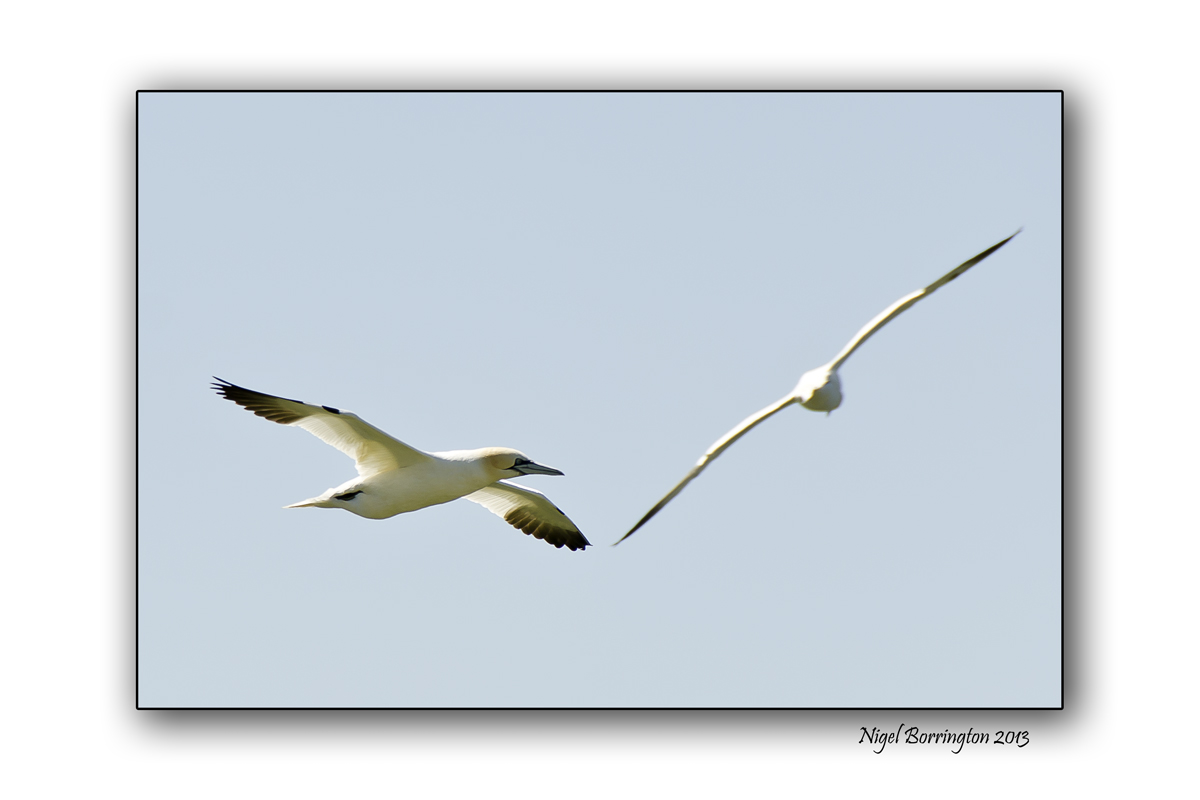
Gannets flying over the Saltees islands, Co Wexford
Nikon D7000
80-300 vr lens
Nigel Borrington

Gannets Roosting, Saltees islands, Wexford
Nikon D7000
80-300 vr lens
Nigel Borrington
Allihies, Beara, Co. Cork, Ireland
A sense of place (Allihies, Beara, Co. Cork, Ireland) in eight images
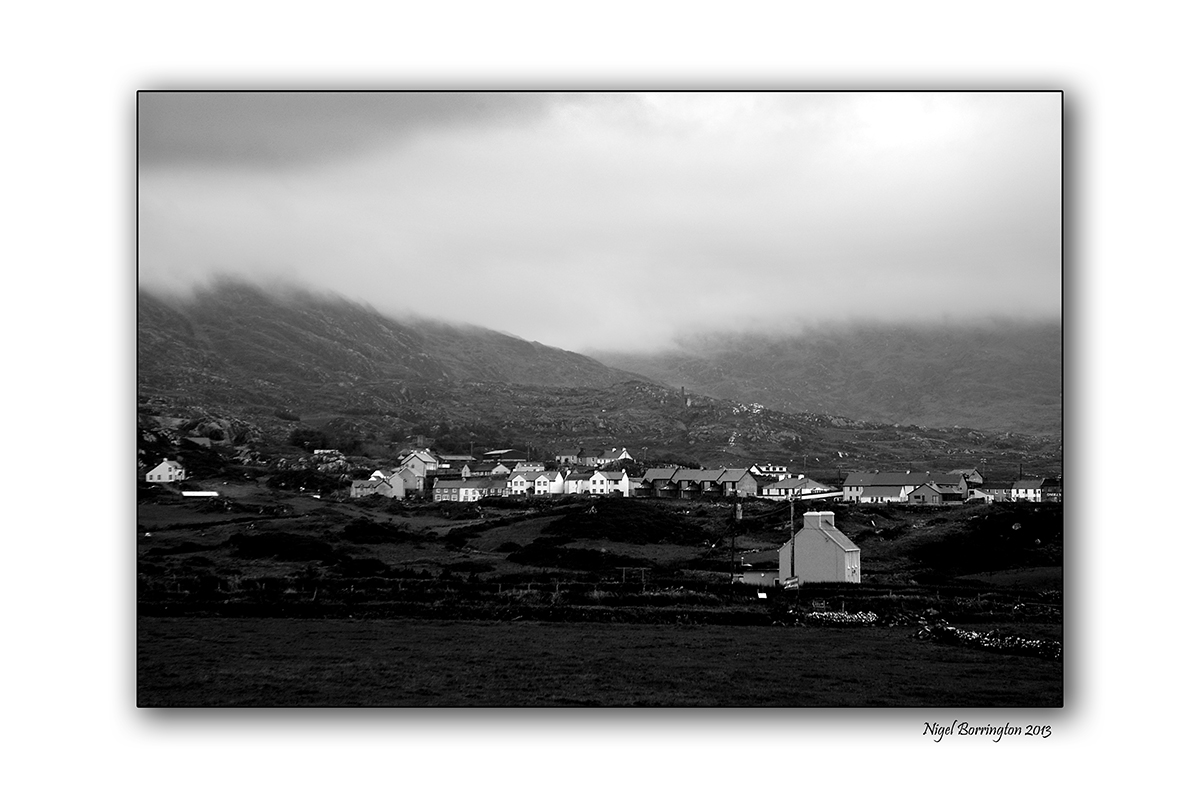
View of Allihies town
Nikon D7000
Landscape photography ; Nigel Borrington
Allihiies, Co Cork is one of my favourite places to stay In Ireland, We have spent some time here and I think it’s very likely we will return.
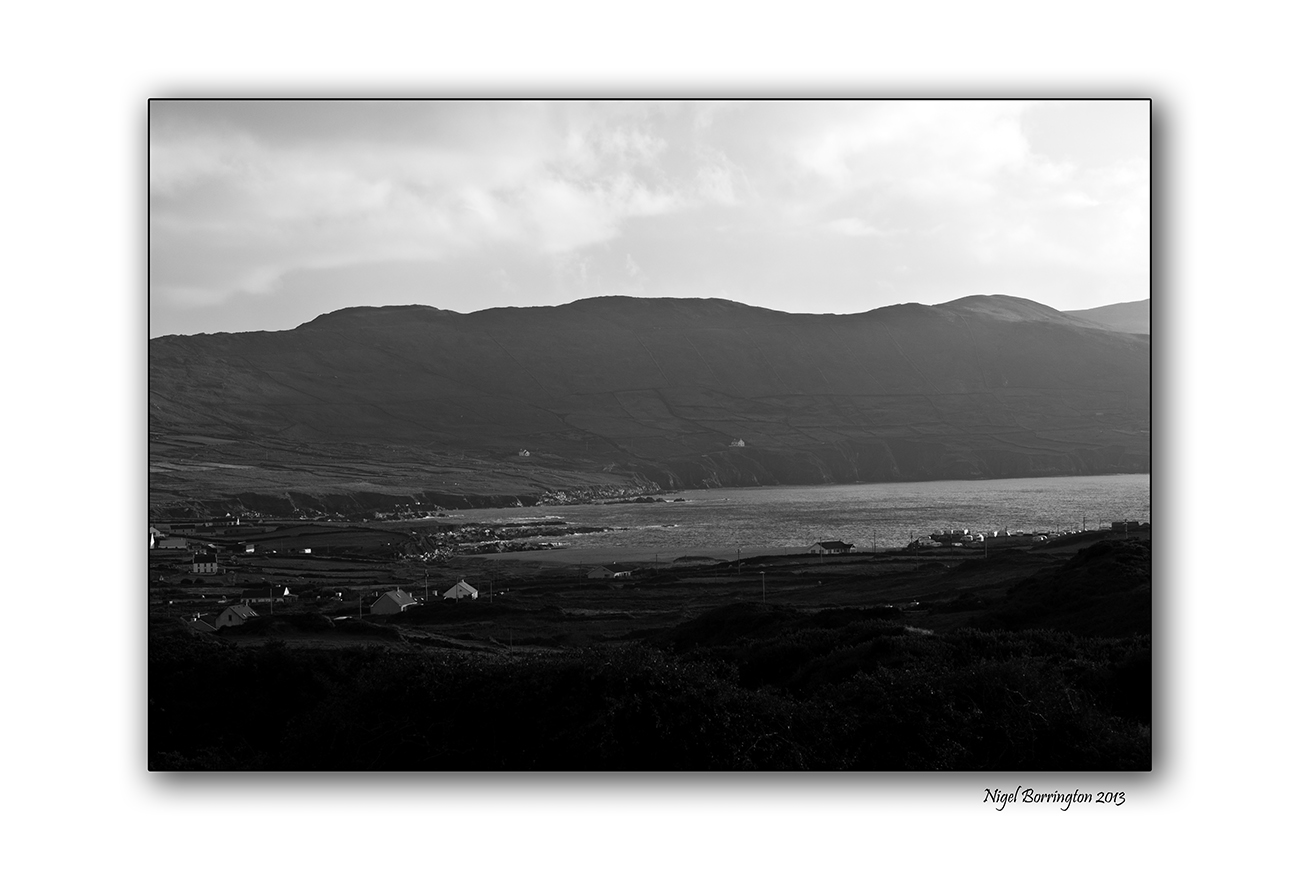
Mountains and setting


.
The town is located at the tip of the Beara peninsular, co cork and is just about as remote a place as you can get. The feeling here is of escape and as such is perfect for a week’s holiday.
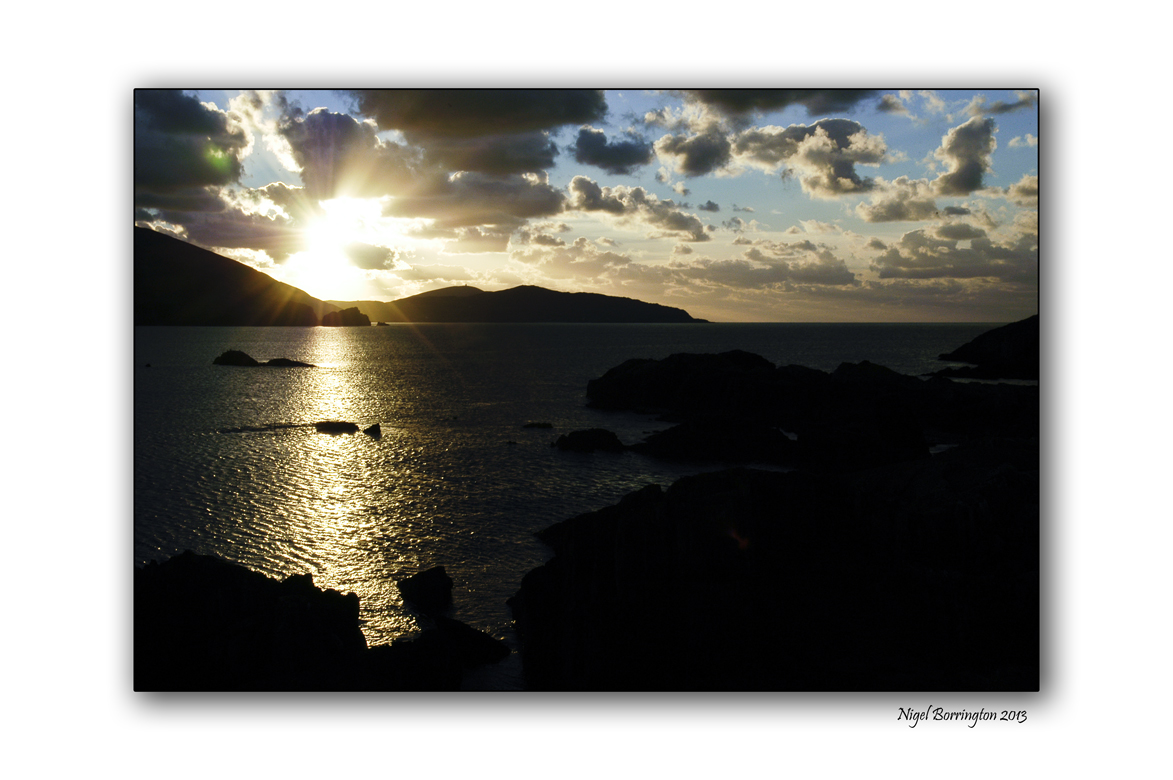
The Harbour
.
The copper mines are the main feature of the town and the museum makes an excellent visit during the week we spent some time in here as it has a great coffee shop with a view of the harbour.


.
I will re-visit Allihies over the next weeks with more posts as it is just a wonderful place
All Images taken on a Nikon D7000, in September 2010
Lough Leane killarney

Looking at the setting sun….
These images of the setting sun over Tornies south and Purple mountain, Killarney National park, were taken two years ago on a week’s visit to Killarney.
I arrived about half an hour before the sun was due to set and placed my camera on its tripod. I was attempting to capture every possible moment of the sun as it set behind the mountains on the other side of (Lough Leane) – lower lake.
What I feel I captured is a set of the best sunset images I have ever managed to photograph, the light that evening was just magical as you can see from the images. They contain every possible combination of yellows, blues and purples you can imagine, along with deep dark tones.
I learnt a lot from this 45mins with my camera, but the biggest thing was to keep the shutter going and never think you have the best moment already on your film or card.
When you get the images onto your pc screen or print’s every frame will surprise you….

Lower Lake, Killarney
Nikon D200
Landscape photography by : Nigel Borrington
.
Pre-Wedding Photography
The following three images are from a wedding I photographed last year.
I love these moment before the main wedding events, all the preparations are over, the weeks before have passed by and the day is here. Everyone feels more relaxed as nothing more can be done. Its now down to remembering a few lines and enjoying the events.


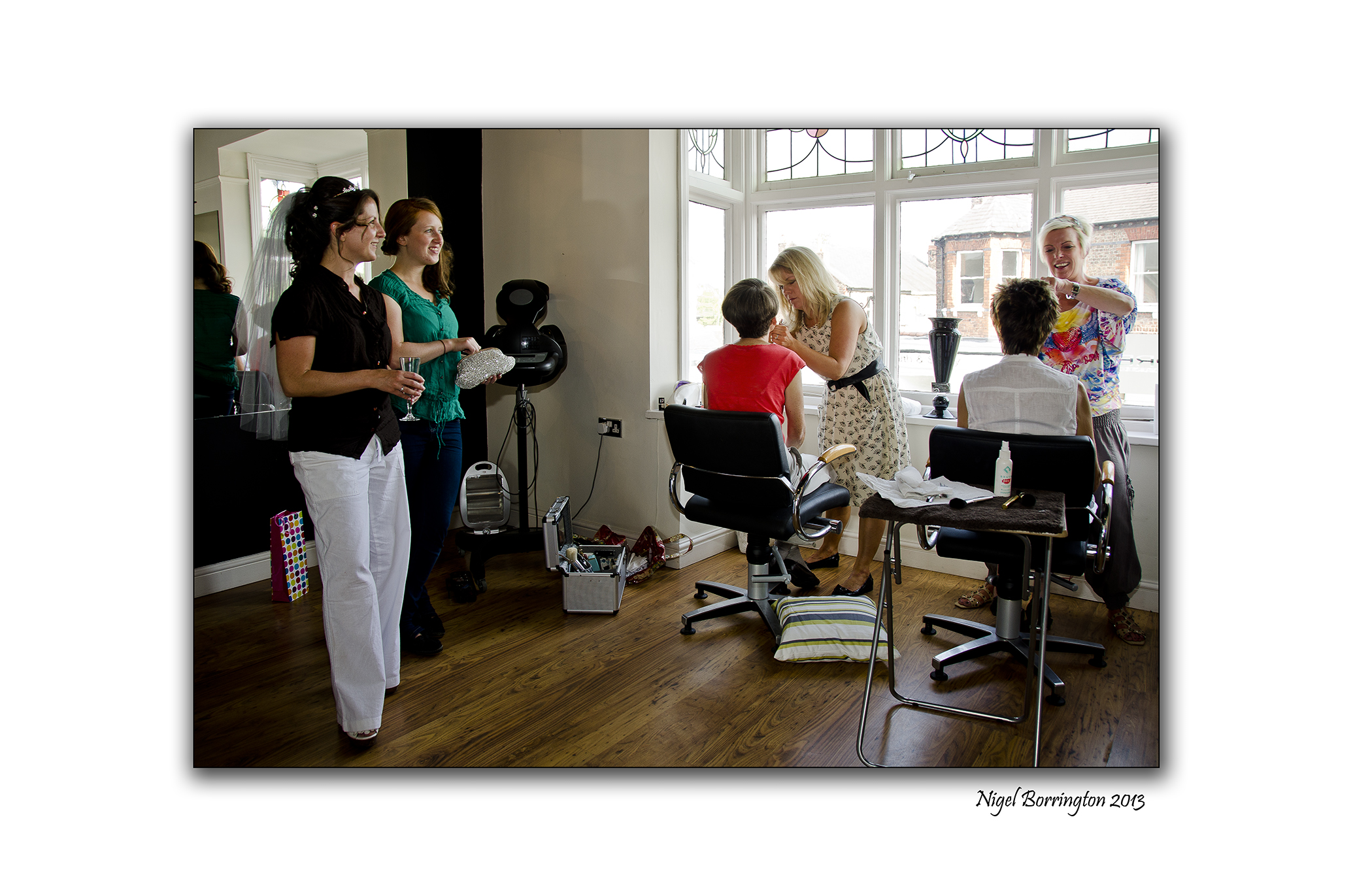
All images taken on a nikon d700/7000 slr…..
Achill island
A sense of place (Achill island, County Mayo) in ten black and white images ..
I don’t usually post images by themselves but I want these images just to speak for themselves ….
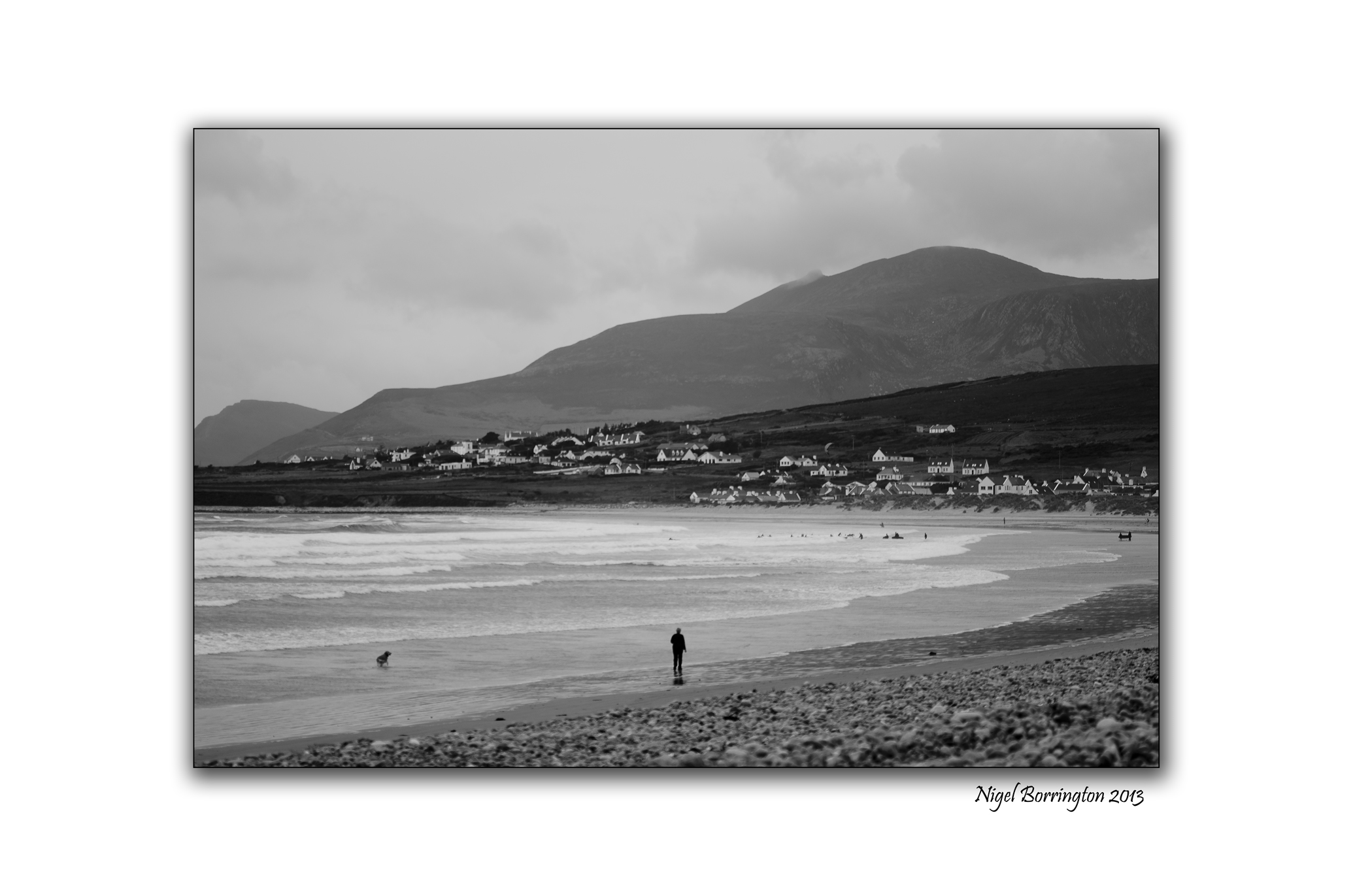

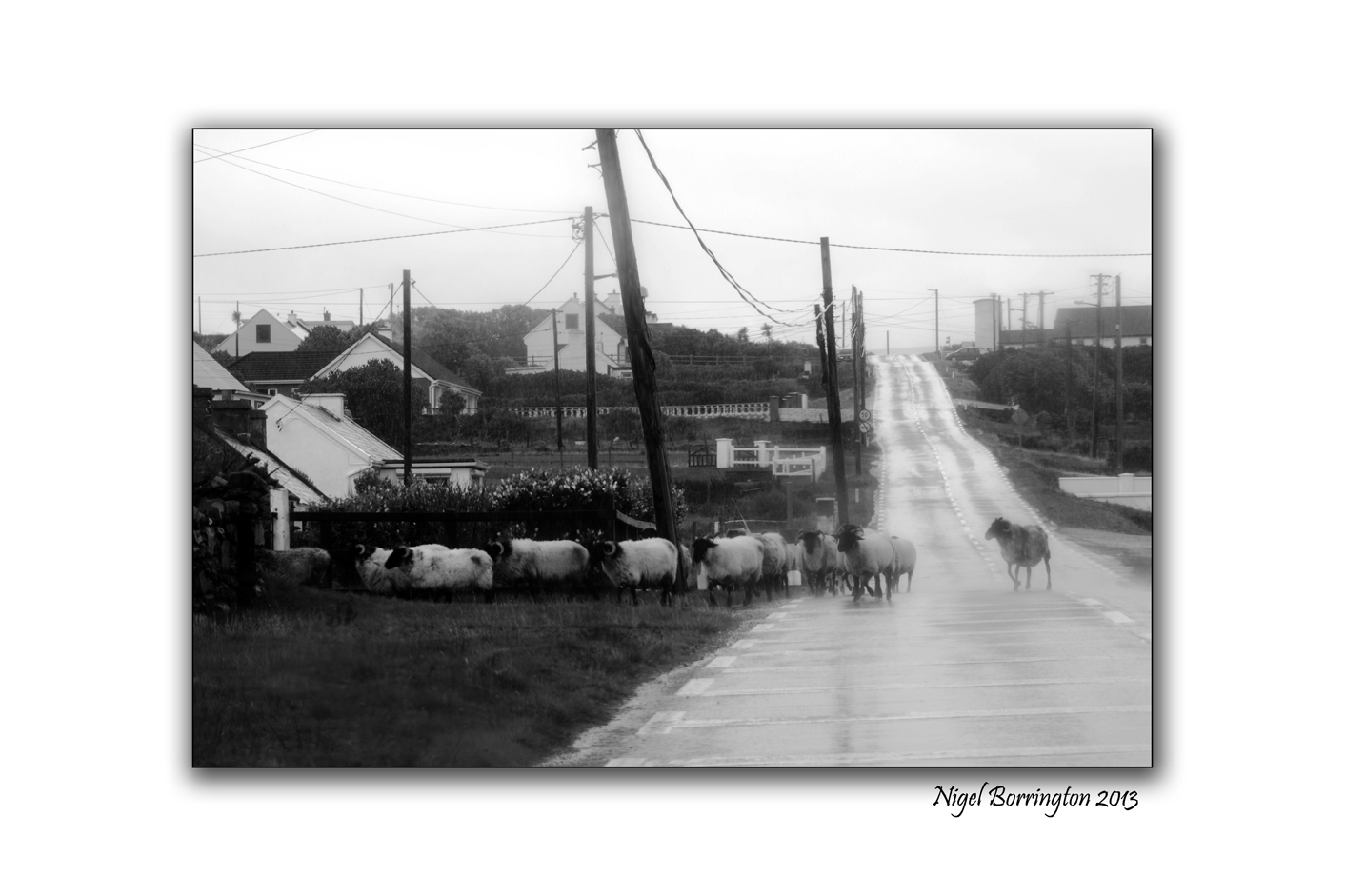
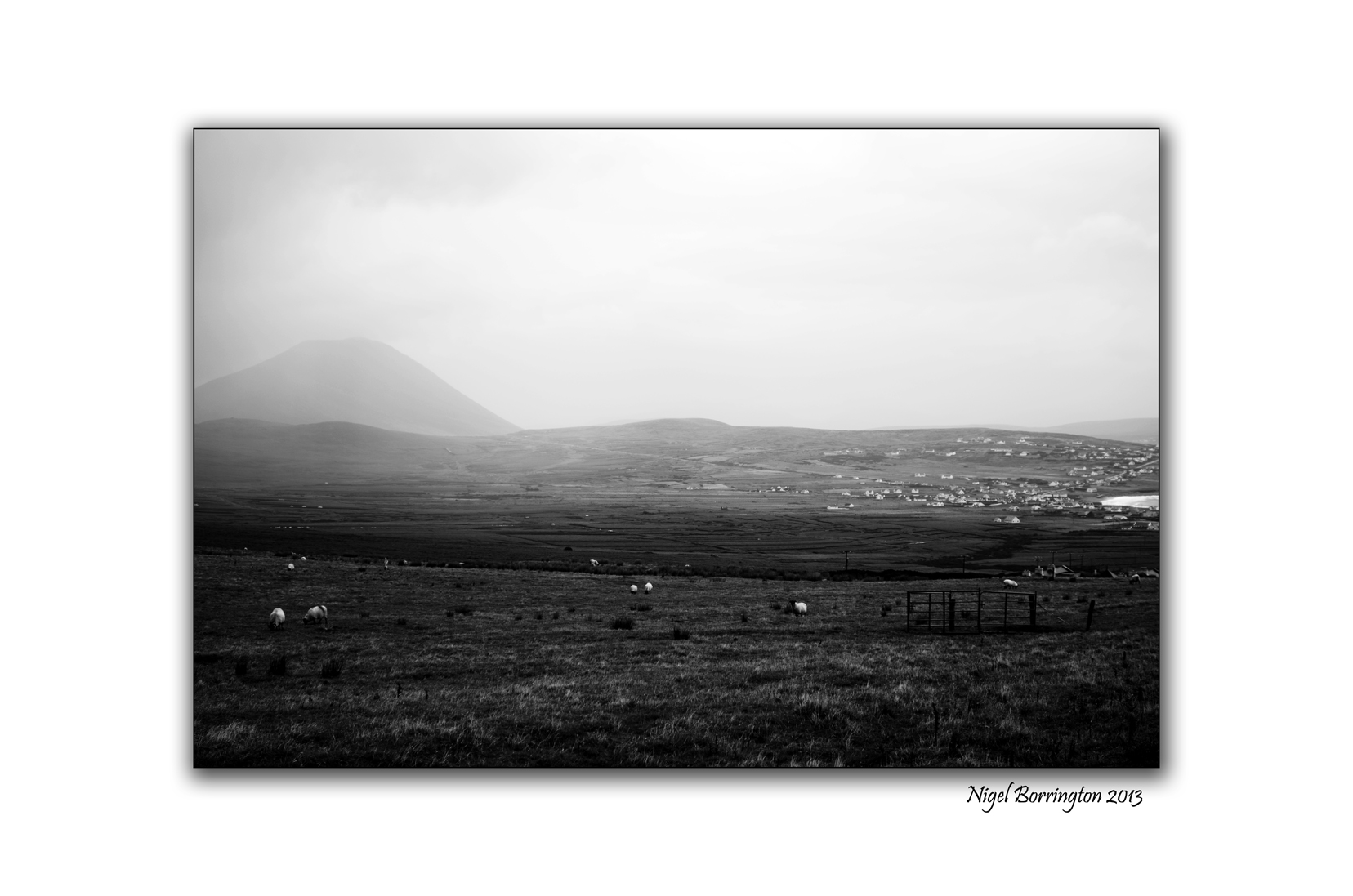

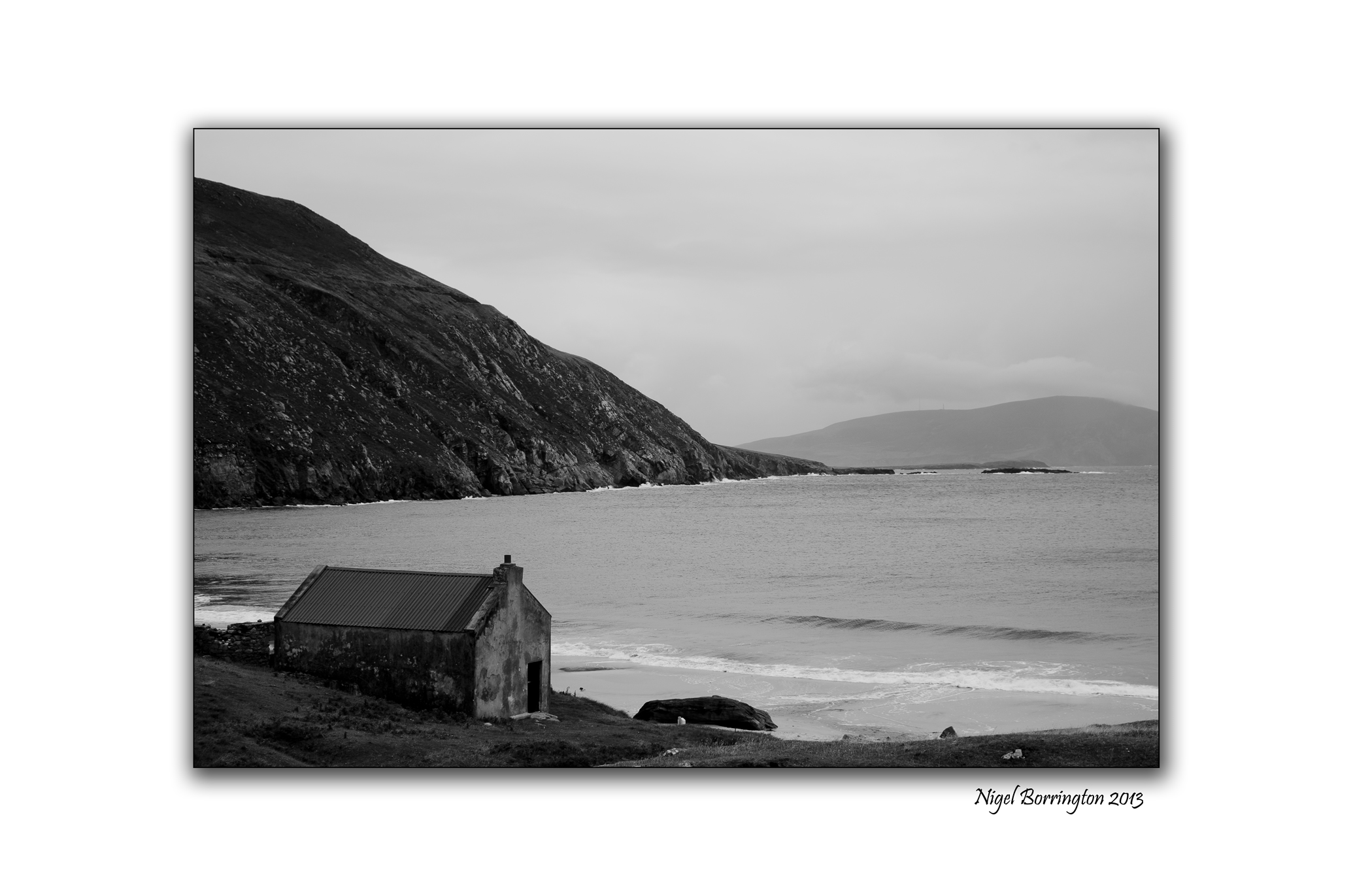

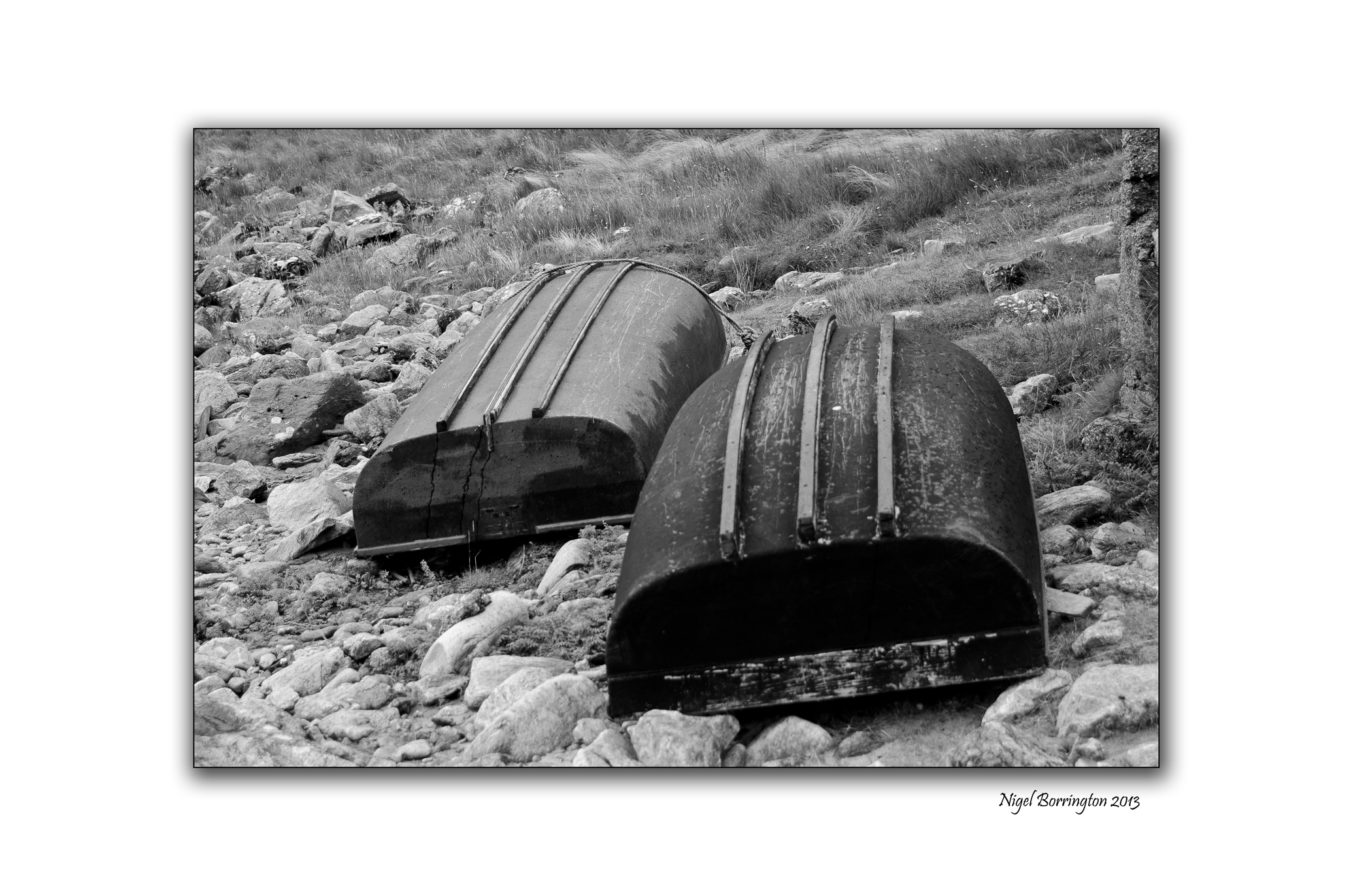
All images taken on a Nikon D7000, set to black and white and in September 2011….
Feel free to add some comments !
Dandelion
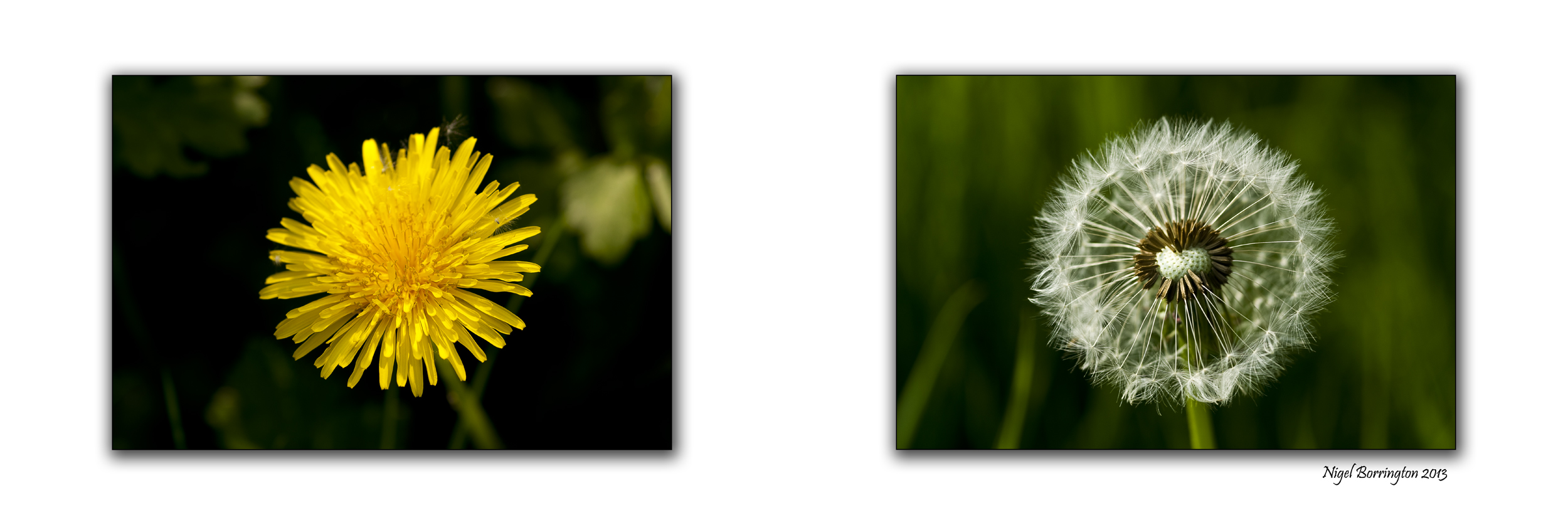
The Dandelion
The Dandelion has to be one of the most available of natures plants and flowers during the summer, but according to the following article it can be used as a very effective drug:
By Peter Gail
Suppose your doctor tells you, on your next visit, that he has just discovered a miracle drug which, when eaten as a part of your daily diet or taken as a beverage, could, depending on the peculiarities of your body chemistry: prevent or cure liver diseases, such as hepatitis or jaundice; act as a tonic and gentle diuretic to purify your blood, cleanse your system, dissolve kidney stones, and otherwise improve gastro-intestinal health; assist in weight reduction; cleanse your skin and eliminate acne; improve your bowel function, working equally well to relieve both constipation and diarrhea; prevent or lower high blood pressure; prevent or cure anemia; lower your serum cholesterol by as much as half; eliminate or drastically reduce acid indigestion and gas buildup by cutting the heaviness of fatty foods; prevent or cure various forms of cancer; prevent or control diabetes mellitus; and, at the same time, have no negative side effects and selectively act on only what ails you. If he gave you a prescription for this miracle medicine, would you use it religiously at first to solve whatever the problem is and then consistently for preventative body maintenance?
All the above curative functions, and more, have been attributed to one plant known to everyone, Taraxacum officinale, which means the “Official Remedy for Disorders.” We call it the common dandelion. It is so well respected, in fact, that it appears in the U.S. National Formulatory, and in the Pharmacopeias of Hungary, Poland, Switzerland, and the Soviet Union. It is one of the top 6 herbs in the Chinese herbal medicine chest.
According to the USDA Bulletin #8, “Composition of Foods” (Haytowitz and Matthews 1984), dandelions rank in the top 4 green vegetables in overall nutritional value. Minnich, in “Gardening for Better Nutrition” ranks them, out of all vegetables, including grains, seeds and greens, as tied for 9th best. According to these data, dandelions are nature’s richest green vegetable source of beta-carotene, from which Vitamin A is created, and the third richest source of Vitamin A of all foods, after cod-liver oil and beef liver! They also are particularly rich in fiber, potassium, iron, calcium, magnesium, phosphorus and the B vitamins, thiamine and riboflavin, and are a good source of protein.
These figures represent only those published by the USDA. Studies in Russia and Eastern Europe by Gerasimova, Racz, Vogel, and Marei (Hobbs 1985) indicate that dandelion is also rich in micronutrients such as copper, cobalt, zinc, boron, and molybdenum, as well as Vitamin D.
Much of what dandelions purportedly do in promoting good health could result from nutritional richness alone. Vogel considers the sodium in dandelions important in reducing inflammations of the liver. Gerasimova, the Russian chemist who analyzed the dandelion for, among other things, trace minerals, stated that “dandelion [is] an example of a harmonious combination of trace elements, vitamins and other biologically active substances in ratios optimal for a human organism” (Hobbs 1985).
Recent research, reported in the Natural Healing and Nutritional Annual, 1989 (Bricklin and Ferguson 1989) on the value of vitamins and minerals indicates that:
* Vitamin A is important in fighting cancers of epithelial tissue, including mouth and lung;
* Potassium rich foods, in adequate quantities, and particularly in balance with magnesium, helps keep blood pressure down and reduces risks of strokes;
* Fiber fights diabetes, lowers cholesterol, reduces cancer and heart disease
risks, and assists in weight loss. High fiber vegetables take up lots of room, are low in calories, and slow down digestion so the food stays in the stomach longer and you feel full longer;
* Calcium in high concentrations can build strong bones and can lower blood pressure;
* B vitamins help reduce stress.
Throughout history, dandelions have had a reputation as being effective in promoting weight loss and laboratory research indicates that there is some support for this reputation. Controlled tests on laboratory mice and rats by the same Romanians indicated that a loss of up to 30% of body weight in 30 days was possible when the animals were fed dandelion extract with their food. Those on grass extract lost much less. The control group on plain water actually gained weight.
Beyond nutritional richness, however, are the active chemical constituents contained in dandelions which may have specific therapeutic effects on the body. These include, as reported by Hobbs (1985):
* Inulin, which converts to fructose in the presence of cold or hydrochloric acid in the stomach. Fructose forms glycogen in the liver without requiring insulin, resulting in a slower blood sugar rise, which makes it good for diabetics and hypoglycemics;
* Tof-CFr, a glucose polymer similar to lentinan, which Japanese researchers have found to act against cancer cells in laboratory mice; Lentinan is a yeast glucan (glucose polymer) that increases resistance against protozoal and viral infections.;
* Pectin, which is anti-diarrheal and also forms ionic complexes with metal ions, which probably contributes to dandelion’s reputation as a blood and gastrointestinal detoxifying herb. Pectin is prescribed regularly in Russia to remove heavy metals and radioactive elements from body tissues. Pectin can also lower cholesterol and, combined with Vitamin C, can lower it even more. Dandelion is a good source of both Pectin and Vitamin C;
* Coumestrol, an estrogen mimic which possibly is responsible, at least in part, for stimulating milk flow and altering hormones;
* Apigenin and Luteolin, two flavonoid glycosides which have been demonstrated to have diuretic, anti-spasmodic, anti-oxidant and liver protecting actions and properties, and also to strengthen the heart and blood vessels. They also have anti-bacterial and anti-hypoglycemic properties, and, as estrogen mimics, may also stimulate milk production and alter hormones;
* Gallic Acid, which is anti-diarrheal and anti-bacterial;
* Linoleic and Linolenic Acid, which are essential fatty acids required by the body to produce prostaglandin which regulate blood pressure and such body processes as immune responses which suppress inflammation. These fatty acids can lower chronic inflammation, such as proliferative arthritis, regulate blood pressure and the menstrual cycle, and prevent platelet aggregation;
* Choline, which has been shown to help improve memory;
*Several Sesquiterpene compounds which are what make dandelions bitter. These may partly account for dandelions tonic effects on digestion, liver, spleen and gall bladder, and are highly anti-fungal;
* Several Triterpenes, which may contribute to bile or liver stimulation;
* Taraxasterol, which may contribute to liver and gall bladder health or to hormone altering.
These chemicals, individually, are not unique to dandelions, but the combination of them all in one plant, along with high levels of vitamins, minerals, carbohydrates, proteins and fiber account for the many claims made regarding the plant.
These claims include the following results of clinical and laboratory research, again as reported in Hobbs (1985):
* A doubling of bile output with leaf extracts, and a quadrupling of bile output with root extract. Bile assists with the emulsification, digestion and absorption of fats, in alkalinizing the intestines and in the prevention of putrefaction. This could explain the effectiveness of dandelion in reducing the effects of fatty foods (heartburn and acid indigestion);
* A reduction in serum cholesterol and urine bilirubin levels by as much as half in humans with severe liver imbalances has been demonstrated by Italian researchers;
* Diuretic effects with a strength approaching that of the potent diuretics Furosemide and Lasix, used for congestive heart failure and cirrhosis of the liver, with none of the serious side effects, were found by Romanian scientists. They found that water extract of dandelion leaves, administered orally, because of its high potassium content, replaced serum potassium electrolytes lost in the urine, eliminating such side effects common with the synthetics as severe potassium depletion, hepatic coma in liver patients, circulatory collapse, and transmission through mothers’ milk;
* In 1979 a Japanese patent was filed for a freeze-dried warm water extract of dandelion root for anti-tumor use. It was found that administration of the extract markedly inhibited growth of particular carcinoma cells within one week after treatment;
* Dental researchers at Indiana University in 1982 used dandelion extracts in antiplaque preparations;
* In studies from 1941 to 1952, the French scientist Henri Leclerc demonstrated the effectiveness of dandelion on chronic liver problems related to bile stones. He found that roots gathered in late summer to fall, when they are rich in bitter, white milky latex, should be used for all liver treatments;
* In 1956, Chauvin demonstrated the antibacterial effects of dandelion pollen, which may validate the centuries old use of dandelion flowers in Korean folk medicine to prevent furuncles (boils, skin infections), tuberculosis, and edema and promote blood circulation.
Also, Witt (1983) recommends dandelion tea to alleviate the water buildup in PMS (pre-menstrual syndrome).
There are many testimonials from those who have benefited from the use of dandelions in the treatment of what ailed them.
Robert Stickle, an internationally famous architect, was diagnosed as having a malignant melanoma 21 years ago, and was given, after radical surgery had not halted its spread, less than 2 years to live. He said, in a letter to Jeff Zullo, president of the Society for the Promotion of Dandelions, (June 23, 1986):
” I went on a search for the answer to my mortal problem, and [discovered] that perhaps it was a nutritional dilemma…. To me, cancer is primarily a liver failure manifestation. {Italians are very concerned about problems of the ‘fegato’]. [I discovered that] the cancer rate in native Italians is very low among the farming population (paesanos). When they get affluent and move to the city, its the same as the rest of civilized man. Paesanos eat dandelions, make brew from the roots, and are healthy, often living to over 100 years.”
He states that he began eating dandelion salad every day, and his improvement confounded the doctors. When he wrote the letter in 1986, 18 years had passed and there had been no recurrence of the melanoma.
Molly, well she should have been an Otter…

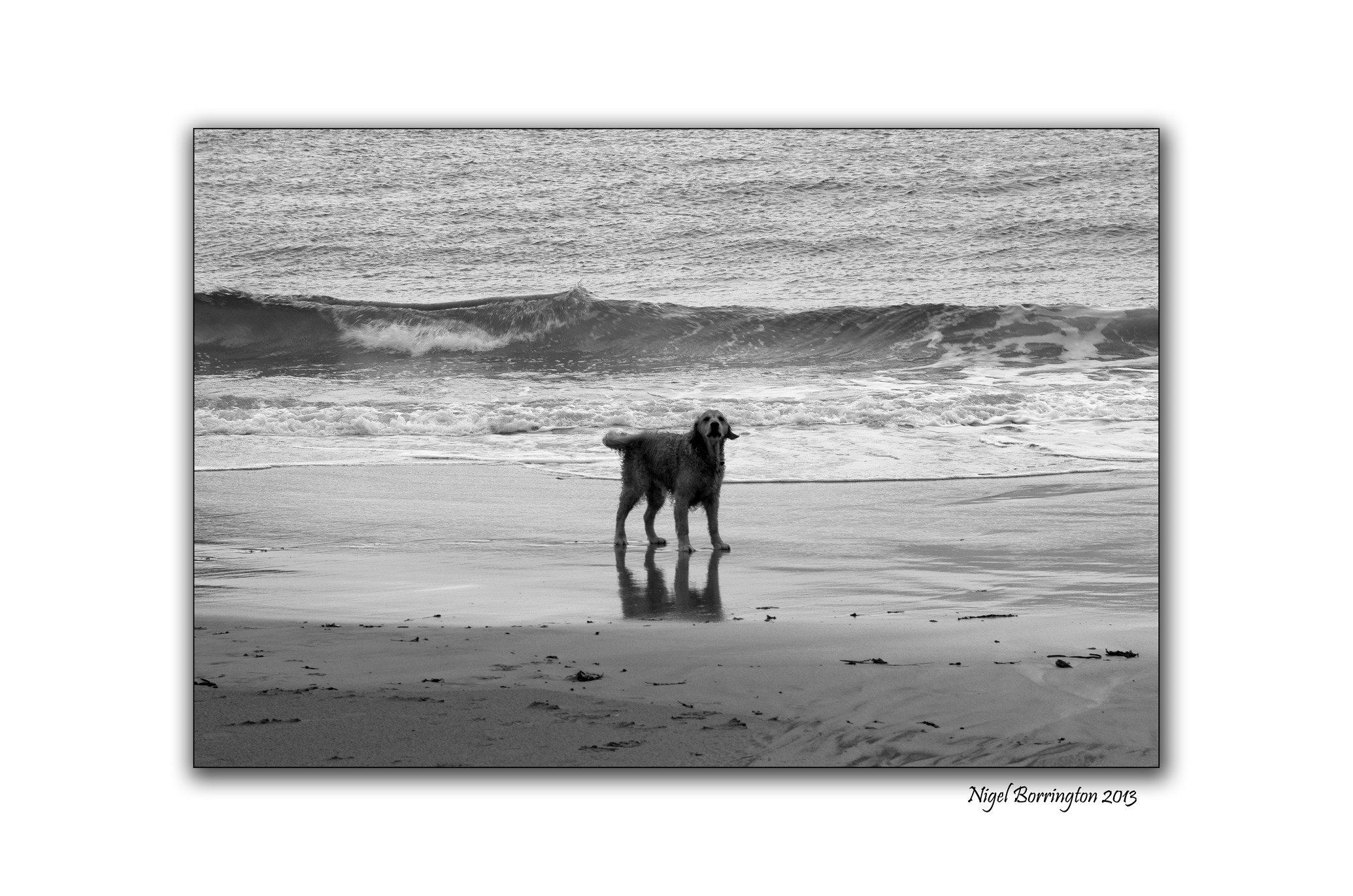
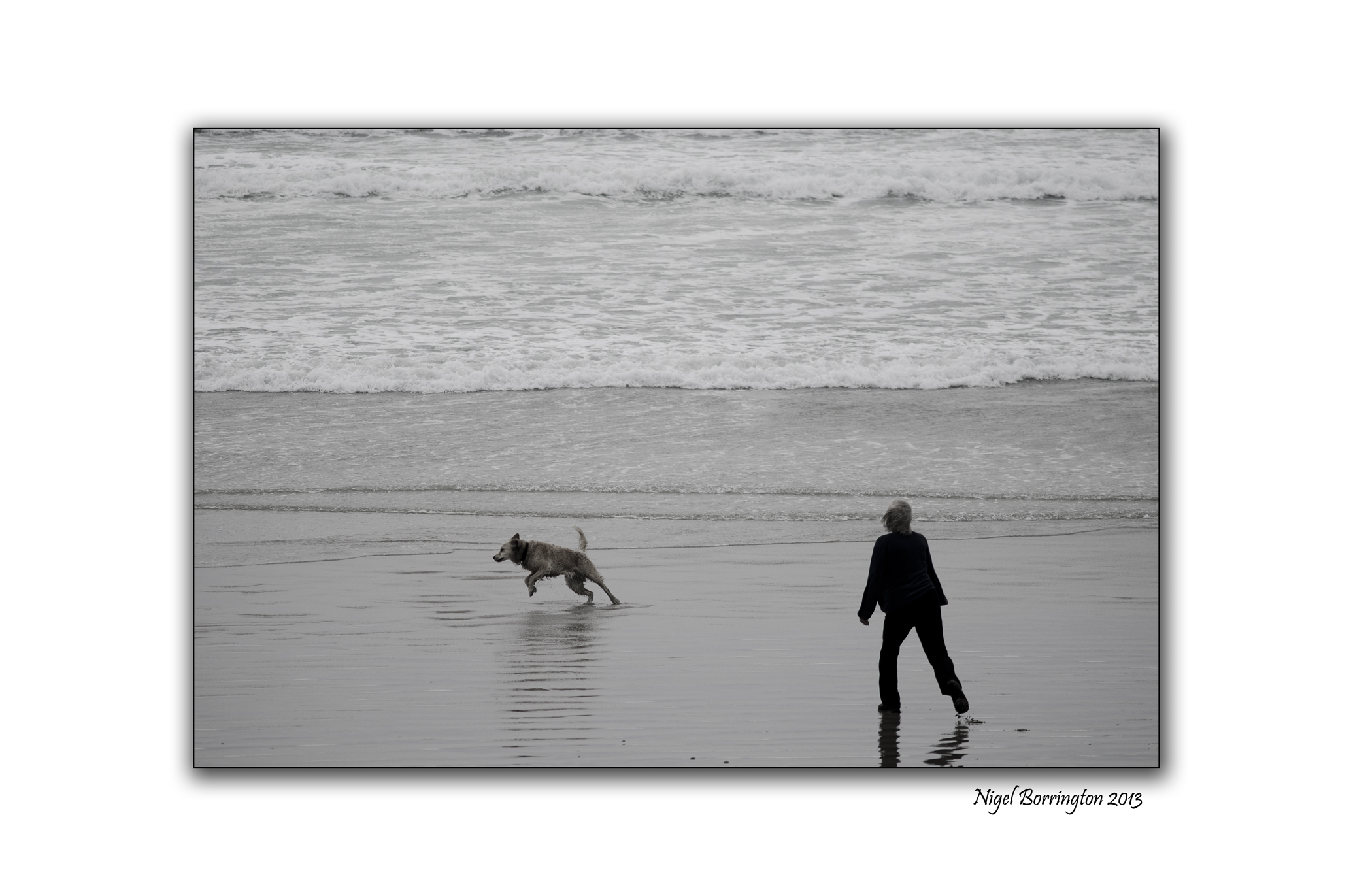
Molly Our Golden retriever just loves to swim, since she was about one year old she is just mad for the water.
If we go for a walk with her and it has not included a dip then she will sit in the boot of the car looking at us as if to say “What about the swim then?”.
I have often wondered just why this is such a strong part of her nature:

Well I found this article on the Pedigree website and it helps in understanding why Golden’s love water, and offers advice if you have a Golden retriever…
Golden Retrievers: Born to Swim
We’ve all seen the Golden Retriever at the beach who chases the tennis ball into the surf for hours. We wonder how he is able to get past the breakers, swim with his head above the chop, and manage the strong currents, focused only on getting that ball and dropping it at the feet of his owner.
The answer is in his DNA. Goldens were bred in Scotland in the mid-19th Century to retrieve waterfowl and game birds. The now-extinct Tweed Water Spaniel was crossed with Irish Setters, Newfoundland dogs, Bloodhounds, and other water retrievers to create the breed we know today. The result is a strong, highly trainable dog with a water-repellent coat that can easily withstand cold water.
Taking the plunge with your favorite Golden
You’ve probably noticed your retriever’s excitement as he gets near water. His instinctive love of water is so strong, trying to hold him back rarely works-so why not join him? Just keep these water safety tips in mind:
If you’re swimming with your Golden near the ocean, remember that he’s probably ingesting some salt water. Carry an ample supply of fresh water for him to drink so he doesn’t become dehydrated during play.
If your Golden is playing with children in a pool or lake, remind them not to hang onto his collar or drag him down. While he’s a stronger swimmer than most children, there is a risk of him getting pulled under.
Remember, cold water is not the deterrent to your Golden Retriever that it is to you. He could jump into frigid waters, and if he can’t get out, this could spell trouble. Leashing your Golden near deep water is a good idea.
Take these few precautions and you can expect years of enjoyment watching your Golden do what he does best-swim effortlessly and endlessly through the water!
This old white Bog pony
This set of images was taken at (Derryhick, Co.Mayo) above Derryhick lake – where we were staying for a week, I was out walking Molly our Golden retriever when we passed a field on our left.
I noticed this old white Bog pony way in the distance and she really took my attention so here she is, I have come back in my mind to this moment a lot for some reason as I hope she’s good and still walking this amazing landscape.


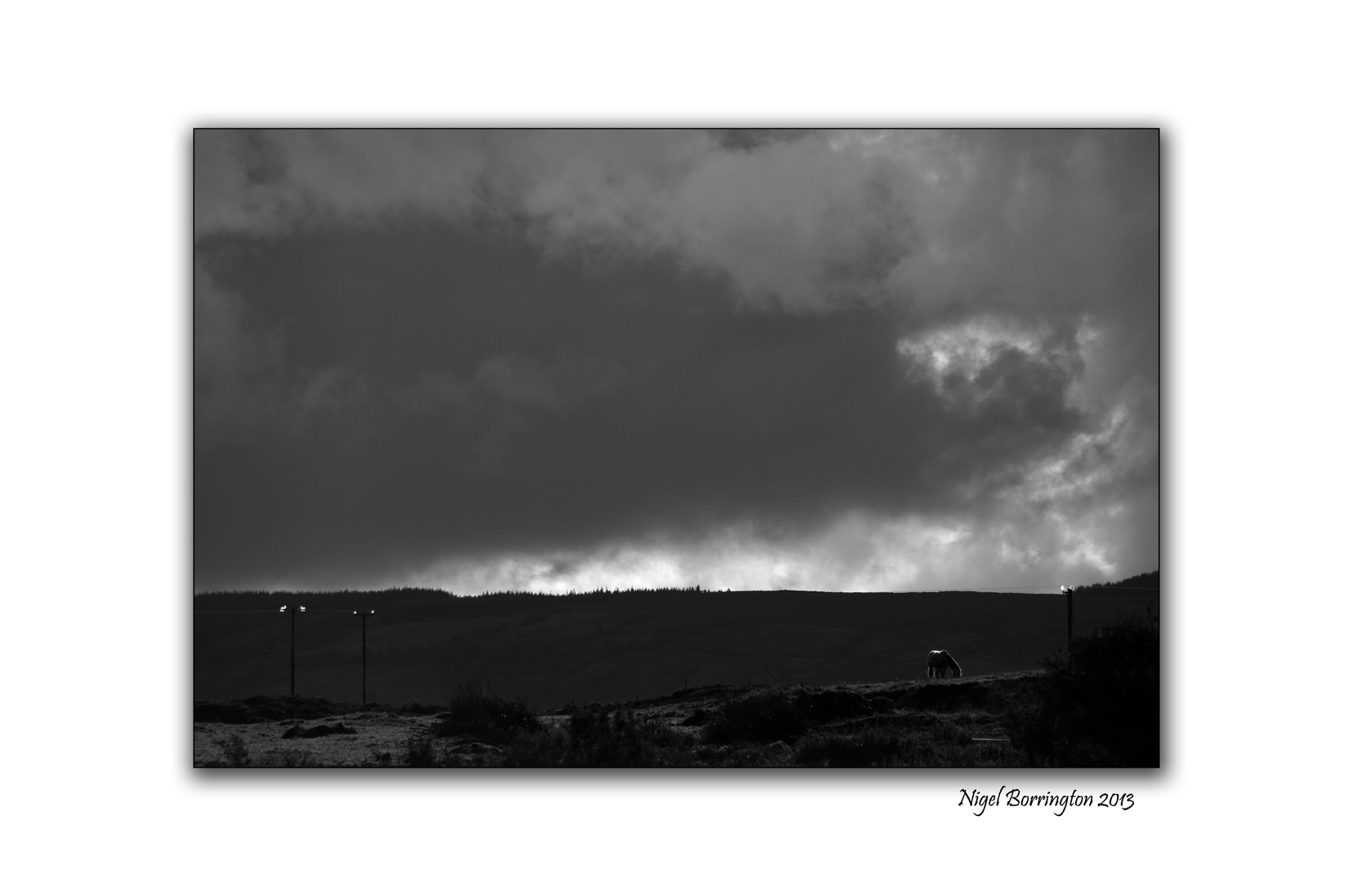
Nikon D7000
Landscape images : Nigel borrington
I walk at the lands edge

Nikon D700
Poem by : Kathleen Jamie
I walk at the land’s edge,
turning in my mind
a private predicament.
Today the sea is indigo.
Thirty years an adult –
same mind, same
ridiculous quandaries –
but every time the sea
appears differently: today
a tumultuous dream,
flinging its waves ashore –

Nikon D700
Nothing resolved,
I tread back over the bog
– but every time the bog
appears differently: this evening,
tufts of bog-cotton
unbutton themselves in the wind
– and then comes the road
so wearily familiar
the old shining road
that leads everywhere

Nikon D700
.
Its the Weekend …..
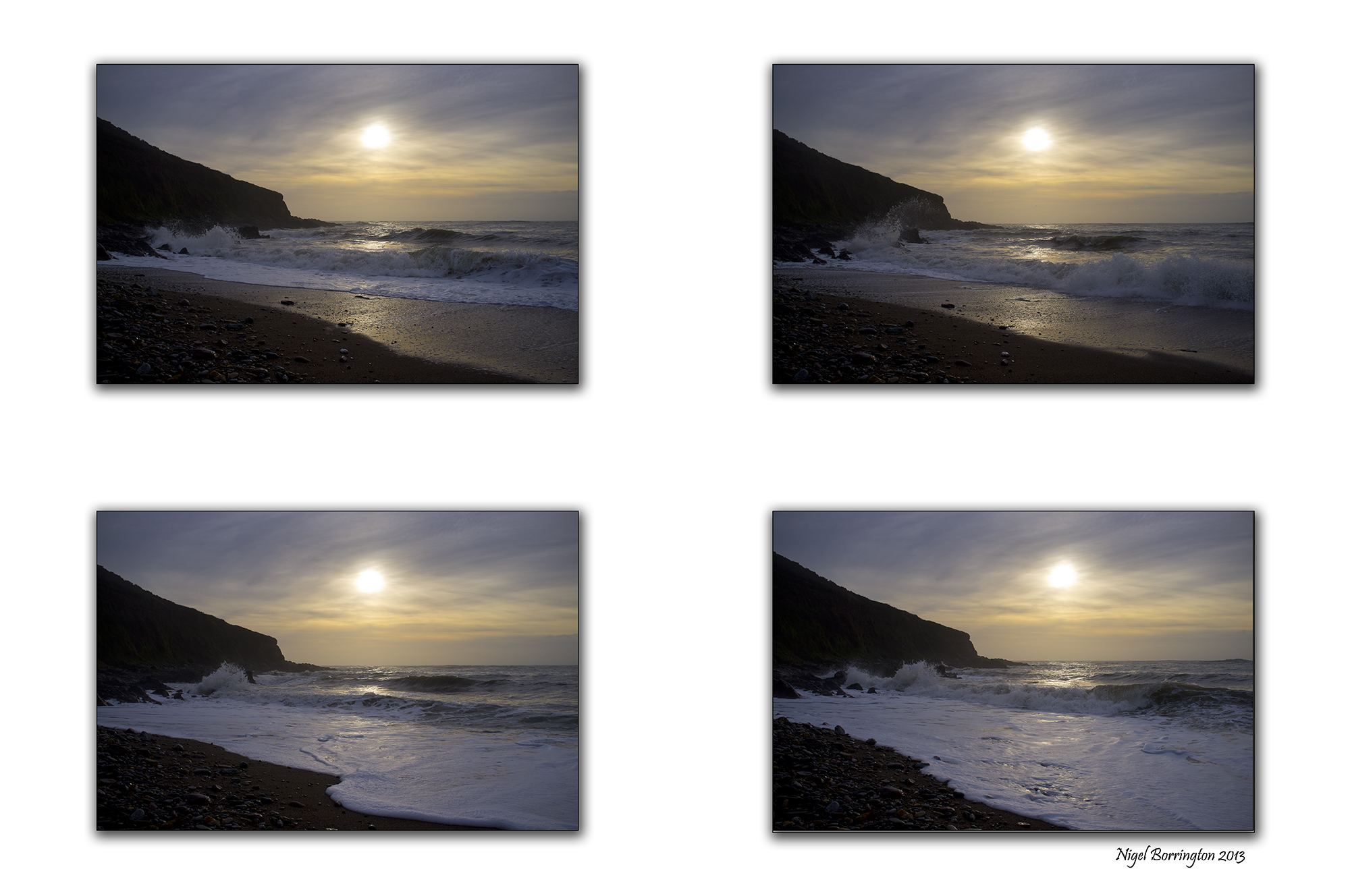
FujiFilm X100
Glenbeg, Co.Cork
Landscape and Seascape photography : Nigel Borrington
Its the weekend so if you can find a beach, watch the waves roll in and relax….
Empty Old Houses.
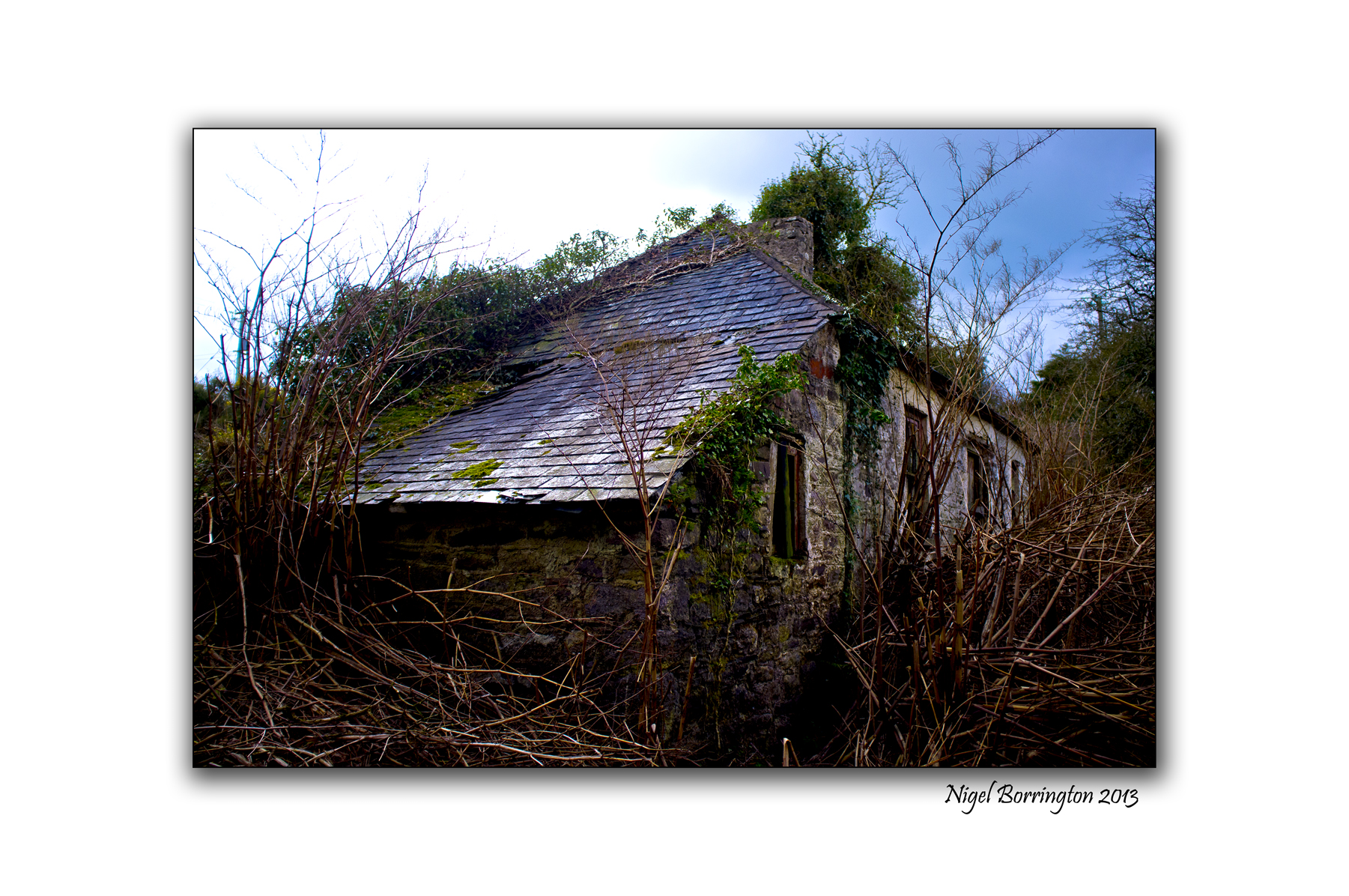
Fuji Film X100
By : David Whalen
Empty old houses can talk…
But one must know how to listen…
to hear them
Empty old houses have stories…
But one must be eager to listen…
to hear them
Empty old houses can suffer..
But one must have empathy …
To feel it
Empty old houses can feel pain
But one must be able to bear it …
To feel it
Empty old houses have memories
But one must believe … that they have…
To share them
Empty old houses contain people’s lives
But one must believe…that they do…
To share them
Empty old houses can seem dead and deserted
But one must know that they’re not..
To know them
Empty old houses can teem with life’s pleasures
But one must walk through
to sense the aura of life
Empty old houses abound in life’s treasures
But one cannot help but…
To admire them
The Vikings in Ireland
A couple of years back I was asked to create some images for a group of Co.Kerry based Re-enactors and they selected the Vikings as there historic period, this shoot was great fun to do for the day. We selected the remains and grounds of an old church yard and this worked very well.
I have posted some history of the Vikings in Ireland at the bottom of the images.
Nigel


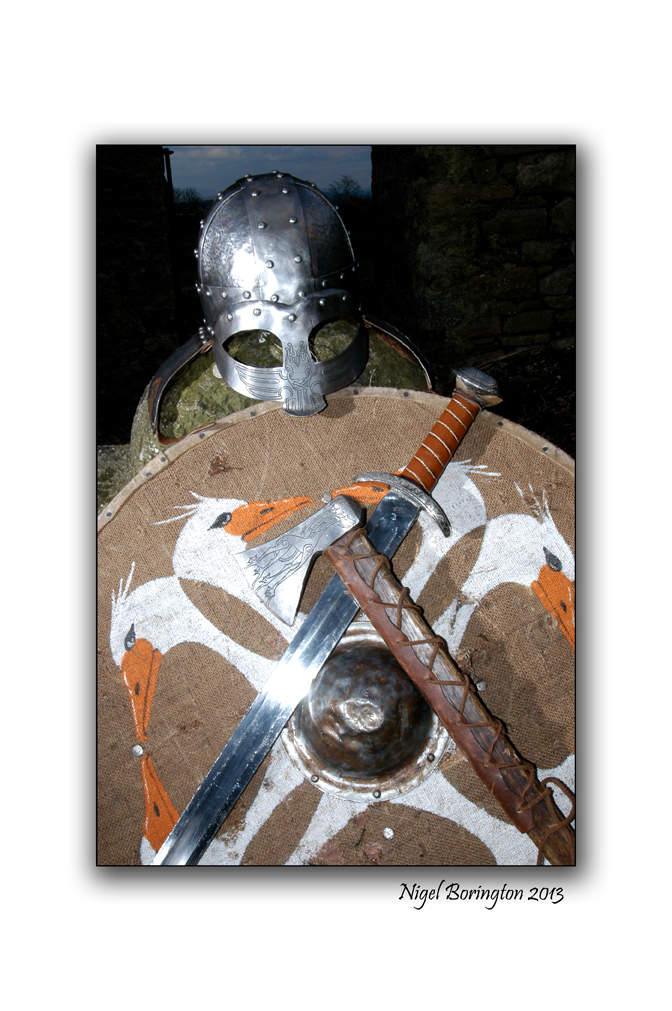
At the end of the eighth century the first Viking raiders appeared in Irish waters. These raiders came exclusively from Norway. The first recorded raid was in 795 on Rathlin Island off the coast of Antrim where the church was burned. On the west coast the monasteries on Inismurray and Inisbofin were plundered possibly by the same raiders. The Scottish island of Iona was also attacked in the same year.
For the first four decades, 795-c.836, the raids followed a clear pattern of hit-and -run affairs by small, probably independent, free-booters. Attacks were usually on coastal targets no Viking raid is recorded for areas further inland than about twenty miles. These attacks were difficult to defend but the Vikings were sometimes defeated. In 811 a raiding party was slaughtered by the Ulaid and the following year raiding parties were defeated by the men of Umall and the king of Eóganacht Locha Léin. By 823 the Vikings had raided around all the coast and in 824 the island monastery of Sceilg, off the Kerry coast, was attacked. The monastic city of Armagh was attacked three times in 832.
In the first quarter century of Viking attacks only twenty-six plunderings by Vikings are recorded in the Irish Annals. During the same time eighty-seven raids by the Irish themselves are recorded. An average of one Viking raid a year can have caused no great disorder or distress in Irish society. Attacks on Irish monasteries were common before the Viking Age. The burning of churches also was an integral part of Irish warfare. Wars and battles between monasteries also occurred in Ireland before the coming of the Vikings. Irish monasteries had become wealthy and politically important with considerable populations. The Vikings attacked the monasteries because they were rich in land, stock and provisions. They also took valuable objects but this was not their primary concern.
Intensified Raids and Settlements
From c. 830 Viking raids became more intense in Ireland. In 832 for instance, there were extensive plunderings in the lands of the Cianachta who lived near the sea in Louth. In 836 the Vikings attacked the land of the Uí Néill of southern Brega and attacked the lands of Connacht. In 837 a fleet of sixty ships appeared on the Boyne and a similar fleet on the Liffey. Soon afterwards Vikings made their way up the Shannon and the Erne and put a fleet on Lough Neagh.
The Vikings wintered for the first time on Lough Neagh in 840-41. In 841 they established a longphort at Annagassan in Louth and at Dublin and used these bases for attacks on the south and west. They wintered for the first time at Dublin in 841-842 and in 842 another large fleet arrived. Also in this year there is the first reference to co-operation between Vikings and the Irish though this may have occurred previously. A fleet was based on Lough Ree and the Shannon and built a fortified position on the shores of Lough Ree from where they ravaged the surrounding countryside in 844. Máel Seachnaill, overking of the Uí Néill attacked the Vikings, captured a leader called Turgesius and drowned him in Lough Owel in Westmeath.
From now on Irish kings began to fiercely fight back against the Vikings. Because they now had fixed settlements or fortified positions they were vulnerable to attack. Máel Seachnaill routed a Viking force near Skreen, County Meath and killed 700 of them. At Castledermot, in Kildare, the joint armies of the kings of Munster and Leinster defeated a large force of Vikings. The newly founded Viking settlement at Cork was destroyed and in 849 the Norse territory of Dublin was ravaged by Máel Seachnaill. The Vikings were now a factor in the internal politics of Ireland and were accepted as such. Norse-Irish alliances became commonplace.
During the years 849-852 new Vikings, probably from Denmark, arrived in the Irish Sea area and many battles took place between the new arrivals and the more established Vikings. In 853 Olaf the White arrived in Dublin and with Ivar, another Viking, assumed sovereignity of the Viking settlement there. Along the Irish coast were other Viking settlements. Vikings at Waterford attacked the King of Osraige but were slaughtered in 860. There was a longphort settlement at Youghal which was destroyed in 866. In 887 the Limerick Vikings were slaughtered by Connachtmen and in 892 the Vikings of Waterford, Wexford and St. Mullins were defeated.
Ivar, joint king of Dublin died in 873 and there were struggles and division in Dublin for the next two decades. In 902 the kings of Brega and of Leinster combined again the Norse of Dublin and defeated them, destroyed their settlement and expelled them from Ireland. By his time extensive cultural assimilation had taken place between the Irish and the Norse. Olaf, king of Dublin in the middle of the ninth century was married to the daughter of Áed Finnliath, king of the northern Uí Néill. The Hiberno-Norse also had gradually become christianised. The annals in recording the death of Ivar in 872 said that “he rested in Christ”.
The Second Phase of Viking Attacks on Ireland
By the first decades of the tenth century opportunities for Vikings in Britain and the Europe were limited. It is not surprising that they chose to attack Ireland again. From 914 large fleets again began to attack Ireland, these Vikings came from those already settled elsewhere in Britain. Munster was ravaged widely in 915 and the king of Tara was defeated when he went to the aid of the Munstermen. The king of Leinster was killed in a battle with Vikings under the leadership of Sitric at Leixlip. The king of Tara was killed in a combined Irish attack on the Norse of Dublin in 919. For the next two decades the Norse kings of Dublin were also trying to establish their power in York. Their activities in Ireland gradually became more confined to Dublin and its immediate hinterland. The Irish began to counter attack with growing success. Dublin was burned by the king of Tara in 936 and was sacked in 944. Its power had declined considerably by the second half of the tenth century.
The Wars of the Great Dynasties
One of the great leaders of this period was Brian Boru of Dál Cais in County Clare. He had defeated the Vikings of Munster. His great rival was Máel Sechnaill 2, King of Tara who had defeated the Norse of Dublin in 980. Brian at times made alliances with Norse as in 984 when the Norse of Waterford attacked Leinster by sea while he attacked by land. In 977 an agreement was made between Brian and Máel Sechnaill that the former would be king of the southern part of Ireland while the latter would be king of the northern part. In 998 the two kings co-operated in an attack on the Norse of Dublin.
A sculpture of Máel Seachnaill in Trim, Co. Meath, by James McKenna.
The next year the Dublin Norse allied with the Leinstermen revolted and were defeated by Brian. He spent January and February 1000 in Dublin, plundering the city and destroying its fortress. He expelled Sitric, king of Norse Dublin who could find refuge nowhere else in Ireland. He returned, gave hostages to Brian and was restored. Brian now claimed the kingship of the whole island and Máel Sechnaill submitted.
In 1012 Leinster revolted against Brian and the Norse of Dublin assisted them. Brian and Máel Sechnaill together attacked Leinster and blockaded the city of Dublin from September to Christmas before returning home. Knowing that the attack would be renewed the Norse set about getting help from allies. Sitric, king of Dublin visited Sigurd, earl of the Orkneys who agreed to be in Dublin on Palm Sunday 1014. Sitric then went to the Isle of Man and persuaded two Viking leaders Brodar and Ospak to support him.
Brian and Máel Sechnaill marched to Dublin but a dispute arose between them and Máel Sechnaill took no part in the battle. Battle was joined at Clontarf on Good Friday 1014 and after a long battle Brian’s forces were victorious. Brian himself was killed. Sigurd and Brodar were also killed though Sitric who remained inside the town during the battle survived.
In subsequent traditions, both Irish and Norse, Clontarf became a heroic battle of saga and story-telling. Fearsome portents and visions were said to have been seen by both sides on the eve of the battle. A fairy woman appeared to Brian’s followers and foretold disaster. Saint Senan appeared to Brian’s followers the night before the battle demanding compensation for an attack by Brian on a monastery years before. In the Isle of Man there were ghostly assaults on Brodar’s ships and ravens with iron beaks and claws attacked his followers. Evil portents were seen throughout the Norse world even in Iceland. Everyone wished his ancestors to have participated in the great battle.
While the battle of Clontarf was not a simple Irish against Norse battle it did signal the end of the power of Norse Dublin and the effective end of the Viking Age in Ireland.
Sister and Brother
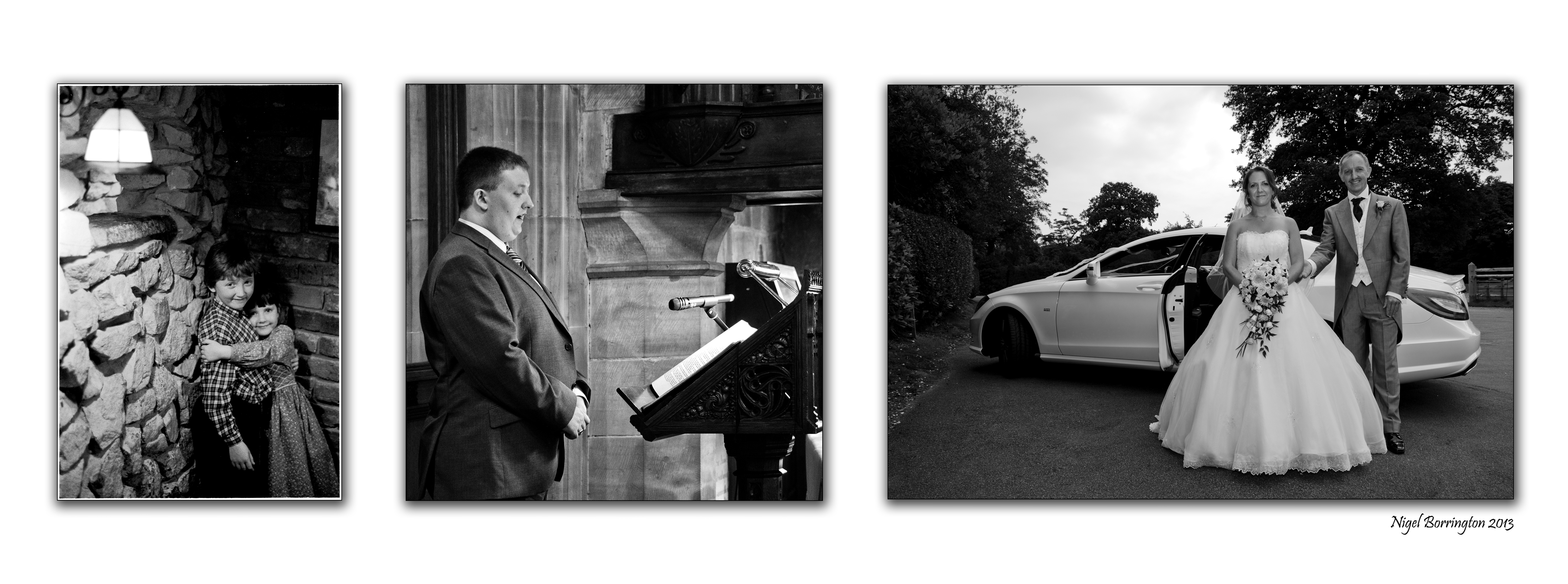
Sister and Brother
There is some 25 years between the photos here on the left and the two images on the right and these two characters are my niece and nephew, Louise and James.
I took the first image on a visit home to (Timperley, chesire) after I had moved to live in London some 3 years before.
The images on the right are the two of them at Louise’s wedding last year in Alderly edge, Chesire. I was asked to do the main photography for Louise and it was a pleasure…
Again I only found this image of the two of them on the left, while scanning some old films.
I hope they enjoy this set!
Nigel
Wild Garlic

Nikon D7000
I captured these photographs in Glenbawn Woods, Clonmel, Co Tipperary in April 2012, these woods are on the banks of the river Suir.
Wild Garlic grows very well in many Irish woodlands it needs a dark and wet part of the wood, In this wood part of the walk passed along the banks of the river. This area if covered with Garlic and the smell as you walk through the carpet of it is overpowering an wonderful. I took a large bag with me and collected enough to last me sometime.
Wild Garlic has been used throughout history as a health and healing food and it heals many complaints, this year I will be back again and its out very soon!
Ramsons Wild Garlic
(Allium ursinum)
Description:
Tall hairless perennial plant, with erect unbranched stem; usually found growing in large colonies. The leaves, normally 2, are upto 20cm long and are broad, pointed and long-stalked. The flowers are white star-shaped with 6 segments. It is readily identified by its strong scent of garlic, particularly if bruised or crushed.
The glossy green leaves of Ramsons, or Wild Garlic are delicious in sandwiches, used sparingly in salads, or added to sauces and dressings. It also makes splendid pesto. The bulb can also be eaten raw or cooked, and can be harvested all year round, though is best used when the plant is dormant from July to December or January. It has a fairly strong garlic flavour, though it is quite small and fiddly to harvest.
Flowers – raw or cooked. These are somewhat stronger than the leaves, in small quantities they make a decorative and very tasty addition to salads. The flowering heads can still be eaten as the seed pods are forming, though the flavour gets even stronger as the seeds ripen.
“maye very well be eaten in April and Maie with butter, of such as are of a strong constitution, and labouring men” – Gerard
Size: 50cm
Distribution: Throughout UK
Flowering months: April – June
Habitat: Damp woods, hedges, shady damp meadows, streamsides.
Folk Names: Broad-Leaved Garlic, Wild Garlic, Ramsons, Wood Garlic, Roman Garlic
Active ingredients; essential oils, vitamin C, allicin, iron.
Used to treat digestive problems, rheumatism, high blood pressure and asthma. When applied to the skin, this species is rubefacient. Externally, the bruised leaves may be applied to abscesses and boils. It may help the circulation and also be antiviral. A popular cure for the kidney stone and for purifying and strengthening the blood. Alone or with other ingredients it was also used in poultices and as a diuretic.
Ref : Wild Garlic
Five go up a hill and come down a mountain

Some time back Five of us (Breda, Tess, Andrew his brother Steve along with Myself) all headed from north London to Melfort Village, Argyll, Scotland for the week. At the time I owned a time share week here and the visit to such a wonderful location each March was more than welcome.
One Morning with myself and Steve both being into photography, the others just wanting a good walk we packed the bags and headed up the hills at the back of the Melford estate, the below images I hope do something to document this walk and the resulting Photographs.
I only found these pictures again last week as I am scanning all my old negatives….


All images taken on a Nikon F90x and on Kodak 200iso colour film as you can see…
Kilkenny Castle

Fujifilm X100
Landscape Photographer : Nigel Borrington
Over the years since I came to live in Kilkenny I have spend many hours in the grounds of this Castle, the above images are from just some of the times I have taken a camera with me and taken a few shots.
If you do visit Kilkenny, the Castle and its grounds just have to be on your list of places to visit…
Kilkenny Castle (Irish: Caisleán Chill Chainnigh) is a castle in Kilkenny, Ireland built in 1195 by William Marshal, 1st Earl of Pembroke to control a fording-point of the River Nore and the junction of several routeways. It was a symbol of Norman occupation and in its original thirteenth-century condition it would have formed an important element of the defences of the town with four large circular corner towers and a massive ditch, part of which can still be seen today on the Parade.
The property was transferred to the people of Kilkenny in 1967 for £50[1] and the castle and grounds are now managed by the Office of Public Works. The gardens and parkland adjoining the castle are open to the public. The Parade Tower is a conference venue. Awards and conferring ceremonies of the graduates of “Kilkenny Campus” of National University of Ireland, Maynooth have been held there since 2002.
Contents
Previous owners of the castle
Earls of Pembroke
Kilkenny Castle has been an important site since Richard de Clare, 2nd Earl of Pembroke, commonly known as Strongbow constructed the first castle, probably a wooden structure, in the 12th century. The Anglo-Normans had established a castle in 1173, possibly on the site of an earlier residence of the Mac Giolla Phádraig kings of Osraighe. Kilkenny formed part of the lordship of Leinster, which was granted to Strongbow. Strongbow’s daughter and heiress, Isabel married William Marshall in 1189. The Earl Marshall owned large estates in Ireland, England, Wales and France and managed them effectively. He appointed Geoffrey fitz Robert as seneschal of Leinster and so began a major phase of development in Kilkenny, including the construction of Kilkenny Castle and the agreement of rents and privileges with burgesses or citizens of the borough. The first stone castle on the site, was completed in 1213. This was a square-shaped castle with towers at each corner; three of these original four towers survive to this day
Butler dynasty
James Butler, 3rd Earl of Ormonde, bought the castle in 1391 and established himself as ruler of the area. The Butler dynasty then ruled the surrounding area for centuries. They were Earls, Marquesses and Dukes of Ormonde and lived in the castle for over five hundred years. Among the many notable, Lady Margaret Butler (c. 1454 or 1465–1539) the Irish noblewoman, the daughter Thomas Butler, 7th Earl of Ormond. Lady Margret Butler was born in Kilkenny Castle. She married Sir William Boleyn and was the paternal grandmother of Anne Boleyn, second wife of King Henry VIII of England.
The Castle became the seat to the very powerful family, the Butlers of Ormonde or Butler family, who lived there until 1935.
Kilkenny castle was the venue for the meeting of the General Assembly, or parliament, of the Confederate Ireland government in the 1640s.
The Irish State
The last member of the Butler family sold the castle to the local Castle Restoration Committee in the middle of the 20th century for £50. Shortly afterward it was handed over to the State, and has since been refurbished and is open to visitors. There are ornamental gardens on the city side of the castle, and extensive land and gardens to the front. It has become one of the most visited tourist sites in Ireland. Now a property in state care. Part of the National Art Gallery is on display in the castle.
History
Richard de Clare (also known as Strongbow) and other Norman knights came to Kilkenny in 1172, the high ground beside the River Nore was as an ideal site on which to build a wooden tower. He built a wooden castle of the type known as motte-and-bailey.
This strategic site was where the local Kings of Osraige had their chief residence before the Norman invasion.
Twenty years later, de Clare’s son-in-law, William Marshal, Earl of Pembroke, built the first stone castle on the site, of which three towers still remain.
The castle was owned by the seneschal of Kilkenny Sir Gilbert De Bohun who inherited the county of Kilkenny and castle from his mother in 1270, in 1300 he was outlawed by Edward I but was reinstated in 1303, he held the castle until his death in 1381. It was not granted to his heir Joan, but seized by the crown and sold to the Butler family.
Butlers of Ormond
The Castle became the seat to a very powerful family, the Butlers of Ormonde or Butler family. They were a remarkable family, resilient, politically astute and faithful to the crown and to Ireland. These loyalties determined their fortunes and career. The Butler family arrived in Ireland with the Norman invasion, and originally settled in Gowran. They changed their name from FitzWalter in 1185 to Butler. The family had become wealthy, and James Butler, 3rd Earl of Ormonde, bought the castle in 1391 and established himself as ruler of the area. The Butler dynasty then ruled the surrounding area for centuries.
By the 18th century, the castle had become run down, reflecting the failing fortunes of the Butler family. However, some restoration was carried out by Anne Wandesford of Castlecomer, who brought wealth back into the family upon marrying John Butler, 17th Earl of Ormonde.
In the 19th century, the Butlers then attempted to restore it to its original medieval appearance, also rebuilding the north wing and extending the south curtain wall. More extensions were added in 1854.
The Butler family remained living in the castle until 1935, when they sold its contents for £6,000, moved to London, and abandoned it for thirty years. The impact of rising taxes, death duties, economic depression and living costs had taken their toll. While the Ormondes had received £22,000 in rental income in the 1880s, investment income in the 1930s was in the region of £9,000 and by 1950 these investments yielded only £850. They disposed of the bulk of their tenanted estates in Tipperary and Kilkenny, 21,000 acres (85 km²), by 1915 for £240,000. Death duties and expenses following the death of James Butler, 3rd Marquess of Ormonde in 1919 amounted to £166,000.[2]
Auction Catalogue, 1935
In 1967, Arthur Butler, 6th Marquess and 24th Earl of Ormonde, sold the abandoned and deteriorating castle to the Castle Restoration Committee for £50, with the statement: “The people of Kilkenny, as well as myself and my family, feel a great pride in the Castle, and we have not liked to see this deterioration. We determined that it should not be allowed to fall into ruins. There are already too many ruins in Ireland.” He also bought the land in front of the castle from the trustees “in order that it should never be built on and the castle would be seen in all its dignity and splendour”. Mick Jagger and Marianne Faithfull turned up at the castle hand over party, with Jagger telling the newspapers “We just came to loon about
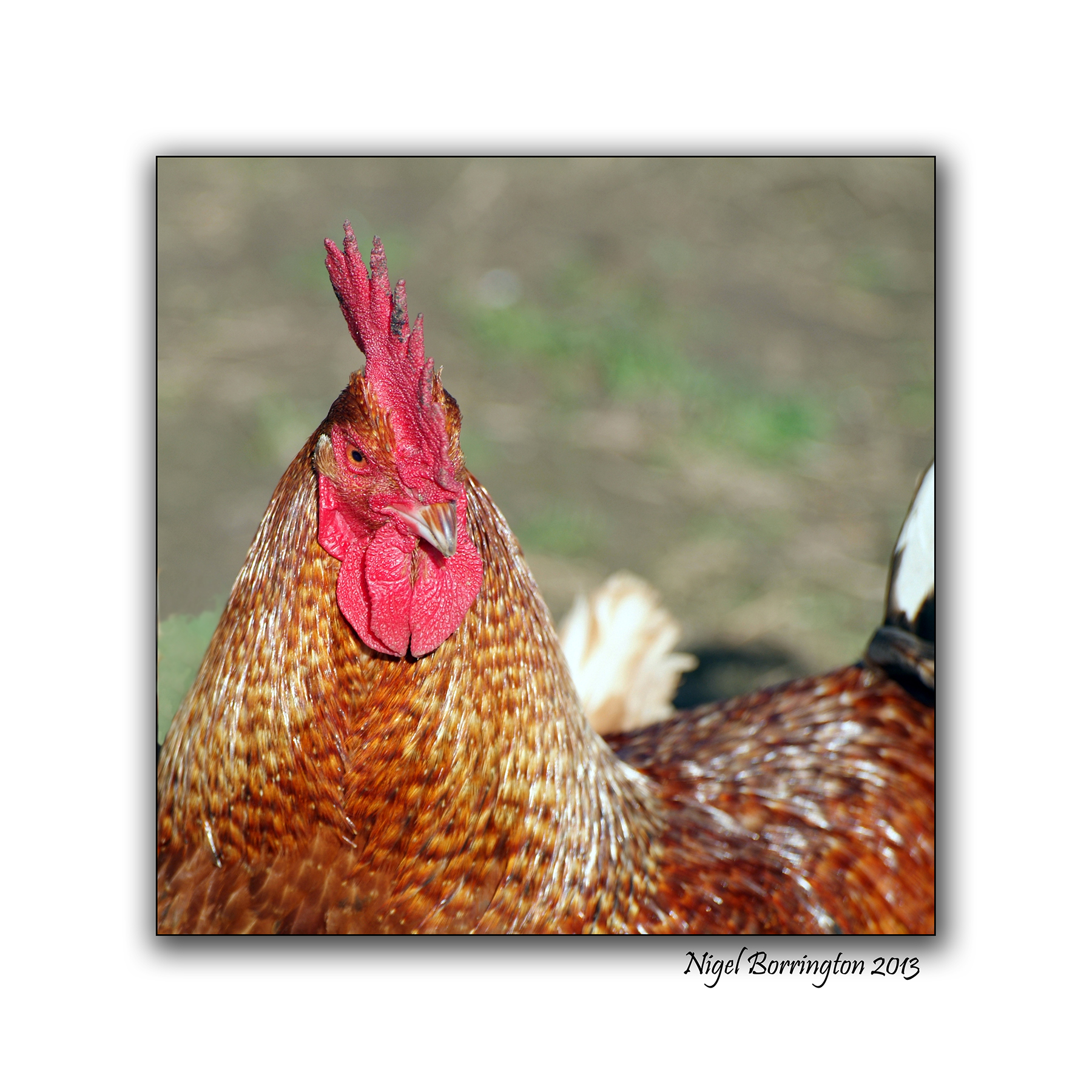
Good Morning Chicken !
Good Morning!
Every now and then we look after a friends farm house while they go on holiday. One of the biggest Jobs is putting the chickens away in the evening, having to collect up everyone of them and shut them in for the night is Great fun!!!
This job is balanced very well though when the next morning you have to let them out and give them some feed, they look very pleased to be set free for the day!

Fujifilm X100
Fujifilm X100
Windermere

A view of Windermere
Contax G2, 45mm lens
Kodak, iso 200 colour film
Landscape photographer : Nigel Borrington
Hook head Lighthouse

Hook head – Lighthouse, Nikon D7000
Back in 2011 I started a project of capturing photos and information about the history and lives of the Lighthouse keepers of Ireland.
I just want to share a small amount in this post.

This area is renowned as the location of Hook Lighthouse. Hook Head is the oldest lighthouse in Ireland, and one of the oldest in Europe still operating. In the 5th century St Dubhán set up a fire beacon on the headland as a warning to mariners. After his death his monks kept the beacon going for another 600 years. Between 1170 and 1184 the Normans built the present lighthouse. It was built from local limestone and burned lime mixed with ox’s blood. Even today traces of the blood-lime mix can be seen coming through the paintwork. The walls are 9 to 13 feet thick and 80 feet above the ground.[1] In 1665 King Charles II granted letters patent to Sir Robert Reading to erect six lighthouses on the coast of Ireland, one of which was at Hook Head on the site of the older lighthouse, the others being at Howth, one to mark the land, the other to lead over the bar; the Old Head of Kinsale, Barry Oge’s castle (now Charlesfort, near Kinsale), and the Isle of Magee.

Hookhead web cams
North view : http://www.teknet.ie/webcamNorth.html,
West view : http://www.teknet.ie/webcamWest.html
Video
I have posted this video before but its well worth doing so again, its a wonderful short film …..
The Lighthouse Keeper’s videos:
 Nigel Borrington
Its the weekend
Fuji X100
The Saltee Islands, St. George’s Channel
County Wexford,
Landscape photography:Nigel Borrington
Its the weekend so if you can find a place with a view and lose your self in it!!
April 27, 2013 | Categories: Comment, Landscape | Tags: Fuji X100, fujufilm x100, Irish landscape photography, Irish photography, Landscape, Saltee islands, wexford | 14 Comments