Sheeps bit – Wild flowers at the old slate quarry

Irish wild flowers
Sheeps bit
Slate quarry’s
County Kilkenny
Sheeps bit – Wild flowers
The Slate Quarry at (Ahenny, Windgap, Co. Kilkenny) is one of our best local locations for wild life and wild flowers – at this time of year. There are three or four old open quarry pits most of which now form small lakes, along with many heaps of slate that remained in place after all the good slate in the area had been removed. In the summer the lakes are used for swimming in.
I often visit and today I captured these blue sheep’s bit flowers at lunch time and they cover most of the tops of the old slate heaps. Natural blue wild flowers are one of natures rarest finds so it was a true pleasure to see such a large amount growing in one place.
Here are some details about these very special little plants ….
Sheep’s-bit
Scientific Name: Jasione montana
Irish Name: Duán na gcaorach
Family Group: Campanulaceae
Also known as Sheep’s-bit Scabious, the books say this is a rather variable plant and can easily be mistaken for a composite or a scabious, but theAlso known as Sheep’s-bit Scabious, the books say this is a rather variable plant and can easily be mistaken for a composite or a scabious, but the florets have a 5-toothed calyx and not a pappus. Also the anthers in this plant do not project – unlike those of Devil’s Bit Scabious. I hope this helps. It is a pretty little downy biennial which grows in rocky places, cliffs and heaths up to 40cm high. It has bright blue rounded flowers aggregated in a compact head (15-25mm) which is borne on a slender stem. Its leaves have wavy edges and are hairy, grey-green and short-stalked. The plant is on flower from May to September. This plant is a native and belongs to the family Campanulaceae.
I first identified this flower in Laragh, Co Wicklow in 1976 and photographed it in Glenmalure, Co Wicklow in 2006.
florets have a 5-toothed calyx and not a pappus. Also the anthers in this plant do not project – unlike those of Devil’s Bit Scabious. I hope this helps. It is a pretty little downy biennial which grows in rocky places, cliffs and heaths up to 40cm high. It has bright blue rounded flowers aggregated in a compact head (15-25mm) which is borne on a slender stem. Its leaves have wavy edges and are hairy, grey-green and short-stalked. The plant is on flower from May to September. This plant is a native and belongs to the family Campanulaceae.
I first identified this flower in Laragh, Co Wicklow in 1976 and photographed it in Glenmalure, Co Wicklow in 2006.
If you are satisfied you have correctly identified this plant, please submit your sighting to the National Biodiversity Data Centre
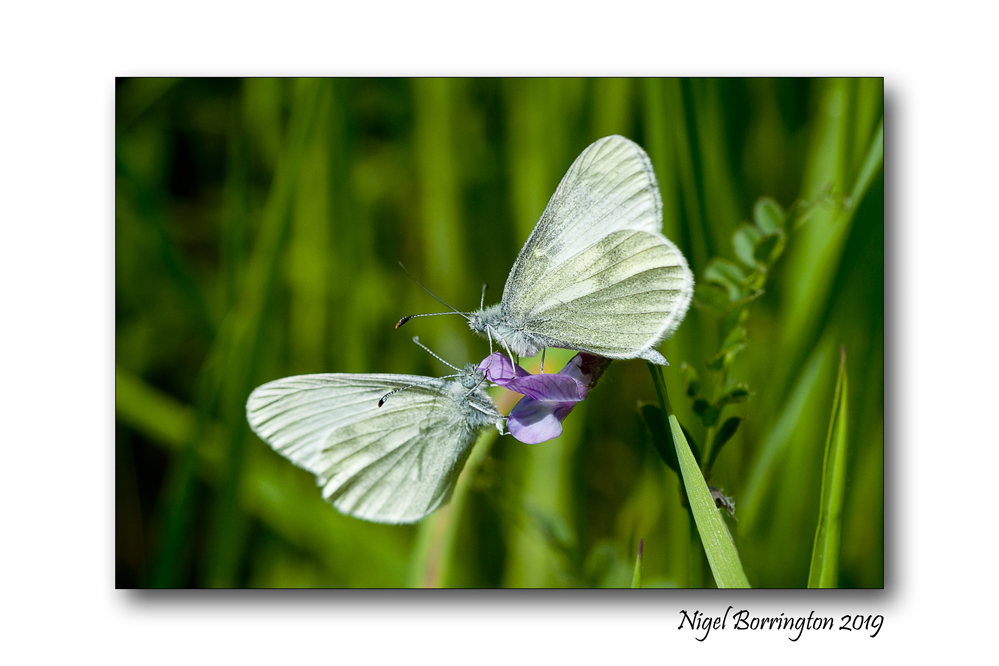
Irish Butterflies – Wood White Leptidea sinapis (lep-TID-ee-uh sy-NAY-piss)
Irish Butterflies
Wood White
Leptidea sinapis (lep-TID-ee-uh sy-NAY-piss)
It a pleasure to be into photography at this time of year, nature is in full flight and at her very best.
For many personal reasons I have no been posting regularly here on my blog for the first time in many years so it also a pleasure to be able to make a start again.
Last week I spent as much time as I could taking my much love Nikon and macro lens out into our local woodlands and capturing lots of nature images. Here is just one of the many images I managed to get the time to process so far.
Now that I am starting again to post here, I plan to be very specific this summer with my images and close-up nature images will be one of my main areas.

Wood White
Family: Pieridae Swainson, 1820
Subfamily: Dismorphiinae Schatz, 1887
Tribe: Leptideini Verity, 1947
Genus: Leptidea Billberg, 1820
Subgenus:
Species: sinapis (Linnaeus, 1758)
Wingspan 42mm
The Wood White is one of our daintiest butterflies with one of the slowest and delicate flights of all the butterflies. When at rest, the rounded tips of the forewings provide one of the main distinguishing features between this butterfly and other “whites”. Adults always rest with their wings closed. In flight, the male can be distinguished from the female by a black spot at the tip of the forewings that is greatly reduced in the female. This butterfly lives discrete colonies and was only recently separated from the visibly-identical Cryptic Wood White. This local species can be found in central and southern England and also in Ireland on the limestone pavements of Clare and South-east Galway. This species is absent from Scotland, the Isle of Man and the Channel Islands.
The River And The Hill – Poem by Henry Kendall

And they shook their sweetness out in their sleep
On the brink of that beautiful stream,
But it wandered along with a wearisome song
Like a lover that walks in a dream:
So the roses blew
When the winds went through,
In the moonlight so white and still;
But the river it beat
All night at the feet
Of a cold and flinty hill –
Of a hard and senseless hill!
I said, “We have often showered our loves
Upon something as dry as the dust;
And the faith that is crost, and the hearts that are lost –
Oh! how can we wittingly trust?
Like the stream which flows,
And wails as it goes.
Through the moonlight so white and still,
To beat and to beat
All night at the feet
Of a cold and flinty hill –
Of a hard and senseless hill?
“River, I stay where the sweet roses blow,
And drink of their pleasant perfumes!
Oh, why do you moan, in this wide world alone,
When so much affection here blooms?
The winds wax faint,
And the moon like a saint
Glides over the woodlands so white and still!
But you beat and you beat
All night at the feet
Of that cold and flinty hill –
Of that hard and senseless hill!”
The River And The Hill
Henry Kendall
A weekend drawing , Hookhead lighthouse county Wexford, Carbon Pencil on Paper.

Hookhead lighthouse
Carbon Pencil Drawing
Nigel Borrington
2019
Hookhead Lighthouse, County Wexford
This pencil drawing that I made a start on, on Friday evening and finished Sunday evening was taken from a set of photographs I took sometime back of the Hookhead Lighthouse, I was staying locally for a week and one evening just as the sun was setting on one side and the moon was rising on different sides of the lighthouse I took a photo that I have wanted for sometime to turn into a painting or a drawing.
The drawing is just the start I hope of creating a set of drawings and painting from all the images taken that week, this part of county Wexford is one on my favourite parts of Ireland, the coast here can be very dramatic and stormy at times yet stunning and peaceful on a summers day.
The Kite flyer, Charcoal on Paper

The Kite flyer
Charcoal on A2 paper
County Waterford
Nigel Borrington 2019
Allihies copper mine, Charcoal and graphite on paper – Nigel Borrington, 2019

Allihies copper mines
Beara Peninsula
County Cork
Charcoal and Graphite, on A2 paper
Nigel Borrington 2019
Allihies is just about as remote a place as they come in Ireland !!
This Charcoal drawing shows just one of the pump houses at Allihies, county Cork. I think there are about 6 of them still standing around this small village.
It was In 1812 when life in Allihies changed utterly as a rich copper deposit was discovered in the area and the biggest copper mining enterprise in Ireland was established by the Puxley family .
The steam engine and pump house both pumped water out from the mine shafts and was used to lower the miners into and out-of the mine, some 250feet below the hill side. Its hard to imagine now the life these miners had , many did not live that long while doing this kind of work.
The Landscape around the mines is just wonderful with mountains facing the coastline of west cork, again its hard to image how the noise and smell of these pump houses change this location and the view of hundreds of miners returning home after a days work must have been something to see, they shared small homes in the village, mostly twenty of them shared the same small houses.
Independent Heart, A poem by : Jodie Moore

Charcoal drawing
Nigel Borrington 2019
Independent Heart
Soft words you spoken
From the heart that is broken
I know deep inside
You have a level of independence
With a mystery of suspense
You are recovering
Waiting for someone
To catch on to the discovering
Of the real you
With a heart so true
Giving of your best
Expecting nothing less
While hurt is making amends
Leaning on loving friends
Accounted for in time you spend
With words you write
Not giving into a broken hearts flight
Staying strong
Carrying others like me along
by Jodie Moore
Storm clouds, BlackValley, Killarney National Park – charcoal and Pastel drawing

Storm clouds at BlackValley
County Kerry
Ireland
Charcoal and Pastel
Nigel Borrington 2019
Monday Poetry : The Comfort of the Hills – Will H. Ogilvie

HEART! If you’ve a sorrow
Take it to the hills!
Lay it where the sunshine
Cups of colour spills!
Hide it in the shadow
Of the folding fern;
Bathe it in the coolness
Of the brown hill burn;
Give it to the west wind
Blowing where it wills;
Heart! If you’ve a sorrow
Take it to the hills!

Heart! If you’ve a sorrow
Take it to the hills,
Where pity crowns the silence
And love the loneness fills!
Bury it in bracken
Waving green and high;
O’er it let the heather’s
Peaceful purple lie!
Trust it to the healing
Heaven itself distils;
Heart! If you’ve a sorrow
Take it to the hills!
Hook head Light house county Wexford, Charcoal and Pastel, Nigel Borrington

Hookhead lighthouse
County Wexford
Charcoal and Pastel Nigel Borrington Feb 2019
Friday Charcoal and Pastel drawing
The lighthouse at Hookhead, county Wexford – Drawing using Charcoal and Pastel on a sheet of A2 cartridge paper.
I have wanted to include the hookhead lighthouse in drawing for sometime so today I used a photo taken about 6 years ago taken one February evening on a walk around the base of the lighthouse looking out to sea. It was late evening just after sunset and light had just just been turned on, a magical moment to be there.
The drawing today took about four hours to complete and is one of the drawing in the last week that I have enjoyed working on the most 🙂 …..
Kilkenny landscape art – Charcoal and Pastels on Paper – Winter trees

Kilkenny landscape art,
Winter Trees,
Charcoal and Pastels on Paper
Kilkenny landscape art – Charcoal and Pastels on Paper – Winter trees
This is my second large scale drawing this week, worked on an A2 sheet of cartridge paper with the drawing itself being formatted to fit inside an A3 mounting card and frame.
I am really enjoying working with charcoal and pastels again, I feel that I could and most likely would be able to get more detail into each drawing if I used a set of pencils, high details for each landscape view however is not that much of a worry for me at the moment. The drawings I am working on at the moment are aimed at being Proprietary Artwork for later paintings.
I am learning all the time now about the possibilities of working with what is the very basic mediums of black charcoal and Pastel, the skills of blending and smoothing the charcoal on the paper, back into areas of grey. Drawing with both these mediums is very interesting, detail is possible but needs care to produce, each stage of the drawing needs fixing on the paper so that it is not smudged.
As with any drawing or painting when finished there are areas I like and areas I do not, here I loved working of the misty sky and the trees but found the foreground of the wet muddy field a challenge. I am happy overall and feel I have managed to work in lots of texture and levels of details hidden in the mud in the foreground and very happy with the blended sky.
I am not in all honesty yet looking for finished work as I want to keep learning as much as possible so the more I learn the better and the more that makes me have to look and think about a finished work the better. I am not finishing anything that I would not show to anyone so that is at least very pleasing.

This is the same drawing cropped down, I wonder if its better without the foreground area or better with it ?
If anyone wants to make a comment here – it would only help me 🙂 🙂
Kilkenny landscape art – Charcoal and Pastels on Paper

KIlkenny Landscape art
Charcoal and Pastels on Cartridge paper
Format 297 × 420 mm
Nigel Borrington 2019
Monday Drawing
Kilkenny landscape – A Charcoal and Pastels on Paper
This week I plan to continued building up my painting and drawing skills, I will continue selected from my landscape photographs and selecting ones that I wfeel will make good Mono drawings and paintings.
This evening I have just finished the above Charcoal and Pastel landscape, its drawn on A2 paper but framed for A3 dimensions. This is a good size from drawing as I feel I can work freely with this size, letting the charcoal move openly. It lets me stand up above by drawing board and move the Charcoal and Pastels with fully movement of my arms.
Just like with my last post I plan next to work the same landscape view in Acrylic paints working with cool grey tones to capture the feeling of a cold grey day, just like the day that I captured the original black and white image on.
Art Project – Kilkenny winter landscape – Photo,Drawing and Acrylic painting.

January Forst
County Kilkenny
Irish Landscape Photography
Nigel Borrington 2019
Kilkenny winters Landscape project Jan 2019
This is the complete set of images including the original photograph, then the Charcoal and Pencil drawing and Acrylic painting on canvas, from the set of county Kilkenny landscape in winter photos captured last week and that I have spent most of this week working on.
This is only the first set of images and I have a lot more work to do yet to produce final drawings and painting of both this single photo and then the full set of other images I want to use. I am happy with the results so far as this is the first none digital art work that I have worked on for a while.
The main thing at the moment is that I am enjoying the process very much, its taken a while to get my art desk setup again and to get all the materials in place but now this is done I can just get working and start having some fun getting creative.

county kilkenny landscape art
The view from Ballycuddihy
Charcoal and Graphite on paper
nigel borrington 2019
This drawing uses Charcoal and Graphite pencils on paper to produce what I hope is a moody image of a winters morning over the local Kilkenny landscape.
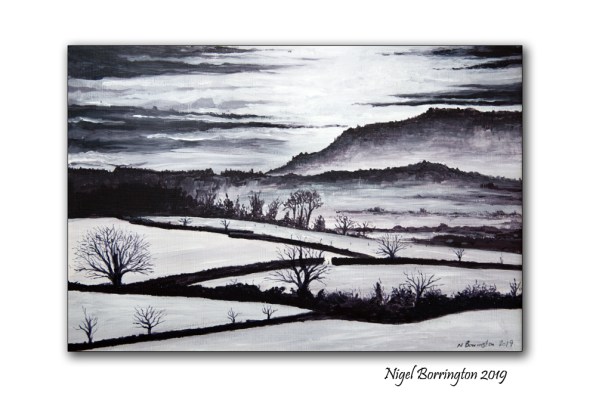
County Kilkenny in Winter
Acrylic on Canvas
Nigel Borrington 2019
This Painting was produced using greys mixed from Acrylic (Cerulean blue, Crimson, Yellow Ocha and titanuim white)to produces grades of Greys, some cool and some warmer.
I hope that this helps to set a feeling of winter in my local Kilkenny landscape, on what was a very cold and frosty morning in mid January 2019.
Berlin from the river Spree

Berlin
from the river spree nigel borrington 2019
Selecting images for an drawing and painting portfolio
Over the next few weeks any images I post on my blog will relate to a selection process I am making for producing some art work. I want to go through my blog photos posted since 2011 and select images that could related to both pencil/ink and Charcoal drawings along with images the will make good subjects for Painting in Acrylic/oil paints. I also have many images that I never posted here, as when I get my camera into the landscape I try to almost exhaust the location as much as possible by taking many images.
With this image of Berlin from the river Spree, I felt it would make a great subject for Charcoal, Pencil and Pen and ink work.
This is a process I have wanted to do for sometime, as it will help me get focused on the art work I want to produce during 2019…..
County Kilkenny Art – The view from Ballycuddihy – charcoal and graphite drawing

County Kilkenny landscape art The view from Ballycuddihy
Charcoal and Graphite on paper
nigel borrington 2019
The view from Ballycuddihy – charcoal and graphite on paper
In my last post I uploaded some photos taken in the hills at Ballycuddihy county Kilkenny, I want to use these images and others as the source for a series of both drawings and acrylic paintings.
So over the weekend I started with a charcoal and graphite drawing. I like very much using these two drawing materials as I like to strip an image down into its monochrome tonal values before returning to repeating the painting in acrylic or oil paint and bring in colour paints. I plan this time however to paint these landscape views using acrylic paint, using black and white only, keeping the finished work to a maximum of ten grey scale values.
Here I have used the charcoal in both willow stick and compressed block form to produce a series of tonal values, using a brush to soften the charcoal into different grey values and tonal grades.The fine details in the drawing are created using graphite.
I am happy with the finished results considering that the drawing was completed within four hours, I have learnt many things here and will repeat this technique many time so that I keep getting to know much more about using charcoal and pencil together.
January frost – A black and white gallery

January Frost
County Kilkenny
Irish Landscape Photography
Nigel Borrington 2019
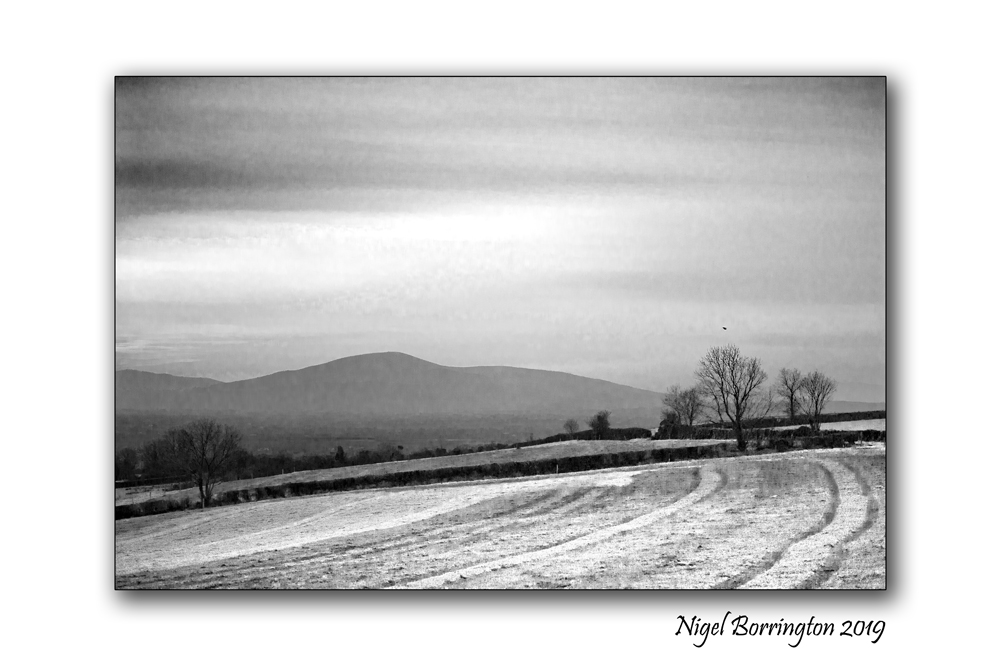
This Morning we had our first frost of the year 2019 and the view from the hillside of county kilkenny was amazing.
Here are three black and white images, I used black and white because I felt it captured the frosty landscape perfectly ….
A Frosty January Morning, Gallery

A Weekend in an Art Course – The art of colour mixing , Rod Moore

Art Courses 2019 – The art of colour mixing , Rod Moore
I have been into art and painting most of my life and you never stop needing to learn new areas or keep going back to basic and practice old ones, so at the start of this year I registered on a Udemy course run by Rod Moore (Rod Moore, Complete Colour mixing course for artists).
I started the course last week in the evenings and so far its very good, I like very much the structure of the courses run by Udemy as they are perfect for adult study allowing you to use your spare time to gain new skills.
Here are some of the basic colour mixing techniques I have covered so far…..
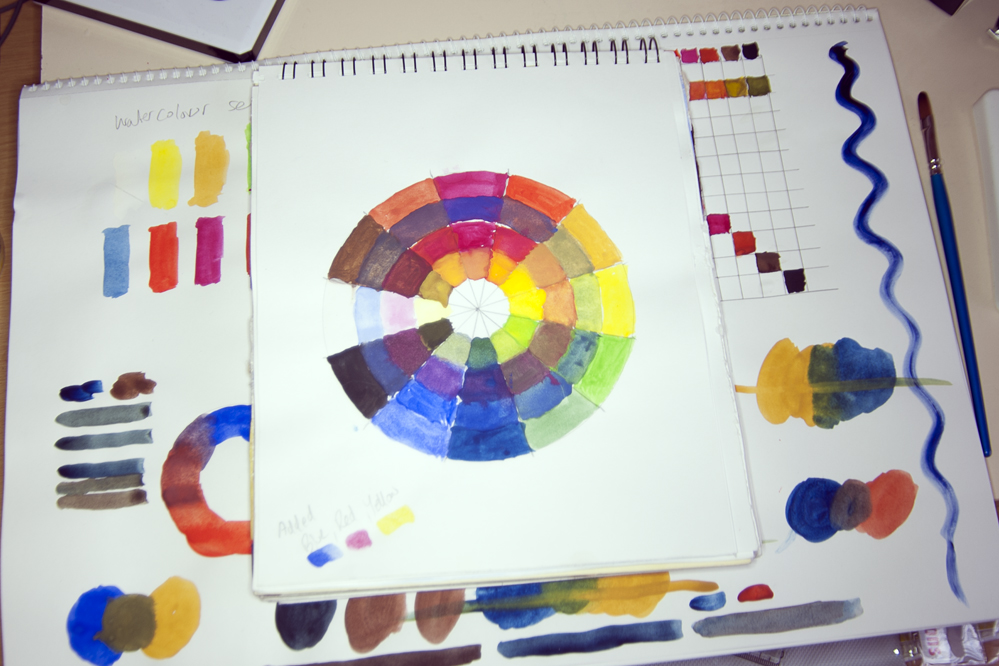
Creating a colour mixing wheel.
Here the colours provided in my watercolour palette are laid out on the very outside of the wheel, working inwards I have mixed the primary colours of Blue, Red and then Yellow to show the results of mixing primary colours.

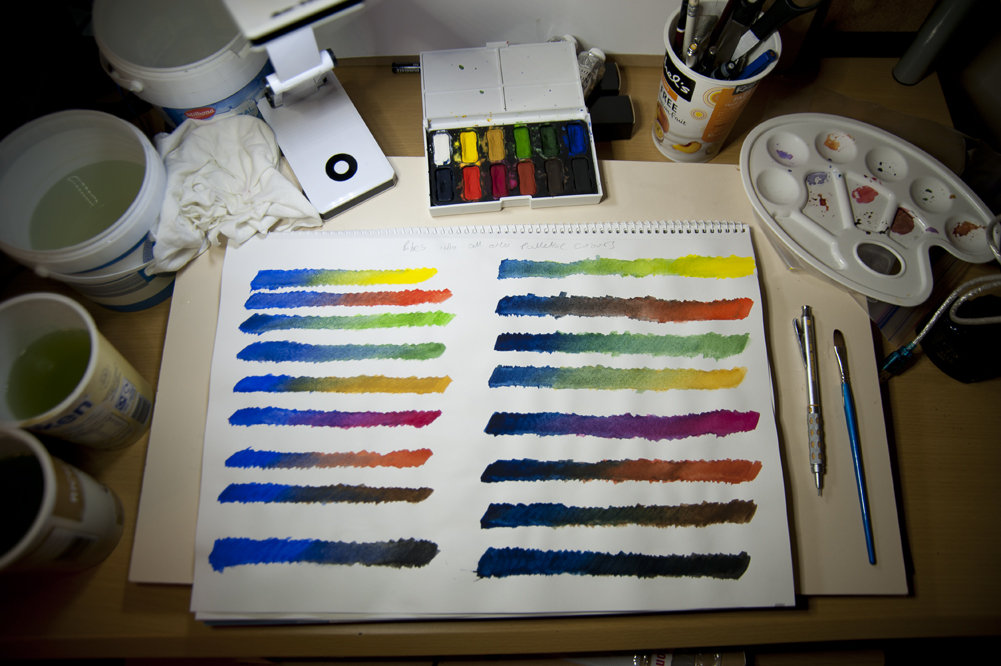
Mixing Blue, Reds, Yellow and Greens.
Most sets of paints contain more than one type of Blue, Red, Yellow and green paints, so in the above images I have worked on taking all the paints in these groups one by one and mixing them with the other paints outside the selected group. The first image for example is using two versions of green, the second two versions of blue – then mixing these with all the other remaining colours.
This type of colour mixing produces some very interesting results and helps show just how different the results of mixing different Blues, Reds, Yellows and Greens with other colours can be.
Landscape colour mixing – wheel and chart.
As said above different available paints can fall into the basic descriptions of blues or yellows and reds, but are individually very different from each other, in the images above I have painted a colour wheel that uses more earth versions of these primary colours.
These versions of the Primary colours (Blue,Red and Yellow) when mixed help to produce results much more likely to be used in Landscape Painting, you can see that they results in a much more earthy looking colour wheel than one produced by more standard primary colours.
I have also produced a colour chart on the right hand side of this page that shows the same mixing results but in block of colour, the standard mixing chart is in the centre of the page and as you can see this produces a much more vivid set of resulting colours, ones much less suitable for landscape painting.
One thing I have noticed while working through these exercises is that watercolour paint does not mix very well compared to Acrylic or Oil paints, which both produce much better stronger results. Its harder to get watercolour to produce many different levels of the mixed colour and for these results to have much depth to them , so my next stage is to repeat all these exercises using artists acrylic paints.
So all in all I feel great about working with this course and had a very enjoyable time over the weekend, I am not intending to turn my blog into just Art and Painting so for now I will return to some photography but its be great fun sharing something different 🙂
A weekend with colour …….

Colour mixing,
WaterColour and acrylics
A weekend in colour
This week I started an online course in colour mixing for watercolour and acrylic painting, so during this weekend I plan to spend as much time as possible learning colour theory.
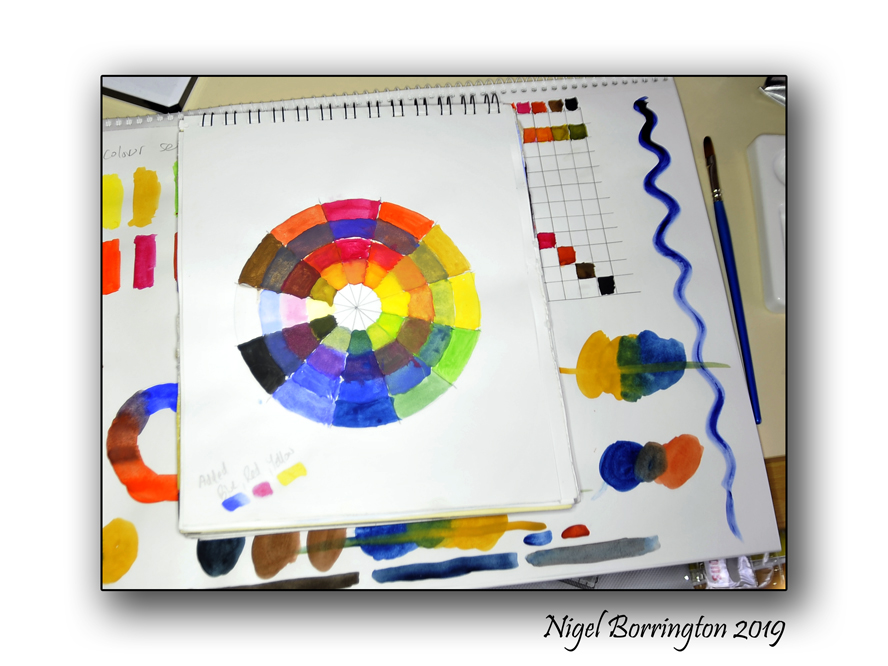
I worked on the course in the evenings and have already used up a few pages of a new sketchbook, including the pages I have posted here.
I feel that one of the most important things I have learned so far, regardless of the type of paint used (Watercolour or Acrylic) is that I am getting to know them very well, how to mix the basic colours included in a sets of paints and what the results look like. Not all colours act the same even when used without mixing them, some colours produce very smooth results others produce a very grainy texture, some colours don’t seem to go into the paper or canvas very deeply others act more like a dye and the moment they touch a painting surface they stain and fix themselves in very quickly and most likely permanently.
The use of colours
When I first stated painting some years back, I would spend a large amount of time trying to match every single colour in a landscape I was painting, however I feel that since these days I have learnt that doing this is not only exhausting it also does not always produce a good painting. Colours can be used much more effectively when limited and balanced so that they are used to compliment each other. When colour is used to highlight areas in a painting or to soften other areas they can make some parts of a painting stand out and others while still included, fall into the background of the finished work.
It’s all these areas and more that I want to study and regain complete understanding again of both in practice and theory, I can then move onto producing colour sketches and full paintings again.

Colour mixing, using just Primary colours
In order to produces all the colours you want to include in a painting you actually only need three , The primary colours (RED,YELLOW and BLUE), what does counts here however is the type of red, yellow or blue you start with in the first place as this will allow you to produces very different final results.
So this weekend I plan to uses as much paper as possible and produce a colour notebook that I can use during the year to help me when producing any paintings I start working on.
If I get time I will post on my progress but if not, I will on Monday post some results and my thoughts on what I worked on.
Connemara, Co. Galway, Ireland – The Landscape of Poetry – Poems by Mary O’Malley
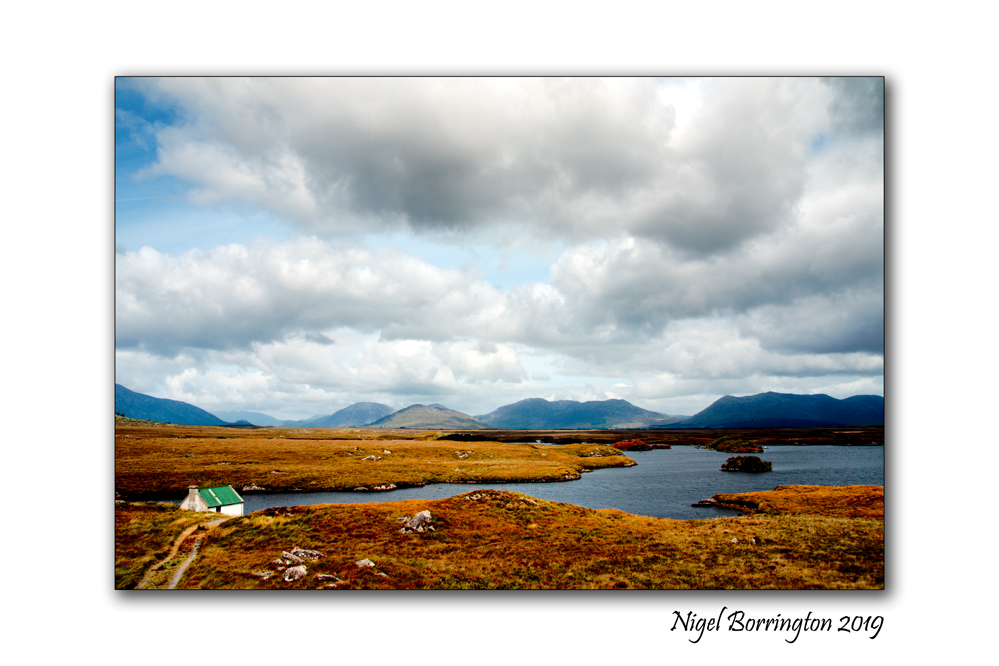
Connemara
county Galway
Ireland
Nigel Borrington
2019
Connemara, Co. Galway
Mary O’Malley is truly the person who has written Connemara, her writing laced with the fierce beauty of the landscape, and the sounds of the sea. In ‘Porpoises’ she sends our minds out to sea from the most westerly point of the county:
The sky is close.
Out from the once manned rock
White electric light
Arcs over the Water
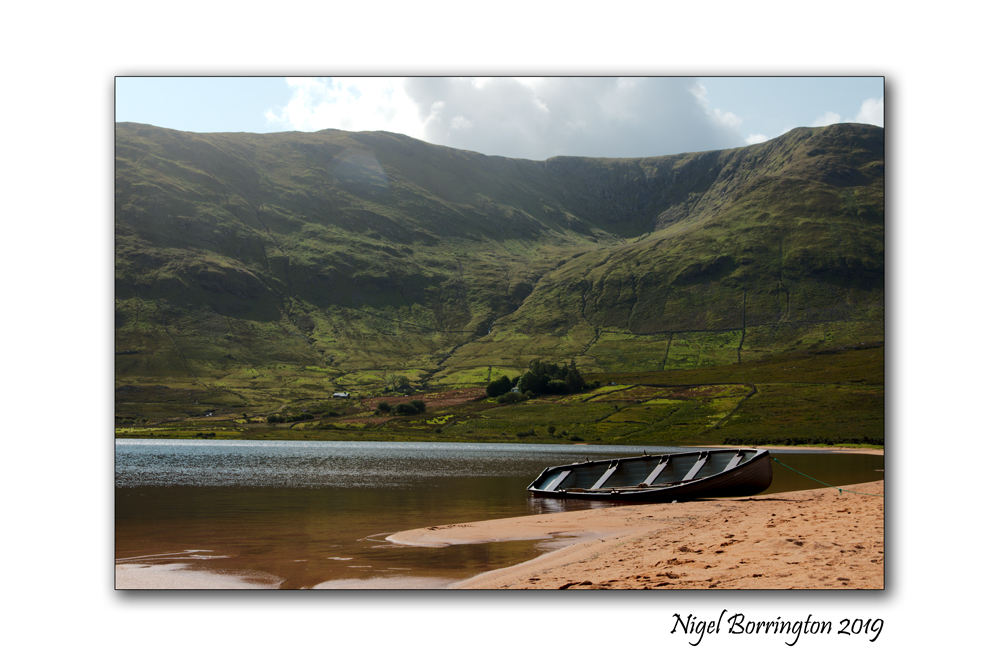
Difficult not to agree with her when she states that the sea is “just the place from which all things make sense”.
Pierce Hutchinson, also writing on Connemara, said:
There are chinks between
the neat stones to let the wind through safe,
You can see the blue sun through them.
But coming eastward in the same county,
the walls grow higher, dark grey;
an ugly grey. And the chinks disappear:
through those walls you can see nothing.
Perhaps our poetic landscapes remind us of that – to keep our hearts alert for experiences of water, wind and wonder.

2019 – A new light , sunrise over Kilkenny’s fields …….

Starting my 2019 Blogging …..
I always like to start my blogging for a new year by changing my site heading image.
This year my first image taken and posted – my new site header image was taken on Sunday Morning at first light, I was on an early morning walk and the weather was cold with a full covering of cloud. I had just about completed the 5km walk I had planned to do and had almost given up on capturing any images as the light was just so unexciting when the sun came bursting through an opening in the clouds and located itself just about some trees in the distance.
I have taken a little time off-line over the Christmas and New-Year period just to give myself an old fashioned way to celebrate and recharge my batteries, I spend some great time with family and friends 🙂 and as a result I feel great and am looking forward with new energy to 2019 and the future 🙂 , my blog and my love of photography still play a massive part in these plans 🙂
I also noticed that the number of likes and visited to my Blog (started in 2011) went well over the 350,000 mark while I was away – I would like to say a massive THANK YOU to you all for this, I don’t post here with such figures in mind , I post to share the things I see and capture around me – That said ! Getting this level of interest and support with so many likes has been a massive boost to me and a huge reason to drive me on in keeping sharing my images and a love of both Art and Photography!
THANK YOU SO MUCH !!!!
Happy Winter solstice 2018 everyone …….
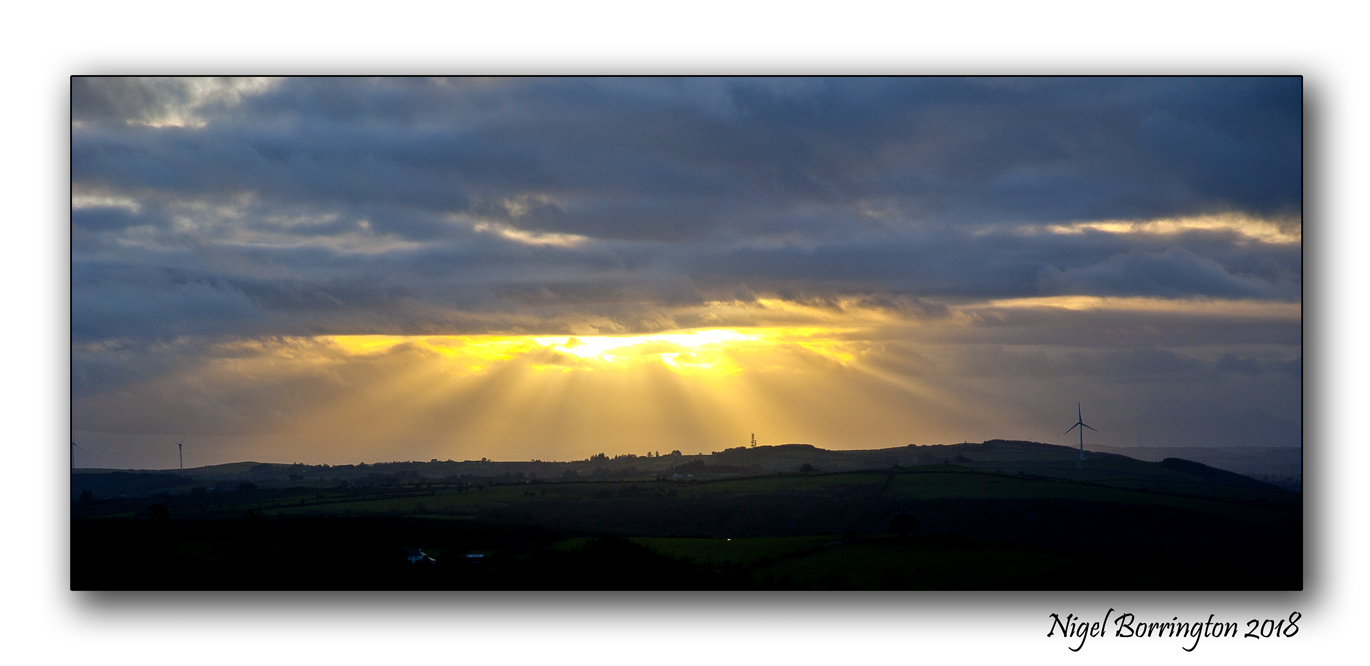
Dec 21 2018
The Winter solstice
Nigel Borrington
The winter solstice (or hibernal solstice), also known as midwinter, is an astronomical phenomenon marking the day with the shortest period of daylight and the longest night of the year. It occurs when one of the Earth’s poles has its maximum tilt away from the Sun. It happens twice yearly, once in each hemisphere. In the Northern Hemisphere this is the December solstice and in the Southern Hemisphere this is the June solstice.
The axial tilt of Earth and gyroscopic effects of its daily rotation mean that the two opposite points in the sky to which the Earth’s axis of rotation points (axial precession) change very slowly (at the current rate it would take just under 26,000 years to make a complete circle). As the Earth follows its orbit around the Sun, the polar hemisphere that faced away from the Sun, experiencing winter, will, in half a year, face towards the Sun and experience summer. This is because the two hemispheres face opposite directions along Earth’s axis, and so as one polar hemisphere experiences winter, the other experiences summer.
More evident from high latitudes, a hemisphere’s winter solstice occurs on the day with the shortest period of daylight and longest night of the year, when the sun’s daily maximum elevation in the sky is at its lowest. Although the winter solstice itself lasts only a moment in time, the term sometimes refers to the day on which it occurs. Other names are “midwinter”, the “extreme of winter” (Dongzhi), or the “shortest day”. In some cultures it is seen as the middle of winter, while in others it is seen as the beginning of winter. In meteorology, winter in the Northern Hemisphere spans the entire period of December through February. The seasonal significance of the winter solstice is in the reversal of the gradual lengthening of nights and shortening hours of daylight during the day. The earliest sunset and latest sunrise dates differ from winter solstice, however, and these depend on latitude, due to the variation in the solar day throughout the year caused by the Earth’s elliptical orbit (see earliest and latest sunrise and sunset).
Worldwide, interpretation of the event has varied across cultures, but many have held a recognition of rebirth, involving holidays, festivals, gatherings, rituals or other celebrations around that time.
Beyond The Door – Poem by Clark Ashton Smith
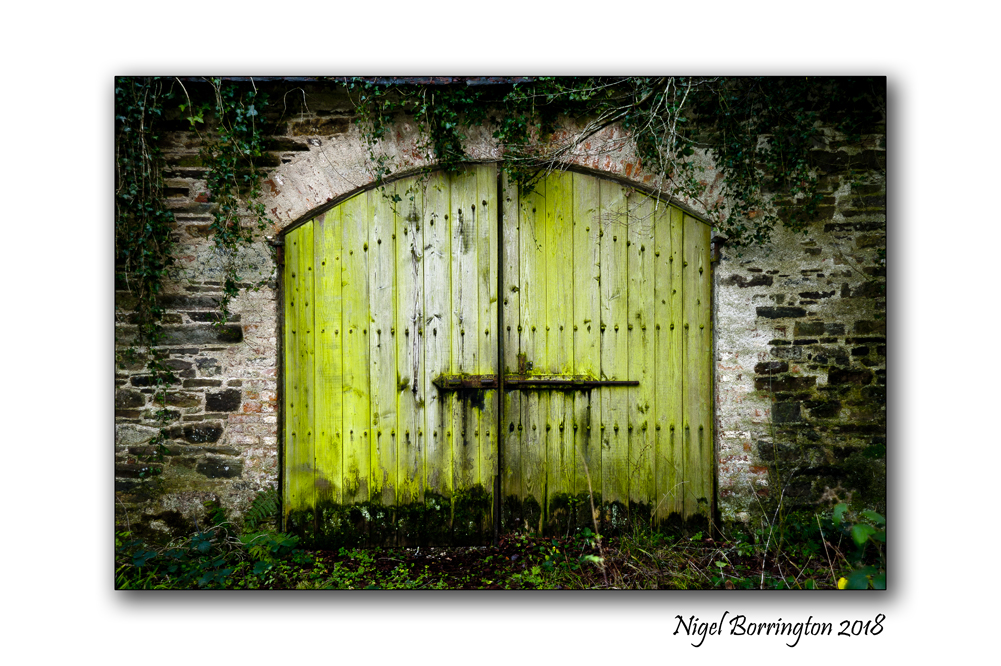
Beyond The Door – Poem by Clark Ashton Smith
Alas! the evanescence of a dream,
That, like a rose, shall never blossom more!
A glimpse of unguessed things, and then the door
Of waking sense clangs to. Alas! the Gleam,
The visioned Secret and the Light supreme,
That one at moments nears, when, lo! the pall
Of veiling darkness drops and covers all –
The darkness of the daylight’s aureate beam!
Leaving but an elusive memory –
A heavenly cadence, a supernal word,
Never but half-recalled. In dreams are heard
Who knows what tidings from Eternity,
Transcendant, strange! Alas! we may not bring
Aught past the gateway of Awakening!
Clark Ashton Smith
 Nigel Borrington
350,000+ WordPress Blog likes and Visits – THANK YOU SO MUCH !!!
I added this thank you message to the post blow but feel that I should also post it by itself !
” I just noticed that the number of likes and visited to my Blog (started in 2011) went well over the 350,000 mark while I was away – I would like to say a massive THANK YOU to you all for this, I don’t post here with such figures in mind , I post to share the things a see and capture around me – That said ! Getting this level of interest and support with so many likes has been a massive boost to me and a huge reason to drive me on in 2019 to keeping sharing my images and a love I have of both Art and Photography!
THANK YOU SO MUCH !!!! “
Share this:
January 8, 2019 | Categories: Comment, Nature and Wildlife, Solo images | Tags: Thank you | 1 Comment