
Kilkenny landscapes (harvest time) , The Harvest Poem by Duncan Campbell Scott

The Harvest
Written by Duncan Campbell Scott
Sun on the mountain,
Shade in the valley,
Ripple and lightness
Leaping along the world,
Sun, like a gold sword
Plucked from the scabbard,
Striking the wheat-fields,
Splendid and lusty,
Close-standing, full-headed,
Toppling with plenty;
Shade, like a buckler
Kindly and ample,
Sweeping the wheat-fields
Darkening and tossing;
There on the world-rim
Winds break and gather
Heaping the mist
For the pyre of the sunset;
And still as a shadow,
In the dim westward,
A cloud sloop of amethyst
Moored to the world
With cables of rain.
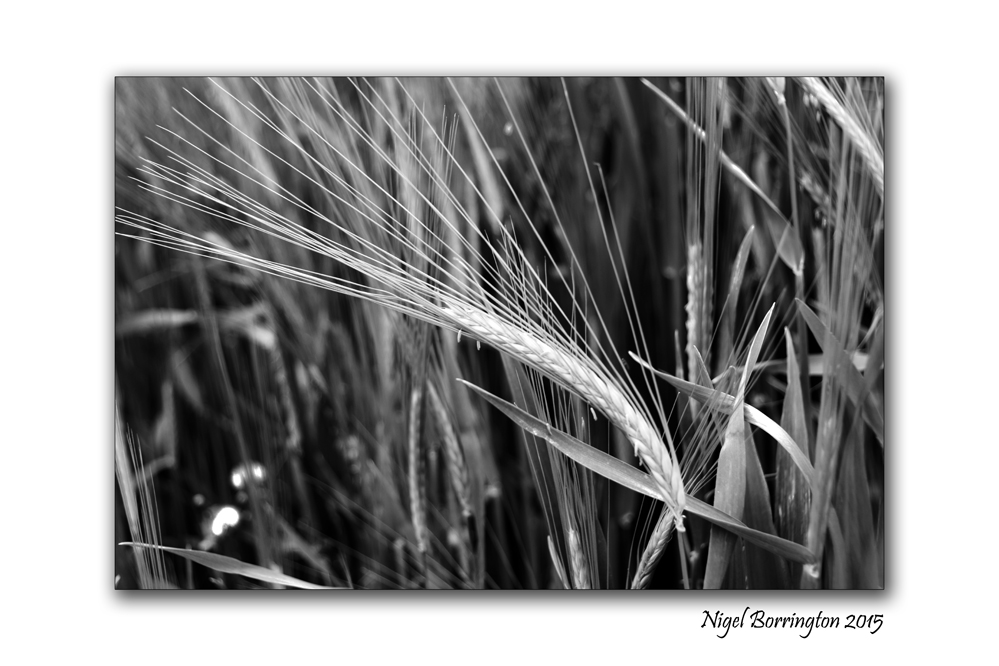
Acres of gold wheat
Stir in the sunshine,
Rounding the hill-top,
Crested with plenty,
Filling the valley,
Brimmed with abundance,
Wind in the wheat-field
Eddying and settling,
Swaying it, sweeping it,
Lifting the rich heads,
Tossing them soothingly
Twinkle and shimmer
The lights and the shadowings,
Nimble as moonlight
Astir in the mere.
Laden with odors
Of peace and of plenty,
Soft comes the wind
From the ranks of the wheat-field,
Bearing a promise
Of harvest and sickle-time,
Opulent threshing-floors
Dusty and dim
With the whirl of the flail,
And wagons of bread,
Sown-laden and lumbering
Through the gateways of cities.
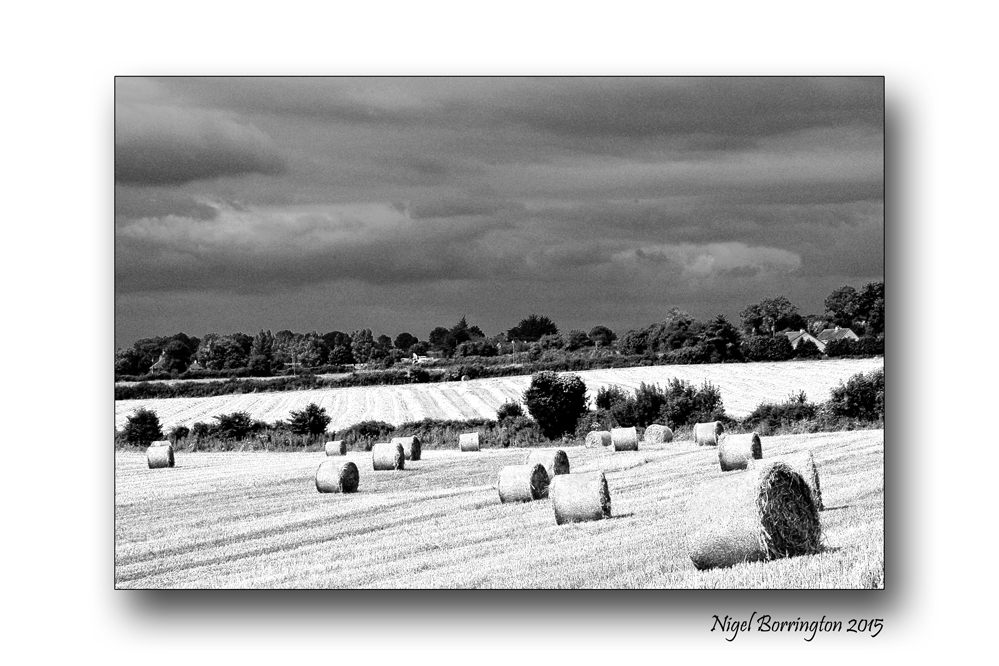
When will the reapers
Strike in their sickles,
Bending and grasping,
Shearing and spreading;
When will the gleaners
Searching the stubble
Take the last wheat-heads
Home in their arms ?
Ask not the question! –
Something tremendous
Moves to the answer.
Hunger and poverty
Heaped like the ocean
Welters and mutters,
Hold back the sickles!
Millions of children
Born to their mothers’ womb,
Starved at the nipple, cry,–
Ours is the harvest!
Millions of women
Learned in the tragical
Secrets of poverty,
Sweated and beaten, cry,–
Hold back the sickles!
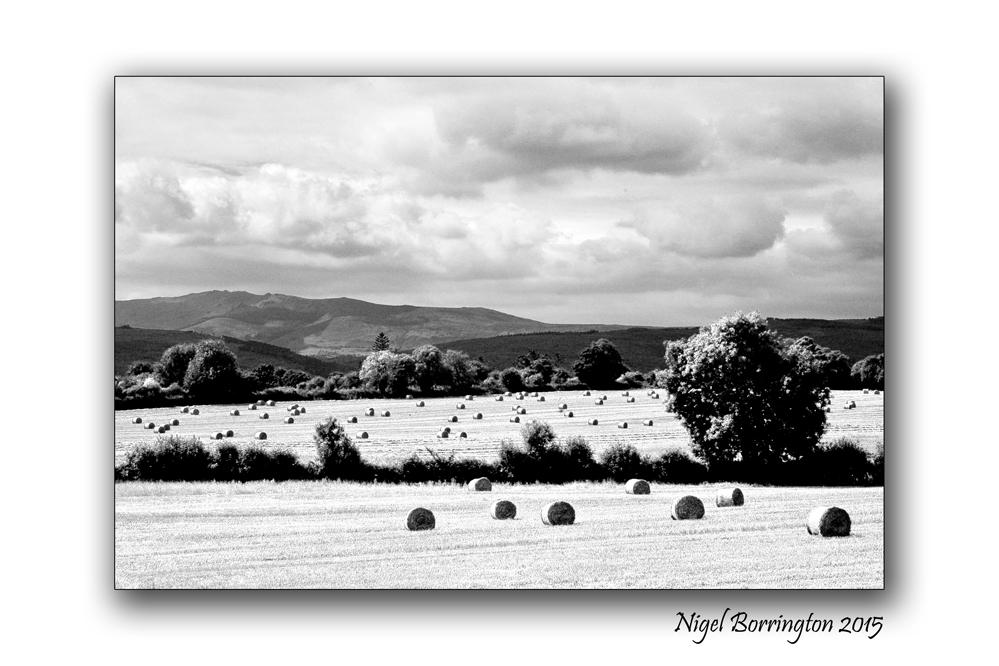
Millions of men
With a vestige of manhood,
Wild-eyed and gaunt-throated,
Shout with a leonine
Accent of anger,
Leaves us the wheat-fields!
When will the reapers
Strike in their sickles?
Ask not the question;
Something tremendous
Moves to the answer.
Long have they sharpened
Their fiery, impetuous
Sickles of carnage,
Welded them aeons
Ago in the mountains
Of suffering and anguish;
Hearts were their hammers
Blood was their fire,
Sorrow their anvil,
(Trusty the sickle
Tempered with tears;)
Time they had plenty-
Harvests and harvests
Passed them in agony,
Only a half-filled
Ear for their lot;
Man that has taken
God for a master
Made him a law,
Mocked him and cursed him,
Set up this hunger,
Called it necessity,
Put in the blameless mouth
Juda’s language:
The poor ye have with you
Always, unending.
But up from the impotent
Anguish of children,
Up from the labor
Fruitless, unmeaning,
Of millions of mothers,
Hugely necessitous,
Grew by a just law
Stern and implacable,
Art born of poverty,
The making of sickles
Meet for the harvest.
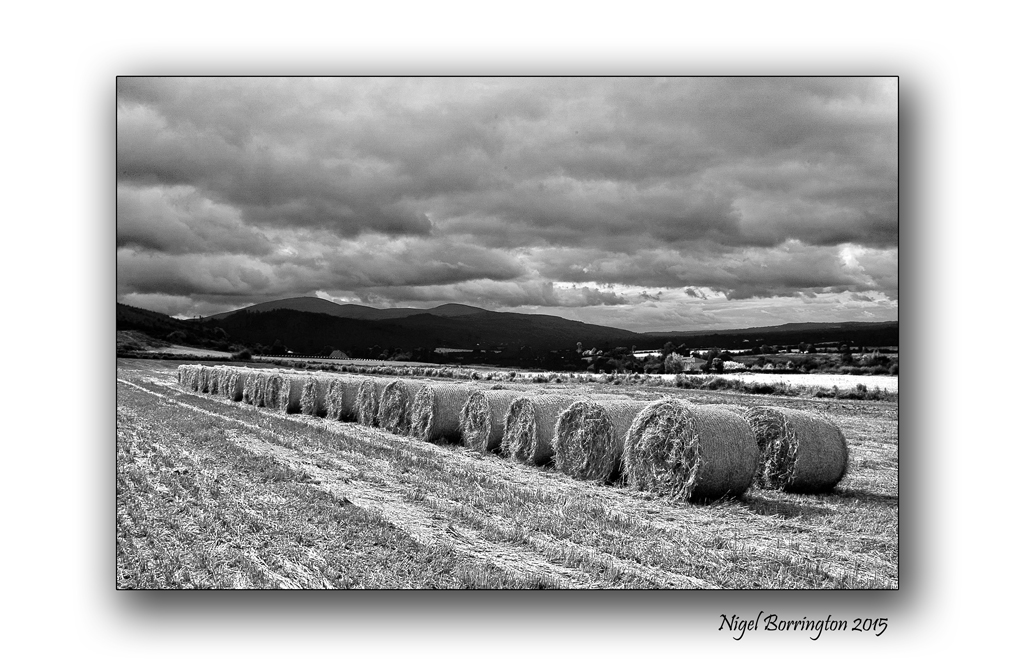
And now to the wheat-fields
Come the weird reapers
Armed with their sickles,
Whipping them keenly
In the fresh-air fields,
Wild with the joy of them,
Finding them trusty,
Hilted with teen.
Swarming like ants,
The Idea for captain,
No banners, no bugles,
Only a terrible
Ground-bass of gathering
Tempest and fury,
Only a tossing
Of arms and of garments;
Sexless and featureless,
(Only the children
Different among them,
Crawling between their feet,
Borne on their shoulders;)
Rolling their shaggy heads
Wild with the unheard-of
Drug of the sunshine;
Tears that had eaten
The half of their eyelids
Dry on their cheeks;
Blood in their stiffened hair
Clouted and darkened;
Down in their cavern hearts
Hunger the tiger,
Leaping, exulting;
Sighs that had choked them
Burst into triumphing;
On they come, Victory!
Up to the wheat-fields,
Dreamed of in visions
Bred by the hunger,
Seen for the first time
Splendid and golden;
On they come fluctuant,
Seething and breaking,
Weltering like fire
In the pit of the earthquake,
Bursting in heaps
With the sudden intractable
Lust of the hunger:
Then when they see them-
The miles of the harvest
White in the sunshine,
Rushing and stumbling,
With the mighty and clamorous
Cry of a people
Starved from creation,
Hurl themselves onward,
Deep in the wheat-fields,
Weeping like children,
After ages and ages,
Back at the mother the earth.
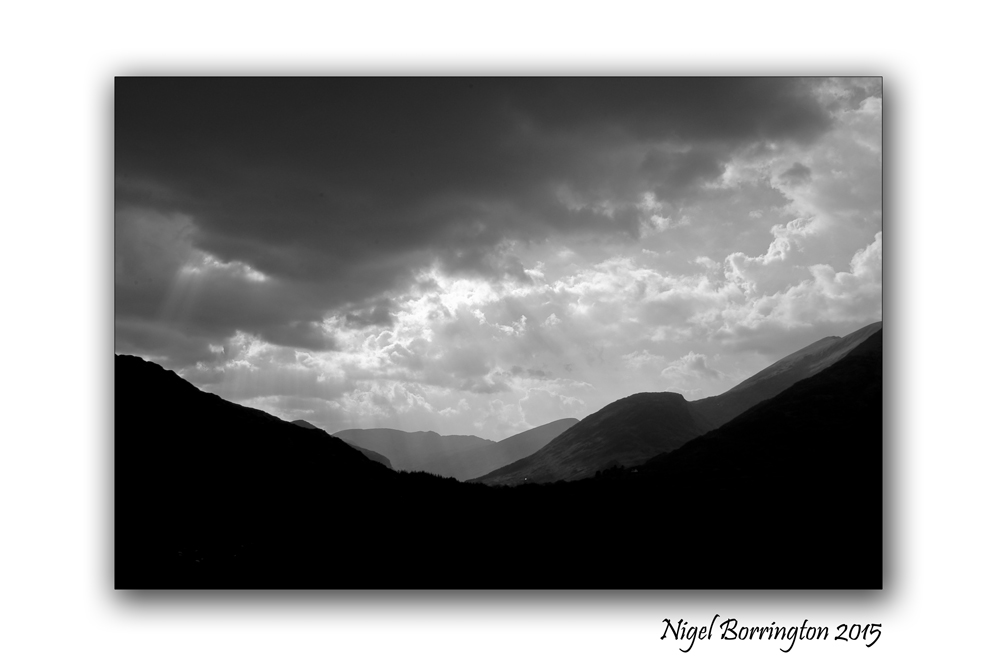
Night in the valley,
Gloom on the mountain,
Wind in the wheat,
Far to the southward
The flutter of lightning,
The shudder of thunder;
But high at the zenith,
A cluster of stars
Glimmers and throbs
In the gasp of the midnight,
Steady and absolute,
Ancient and sure
Monday Poetry , Wild Woodbine By : Joan McBreen

Wild Woodbine
Joan McBreen
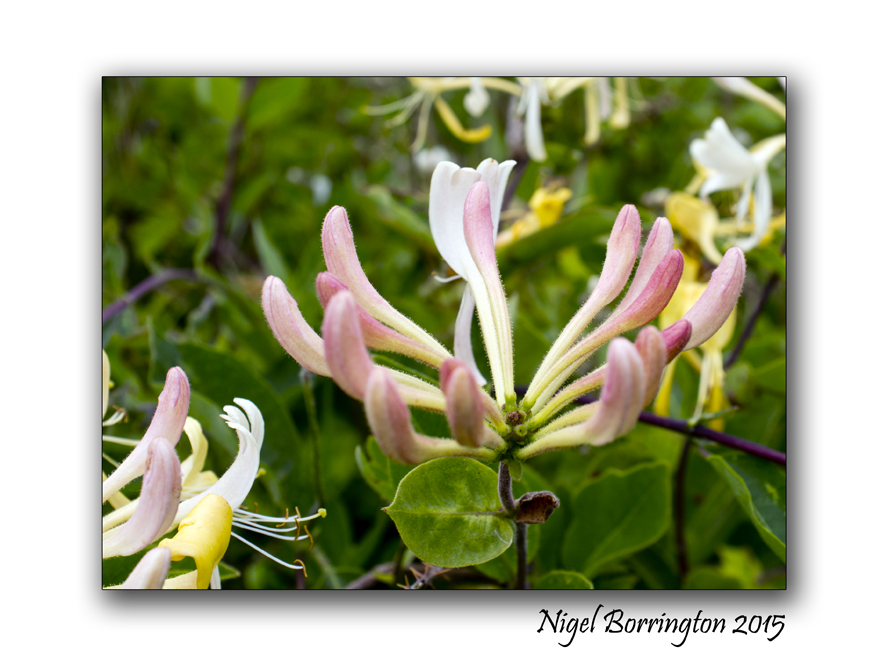
Wild woodbine was beyond my reach
in the thick hedges round Lough Gill.
The heavy scent filled the house for days
when my father brought it in
and it stayed fresh far longer
then meadowsweet.
Because I loved the delicate
pink and white wild rose
he picked it too, cursing the thorns, muttering
“it dies too soon,
you’d be better leaving it alone”.
Yet once, when my mother
swept its petals from the floor
I saw him rescue one
and place it carefully
in the small wallet
where he kept her photograph.
 Wild Woodbine
Wild Orchids – Three Poems for Friday…..
Patricia Drake
Feb 26, 2013
Orchids
She had tried to grow them
For years she had watched others
How they had theirs
Bloom
But nothing happened in her
Windowsill
Now they sat there
Beautiful and vibrant
For all to admire
Through her window
Forever perfect
Sewn
Not grown

EP Mason
Jan 2, 2014
The organs of orchids
I hope that when I die
the insides of me
are placed into
the insides of the needy
so that they can bloom like flowers
And the rest of me
is buried with the Earth
so the prettiest flowers can grow from my bones
and bloom in my soul
knowing I gave my life to nature
and all her children

Marie-Chantal
Ireland’s Wild Orchids
Through the rain stained glass,
With a sickly purple hue,
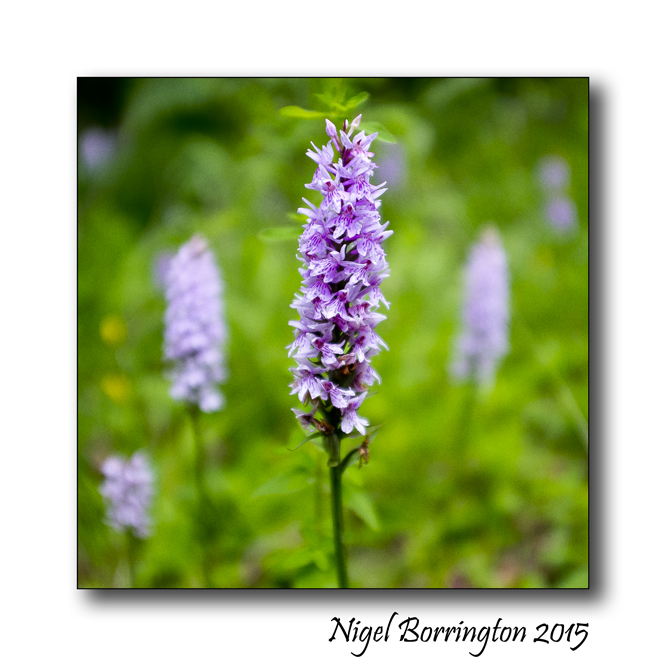
I can see early marsh orchid,
And it makes me think of you.
The gardener’s son
Is looking at it too,
His sickly grey suit
Makes me think of you.
I was not born a bog child,
I was only passing through,
The Irish Lady’s Tresses
Made me think of you.
Nature’s gifts : Celandine, Lesser
Celandine, Lesser
Nature Photography : Nigel Borrington
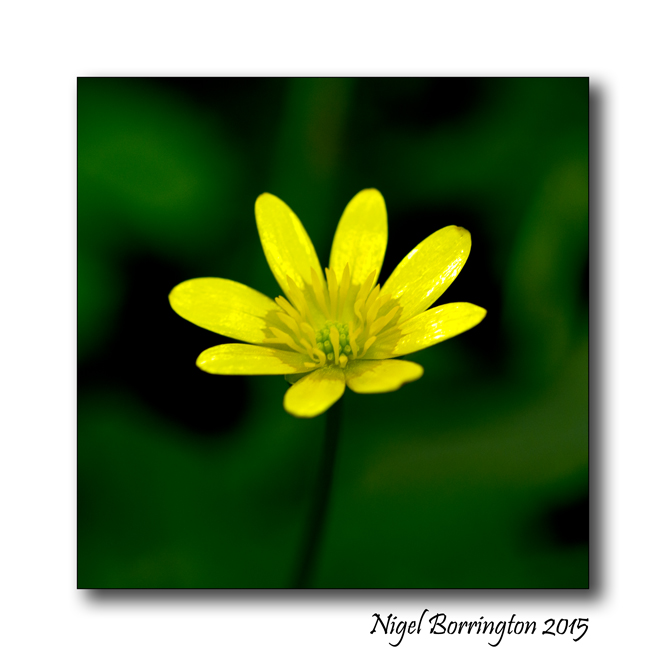
Its so easy to just walk past some of natures smaller Herbs and Flowers, however I guess that some flowers cannot help but get themselves noticed.
“Celandine, Lesser” is one of these little gems, its strong yellow flowers in the early summertime cannot help but get noticed as you walk down woodland paths or along the road sides.
Here are a many details about this wild Herb and it flowers:
Celandine, Lesser
Botanical: Ranunculus ficaria (LINN.)
Family: N.O. Ranunculaceae
Part Used
Constituents
Medicinal Action and Uses
Recipes
—Synonyms—Small Celandine. Figwort. Smallwort. Pilewort.
—Part Used—Herb.
—Habitat—The Lesser Celandine, one of the very earliest of spring flowers, its cheery, starlike blossoms lighting up our hedges even before winter is quite spent, is distributed throughout Europe, Western Asia, and North Africa, in these islands, growing up the hillsides in Wales to a height of 2,400 feet. It grows in moist corners of fields and places near watersides, but is found also on drier ground, if shady, being one of the few plants that thrive beneath the shade of trees, where its glossy foliage frequently forms a dense carpet.
Wordsworth, whose favorite flower this was (in recognition of which the blossoms are carved on his tomb), fancifully suggests that the painter who first tried to picture the rising sun, must have taken the idea of the spreading pointed rays from the Celandine’s ‘glittering countenance.’ The burnishing of the golden petals gives a brilliant effect to the flowers, which burst into bloom about the middle of February, a few days only after their bright, shining leaves. The leaves are on long stalks, arising from a short, prostrate stem, and are very variable, the first being heart-shaped, the later ones bluntly cut into, somewhat like the ivy. They often have dark markings.
The blossoms shut up before rain, and even in fine weather do not open before nine o’clock, and by 5 p.m. have already closed for the night. The Celtic name of the plant, Grian (i.e. the sun), refers to this habit. The petals are green on the underside, and directly the flowers close they become inconspicuous.
Throughout March and April, this cheerful little plant is in full bloom, but as the spring passes into summer, the flowers pale somewhat, and the whole plant looks rather sickly, the warmth of the lengthening days withdrawing from it the needed moisture. By the end of May, no flowers are to be seen, and all the plant above ground withers and dies, the virtue being stored up in the fibres of the root, which swell into the form of tubers. If the plant is dug up, late in the summer or autumn, these tubers are seen hanging in a bunch, a dozen or more together, looking like figs, hence the plant’s specific Latin name ficaria, from ficus (a fig). By these tubers, the plant is increased, as they break off readily, each tuber, like a potato, producing a new plant. To eradicate this plant from any ground, it is necessary to remove the roots bodily, for if the plants are dug into the soil, they work their way up to the surface again, the stems branching as they grow upward from the tubers, and at every branch producing fresh tubers.
The early awakening of the plant is due to these fully-stored tubers, which lie quiescent all the summer and autumn, but all necessary materials being at hand, leaves and flowers are quickly pushed upwards directly the depth of the winter has passed.
Although the Lesser Celandine has been placed by some botanists in a distinct genus, when it is called Ficaria verna, it is more generally assigned to the Buttercup or Crowfoot genus, Ranunculus. The name of this genus, first employed by Pliny, alludes to the damp and marshy localities preferred by the plants of the family, Rana, being the Latin for a frog, whose native haunts are those of the majority of this group of plants. The Lesser Celandine is distinguished from the Buttercup by having nine or ten, even sometimes a dozen narrow petals, instead of five, and only three sepals (the outer, generally green leaves of the flower), which fall off on opening, instead of the usual five, which remain after the flower has expanded, in the other species of Ranunculus. The flowers rise singly from the root, on long, slender, leafless stalks and are about 1 inch in diameter. There are a number of stamens. The fruits are not unlike those of the Buttercups being dry and distinct, set together in a globular head, somewhat like a grain of corn and whitish in colour, but comparatively few fertile seeds are produced.
The flowers would originally appear to have been designed with the object of attracting insects for their fertilization, the bright coloured, burnished petals having honey sacs at their base, but the flowers can face colder days than the insects can, for whom the honey has been provided, blooming when few of the insects have emerged, with the result that comparatively few become fertilized in this country and not many seeds are produced. The plant, therefore, has recourse to another method of reproduction, independent of all external aid. At the point where the upper leaves join the stem are to be seen little objects like minute round tumours, which grow about the size of a grain of wheat. In the early summer, when the leaves and stems are dying down, these grains become loose and drop to the ground. Each is capable of producing a new plant. A heavy rain will sometimes wash them from the plants in every direction. Kerner, in his Natural History of Plants, tells us that:
‘a sudden downpour of rain in a region abundantly overgrown with Lesser Celandine is sufficient to float away numbers of the tubers, and heap them up on the borders of irrigation channels when the rain disperses. In such places the quantity of tubers which have floated together is often so large that one can hardly gather them in one’s hands. In this way arose the idea that the tubers had fallen from heaven with the rain and the myth of a rain of potatoes.’
This fact probably accounts, also, for the ‘rains of wheat’ sometimes vouched for by country people in various parts. These bulbils (i.e. Iittle bulbs) are only produced on those plants whose fruits have failed to set.
The root of the Lesser Celandine is perennial.
Seedlings do not flower in their first year, but collect and store up material to start their accustomed course at the end of the ensuing winter.
The whole plant is glabrous.
It is called the Lesser Celandine to distinguish it from the Greater Celandine, to which it has neither relationship nor similarity, except in the colour of its flowers, though the older herbalists applied the name to both plants indiscriminately. The confusion of names existed in Gerard’s time, for he published a list of all the plants in cultivation in his garden on Holborn Hill – to wards the close of the sixteenth century and introduced in it, under the same name, both this and the Greater Celandine (Chelidonium majus) which certainly is in bloom when the swallows arrive, and continues to flower the whole summer, and so would have more right to the name Celandine than this species, which blossoms long before they come, and dies down months before they leave our shores.
A figure of the Lesser Celandine – under the name of Erdöpffel – appears in an old German Herbal of 1533, Rhodion’s Kreutterbuch, evidence that this plant was well known to the herbalists of the Middle Ages.
It is also called ‘Small-wort.’
The old English name of Pilewort is due to the fact that it has long been considered a cure for piles, one of the reasons assigned for this resting on the strange doctrine of signatures. We are told by an old writer: ‘If you dig up the root of it you will perceive the perfect image of the disease commonly called the piles.’ Gerard writes of it:
‘It presently, as Galen and Dioscorides affirm (though this perhaps refers to the Greater Celandine) exulcerateth or blistereth the skin: it maketh rough and corrupt nails to fall away. The juice of the roots mixed with honie and drawn up into the nosthrils purgeth the head of foul and filthy humours. The later age use the roots and graines for the piles . . . there be also who think that if the berbe be but carried about one that hath the piles, the pain forthwith ceaseth.’
Culpepper, writing fifty years later, tells us:
‘It is certain by good experience that the decoction of the leaves and roots doth wonderfully help piles and haemorrhoids; also kernels by the ears and throat called the King’s Evil, or any other hard wens or tumours.’
He had such faith in the virtues of this little plant that he further tells us, with more definite belief than Gerard: ‘The very herb borne about one’s body next the skin helps in such diseases though it never touch the place grieved.’
The young leaves, the substance of which is soft and mucilaginous, have sometimes been boiled and eaten as a vegetable in Sweden, but have not the reputation of being very palatable, either thus treated or raw as a salad.
Linnaeus advised farmers to eradicate the plant from their land on account of it being disliked by cattle (though wood-pigeons eat it with avidity), also for its injurious effect on other herbs in the meadow, but there seems little ground for this assumption, as although the tissues of most plants in this order contain acrid juices to a high degree, the acrimony of the Lesser Celandine is of a very mild character. A dressing of coal or wood ash is said to effectually destroy the whole plant.
Monday Morning Poems : “A Red, Red Rose” by : Robert Burns
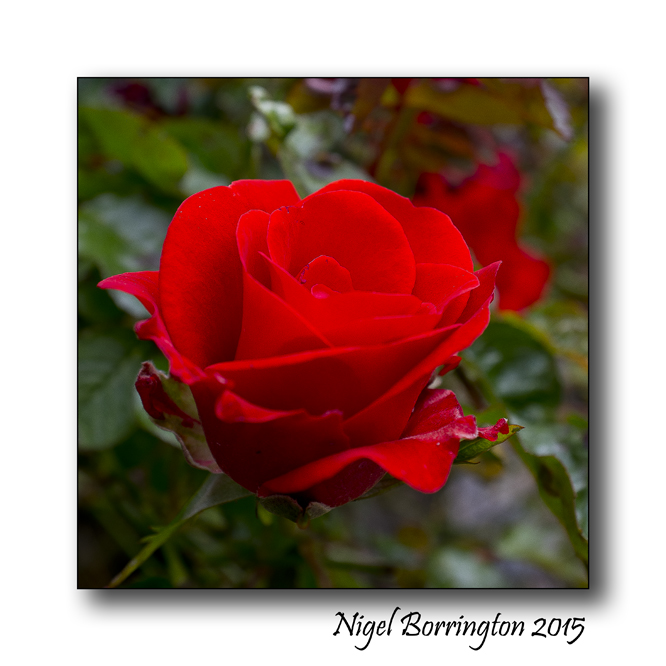
Like a Red Rose in June
Nigel Borrington
A Red, Red Rose
by Robert Burns
My love is like a red, red rose
That’s newly sprung in June :
My love is like the melody
That’s sweetly played in tune.
As fair art thou, my bonnie lass,
So deep in love am I :
And I will love thee still, my dear,
Till a’ the seas gang dry.
Till a’ the seas gang dry, my dear,
And the rocks melt wi’ the sun :
And I will love thee still, my dear,
While the sands o’ life shall run.
And fare thee weel, my only love,
And fare thee weel a while !
And I will come again, my love,
Thou’ it were ten thousand mile.
Getting close to the Rhododendron, Gallery.
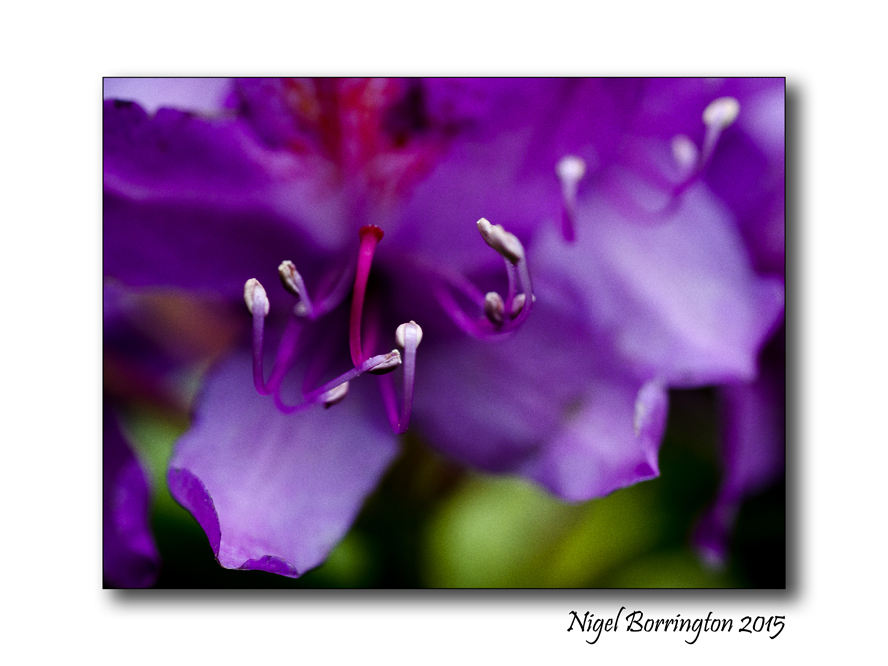
Rhododendron flowers
county Kilkenny
Nigel Borrington
At this time of year , many parts of the Irish landscape come alive with the purples and pinks of the Rhododendron flower.
These images are just a few closeup shots taken on an evening walk yesterday …..
Rhododendron (from Ancient Greek ῥόδον rhódon “rose” and δένδρον déndron “tree”) is a genus of 1,024 species of woody plants in the heath family (Ericaceae), either evergreen or deciduous, and found mainly in Asia, although it is also widespread throughout the Southern Highlands of the Appalachian Mountains of North America. It is the national flower of Nepal. Most species have showy flowers. Azaleas make up two subgenera of Rhododendron. They are distinguished from “true” rhododendrons by having only five anthers per flower.
Gallery


Cuckoo-flower / Lady’s Smock , Irish Nature Photography
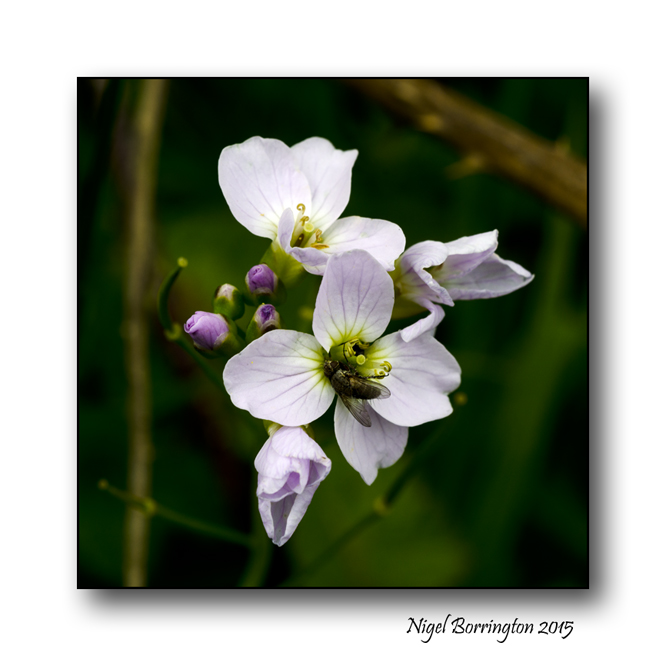
Cuckoo-flower / Lady’s Smock
Nigel Borrington
In late springtime here in county Kilkenny – Ireland, I always notice when the wild flower come out.
Some of the most noticeable are the Cuckoo flowers, they grow at the side of rivers and along damp woodland paths.
I always feel like summer has started in full when I first see them …..
Cuckoo-flower / Lady’s Smock
Cardamine pratensis
Biolar gréagáin
Family: Brassicaceae
Flowering time: March-June. Perennial. Native.

Large white to pinkish-mauve flowers. Yellow anthers. Colour depends
on habitat, pink-mauve on dryer ground. Fruit with long or short style.
Basal leaves round / oval, in rosette. Stem leaves narrow-lanceolate.
Variable plant, sometimes with runners. Height: To 60 cm
Very frequent. Damp meadows and lawns, stream sides, open moist woodland.
The Growth of a Seed – By Dan Farella

The Growth of a seed
Nature Photography : Nigel Borrington
The Growth of a Seed
– By Dan Farella
The growth of a seed
Starts with a need
A feeling inside her
Like a burning fire
Glowing to inspire
And the growth transpires
Inside her that fire
Burning brighter and brighter
Ignites her into a frenzy of burning desire
To lift herself higher, and higher, and higher…
A desire to surrender to the growth that transpires
And she never grows tired, growing, and growing
And a sprout grows out from beyond the doubt
The shadows get exposed to the light of insight
As the stem grows longer getting stronger and stronger

The days get brighter and her spirit feels lighter
The pulsing emanates from a sacred place…
Babump…. babump… babump….
Reaching for the light radiating inner sight
[And an animal comes to take a little bite]
And the nutrients they grow as the energy it flows
And the time has come for her soul to become one
So she sends out her leaves allows herself to be alive
No running no hiding and nowhere to go
So it waits and it grows and it sits and it flows
As the thoughts pass by and she holds her composure
Growing and growing flowing and flowing
Getting taller and stronger
Allowing herself to be seen

It goes on and on as she reaches her dawn
Only to know that its time for her to move on
And release her seeds to the wind, set sail
And she trusts they will grow through wind, rain, or hail
As she brings all the energy up into her crown
The wind begins to blow as she listens to the sound
And she knows its time to let her children take flight
Getting lost in the life, the love, and de-light
She completes her deed and she dies a slow death
But she knows she will go back into the goddess breath
Where she feeds the soil that will grow her kin
With the nutrients she once used to help her begin
And she feels a sense of right-ness and completeness inside
As she knows that she worked with Natures highest design
And she never grows tired, growing and growing
Reaping and sowing, reaping and sowing.
– By Dan Farella
Blue flowers , they stands for desire the infinite and unreachable

Blue flowers of , Common-Field-Speedwell
Nature Photography : Nigel Borrington
Blue flowers must be one of the hardest types of wild flowers to find, these Field-Speedwell’s are just some of a few we have in our local woodlands.
Blue in nature has been used as a powerful symbol, the following uses are just a few …..
Blue flowers
A blue flower is a central symbol of inspiration. It stands for desire, love, and the metaphysical striving for the infinite and unreachable. It symbolizes hope and the beauty of things.
Early use of the symbol of blue flowers
German author Novalis used the symbol in his unfinished Bildungsroman, entitled Heinrich von Ofterdingen. After contemplating a meeting with a stranger, the young Heinrich von Ofterdingen dreams about a blue flower which calls to him and absorbs his attention.
Explanation of the symbol of blue flowers
In the book Heinrich von Ofterdingen the blue flower symbolises the joining of human with nature and the spirit so the understanding of nature and coincident of the self is growing. In the Romantic the meaning of human was a continuation from Humanism and the Age of Enlightenment, but the focus was on the own emotions not on abstract theory. Understanding and thinking rise in the comprehension of Romantic from own individual love. Feeling is based on the self, thinking is based on the self and the development of the self leads the individual person. Also very important is contemplation. About the feeling, the thinking and contemplation personal inward cognition is possible. The process of cognition merge again with own individual love. The self and the nature is in this theory always linked.
Use of the symbol
Joseph Freiherr von Eichendorff wrote a poem called Die blaue Blume (The blue flower). Adelbert von Chamisso saw the core of Romanticism in the motif, and Goethe searched for the “Urpflanze” or “original plant” in Italy, which in some interpretations could refer to the blue flower. E. T. A. Hoffmann used the Blue Flower as a symbol for the poetry of Novalis and the “holy miracle of nature” in his short tale “Nachricht von den neuesten Schicksalen des Hundes Berganza”.
In 1902, Charles Scribner’s Sons published “The Blue Flower”, a collection of short stories by Henry Van Dyke, the first two of which, “The Blue Flower” and “The Source” refer to the blue flower as a symbol of desire and hope, and the object of the narrator’s search. This volume also includes Van Dyke’s most famous story, “The Other Wise Man”.
Blue rose
Walter Benjamin used the image of the blue flower several times in his writing. For example the opening sentence of his essay Dream Kitsch: “No one really dreams any longer of the Blue Flower. Whoever awakes as Heinrich von Ofterdingen today must have overslept.” Also in his Work of Art essay: “The equipment-free aspect of reality has here become the height of artifice, and the vision of immediate reality the Blue Flower in the land of technology.”
C.S. Lewis, in his autobiographical book, Surprised By Joy, references the “Blue Flower” when speaking of the feelings of longing that beauty ellicited when he was a child of six. He associates it with the German word sehnsucht, and states that this intense longing for things transcendent made him “a votary of the Blue Flower.”
English writer Penelope Fitzgerald’s historical novel The Blue Flower is based on Novalis’s early life. In John le Carré’s 1968 novel A Small Town in Germany, the character Bradfield says, “I used to think I was a Romantic, always looking for the blue flower.” (Pan edition, p. 286 – chap. 17) Substance D, a fictitious drug in Philip K. Dick’s 1977 novel A Scanner Darkly, is derived from a plant with blue flower.
Tennessee Williams used images of blue roses in his play, The Glass Menagerie, to symbolize the frailty and uniqueness of Laura, a central character that reflects the life of Williams’ sister, who underwent a lobotomy. In the play, Laura is nicknamed “Blue Roses” after another character misheard her say “pleurosis”.
In his fantasy series A Song of Ice and Fire, American author George R. R. Martin uses the blue flower as a reoccurring symbol to represent young women of the noble House Stark, often with hints to an illicit love affair. In one instance, Prince Rhaegar Targaryen uses blue winter roses to crown the Lady Lyanna Stark as the “Queen of Love and Beauty” at the Tournament of Harrenhal, passing over his own wife, Princess Elia of Dorne.
“Blue Flower” is the name of a song by the British avant-garde pop band of the early 1970s, Slapp Happy, later covered by the 1990s indy rock bands Pale Saints and Mazzy Star. “Blue Flowers” is a song by the alternative MC, Kool Keith (AKA Dr. Octagon), on his 1996 album, Dr. Octagonecologyst.
Spring Herb’s : Herb-Robert
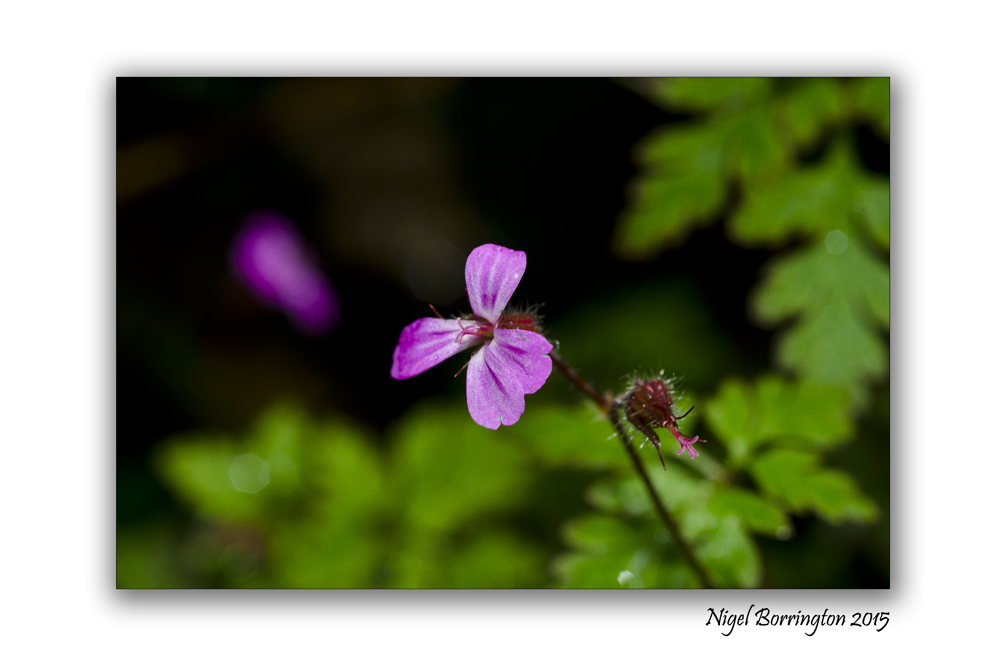
Herb Robert
Irish nature Photography : Nigel Borrington
Spring Herb’s : Herb-Robert
Familiar little pink flower from April to November, Herb-Robert is a hairy, unpleasant-smelling plant which grows on banks, bases of walls, shingle and shady places throughout the country. Its pink flowers (8-15mm across) have five un-notched petals and in the center of the flower are orange anthers. Each petal is marked by small lighter-pink lines running into the center of the flower. The hairy, stalked leaves are often tinged red and have three to five deeply cut lobes. The fruit is hairy and beak-like. This is a native plant belonging to the family Geraniaceae.
This plant has been introduced into North and South America from Europe and Asia. In traditional medicine in the Americas it has been used to stop nosebleeds. Its leaves are also made into a herbal tea which is recommended as a gargle and an eyewash. (you would not recommend this course of action).
One wonders who is the ‘Robert’ of this plant. Maybe the name comes from the Latin word ‘ruber’ meaning red which may have referred to the colouring of the leaves and stems.
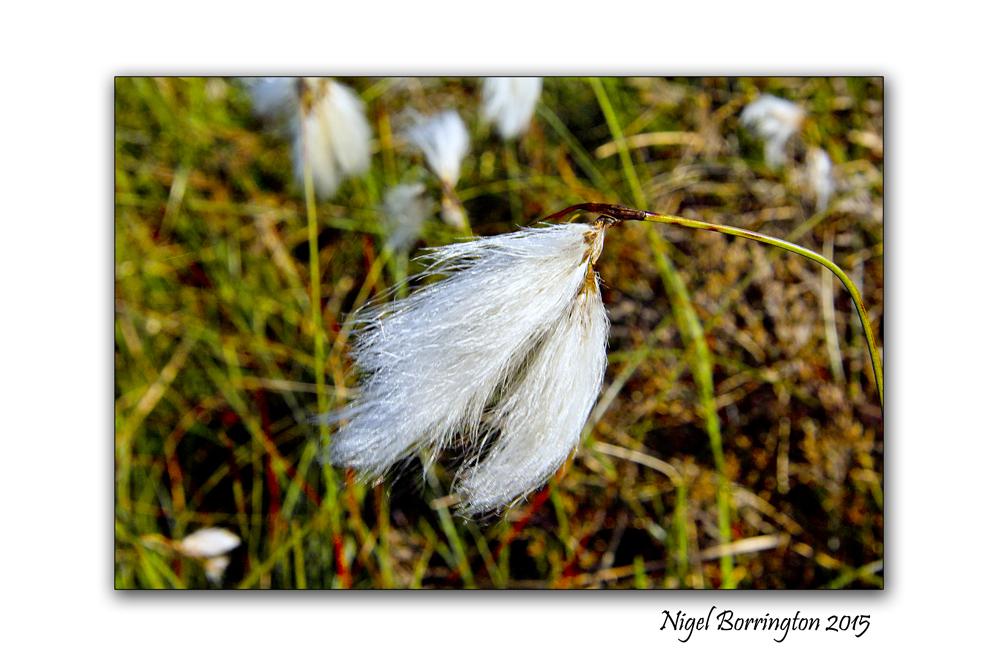
When will I see the Bog Cotton again ?
Bog Cotton
Irish Landscape Photography : Nigel Borrington
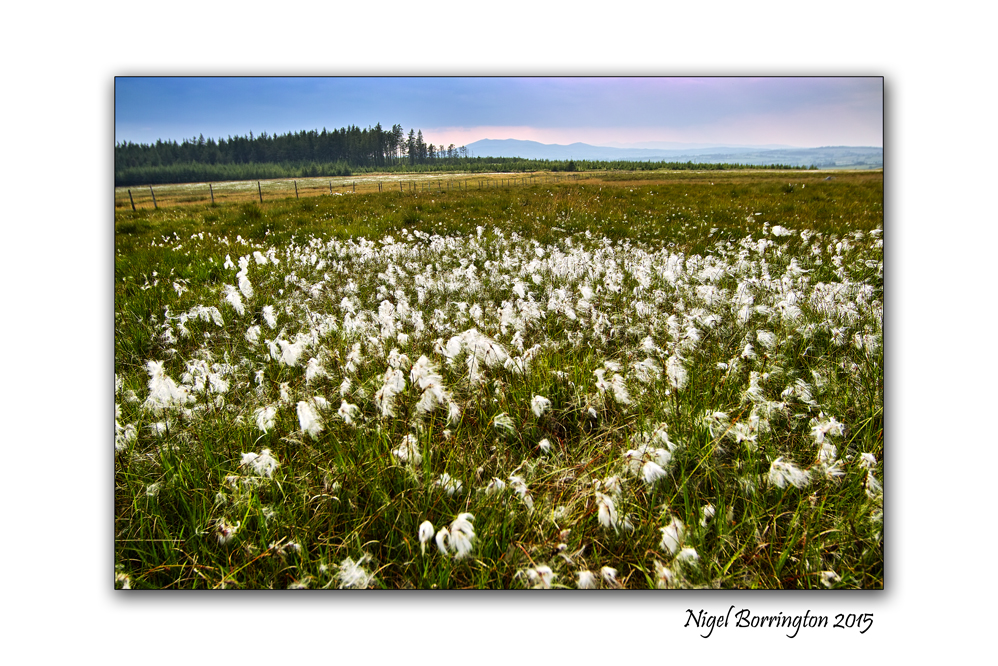
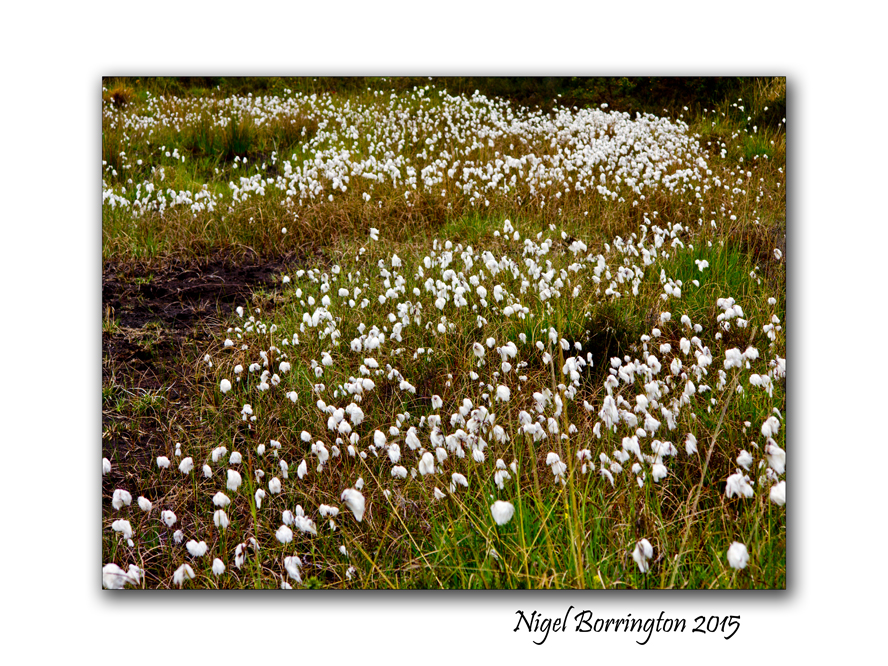
Each year that comes and goes in the Irish bog-land landscape, for me is marked by the summer Bog Cotton. This amazing grass covers many of Ireland boggy wet lands , on the mountain sides and the low lands of midlands through out the country. Only for the fact that much of the Countries bogs are farmed for peat ( leaving the landscape scraped and scared, with no plant life left ! ) then their would be huge areas in the summer months all covered with white Cotton blowing in the wind.
When Will I see the Bog Cotton again ?
Well Starting from this May and June I hope, and I will be getting lots more pictures and just taking time to appreciate the views it brings !!!


Gorse flowers – in mythology
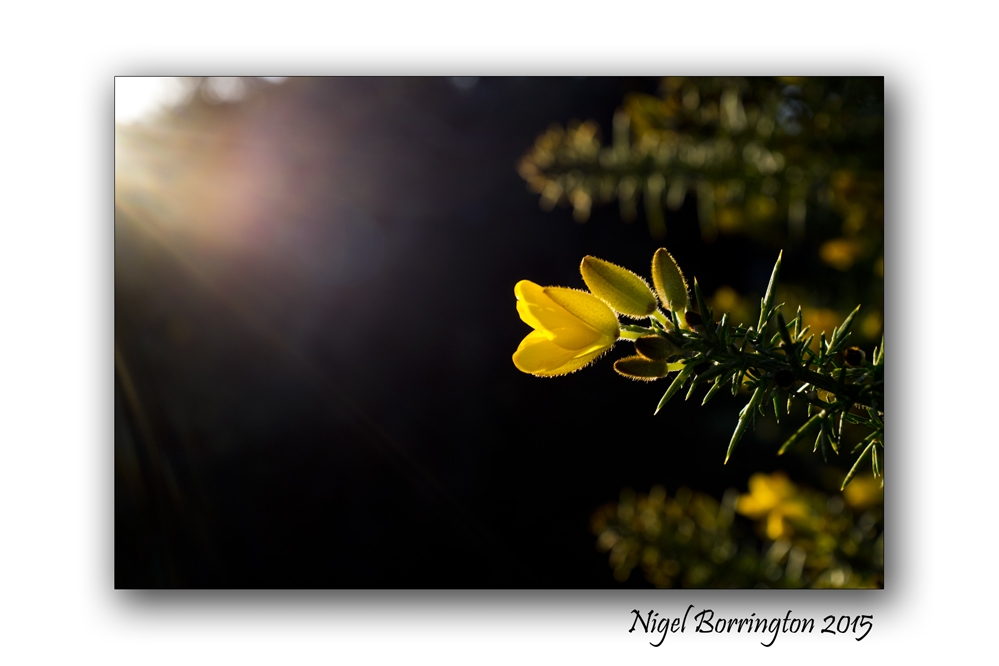
Irish Gorse flowers
Nigel Borringtpn
Gorse flowers – in mythology
Gorse, also known as furze, is a sweet scented, yellow flowered, spiny evergreen shrub that flowers all year round.
In fact, there are several species of gorse that flower at different times of the year making it a much-loved plant for the bees and giving it the appearance of being in bloom all year long. There is an old saying that goes, “When the gorse is out of bloom, kissing is out of season.”
Gorse Tree copyright Ireland Calling
Gorse is often associated with love and fertility. It was for this reason that a sprig of gorse was traditionally added to a bride’s bouquet and gorse torches were ritually burned around livestock to protect against sterility. However, one should never give gorse flowers to another as a gift for it is unlucky for both the giver and receiver.

.
Beltane bonfires
Gorse wood was used as very effective tinder. It has a high oil content which means it burns at a similar high temperature to charcoal. The ashes of the burnt gorse were high in alkali and used to make soap when mixed with animal fat.
Onn, meaning gorse, is the 17th letter of the ogham alphabet. It equates to the English letter O.
In Celtic tradition, gorse was one of the sacred woods burned on the Beltane bonfires, probably the one that got them started. It was a shrub associated with the spring equinox and the Celtic god of light, Lugh, doubtlessly because of its ever blooming vibrant yellow flowers.
In Brittany, the Celtic summer festival of Lughnastdagh, named after the god, was known as the Festival of Golden Gorse.
Flowers used in wine and whiskey
The flowers have a distinct vanilla-coconut aroma and are edible with an almond-like taste. They can be eaten raw on salads or pickled like capers. They have also been used to make wine and to add colour and flavour to Irish whiskey. However, consuming the flowers in great numbers can cause an upset stomach due to the alkalis they contain.
The prickly nature of gorse gave it a protective reputation, specifically around livestock. As well as providing an effective hedgerow, gorse made an acceptable flea repellent and the plant was often milled to make animal fodder.
The Oak tree in Pagan life, Poems and Oak tree stories.

Mighty Oak Tree
By : Russell Sivey
The mighty oak tree sits near
Orange and red leaves
Looking like it is on fire
They clog up the eaves
Beautiful to see Sight
unlike any around In awe completely
The Oak tree in Pagan Mythology
An oak is a tree or shrub in the genus Quercus, of the beech family Fagaceae, having approximately 600 extant species.
The Pagan world gave the Oak tree the following properties :
Planet: Jupiter and Mars
Element: Water
Symbolism: Sovereignty, rulership, power,
Strength & Endurance, Generosity & Protection, Justice & Nobility, Honesty & Bravery
Stone: Diamond, Aventuring
Metal: Gold
Birds: Oriole, Wren
Color: Gold
Deity: The Dagda, The Green Man, Janus, Diana, Cybele, Hecate, Pan
Sabbat: Summer Solstice (Litha)
Folk Names: Jove’s Nuts, Juglans
Medicinal properties:
The medicinal park of the Oak is its bark, because of the strong astringent properties. Internally as a tea it helps fight diarrhea and dysentery. Externally it can be used to treat hemorrhoids, inflamed gums, wounds, and eczema. The tannin found in oak can help reduce minor blistering by boiling a piece of the bark in a small amount of water until a strong solution is reached, and applying to the affected area. To cure frostbite, American folk medicine called for collecting oak leaves that had remained on the tree all through the winter. These leaves were boiled to obtain a solution in which the frostbitten extremities would soak for an hour each day for a week.
Magickal properties:
Dreaming of resting under an oak tree means you will have a long life and wealth. Climbing the tree in your dream means a relative will have a hard time of it in the near future. Dreaming of a fallen oak means the loss of love. If you catch a falling oak leaf you shall have no colds all winter. If someone does get sick, warm the house with an oakwood fire to shoo away the illness. Carry an acorn against illnesses and pains, for immortality and youthfulness, and to increase fertility and sexual potency.
Carrying any piece of the oak draws good luck to you (remember to ask permission and show gratitude.)
Oak twigs bound together with red thread into a solar cross or a pentagram will make a mighty protective talisman for the home, car, or in your desk or locker at work.
“Oaken twigs and strings of red Deflect all harm, gossip and dread.”
Celtic Moon sign – Oak Moon
The oak tree endures what others cannot. It remains strong through challenges, and is known for being almost immortal, as is often attested to by its long life and ability to survive fire, lightning strikes, and devastation. If you were born under this sign, you have the strength of character and purpose to endure, too – no matter what your challenges. Direct your energies wisely, make sure your your risks are well-calculated, and you’ll overcome whatever seemingly “impossible” quests are sent to you.
Written by Kim Rogers-Gallagher, and Llewellyn’s Witches’ Datebook 2000
The Oak moon falls during a time when the trees are beginning to reach their full blooming stages. The mighty Oak is strong, powerful, and typically towering over all of its neighbors. The Oak King rules over the summer months, and this tree was sacred to the Druids. The Celts called this month Duir, which some scholars believe to mean “door”, the root word of “Druid”. The Oak is connected with spells for protection and strength, fertility, money and success, and good fortune. Carry an acorn in your pocket when you go to an interview or business meeting; it will be bring you good luck. If you catch a falling Oak leaf before it hits the ground, you’ll stay healthy the following year.
Growth and fertility spells work best at this time of the year. Focus on building and consolidation your wisdom, endurance and security.
Lesson of the Oak
from The Wisdom of Trees
by Jane Gifford
The oak represents courage and endurance and the protective power of faith. The tree’s noble presence and nurturing habit reassured ancient peoples that, with the good will of their gods, their leader, and their warriors, they could prevail against all odds. As the Tree of the Dagda, the oak offers protection and hospitality without question, although its true rewards are only apparent to the honest and brave. The ancient Celts deplored lies and cowardice.
To be judged mean spirited could result in exclusion from the clan, which was one of the most shameful and most feared of all possible punishments. Like the oak, we would do well to receive without prejudice all those who seek our help, sharing what we have without resentment or reservation. The oak reminds us all that the strength to prevail, come what may, lies in an open mind and a generous spirit. Inflexibility, however, is the oak’s one weakness and the tree is prone to lose limbs in storms.
The oak therefore carries the warning that stubborn strength that resists will not endure and may break under strain.
The Oak Fairy
by Teresa Moorey
Oak is one of the most sacred trees, traditionally prized by the Celts and Druids. The oak fairy is very powerful, and imparts strength and endurance to any who stay within its aura.
Each oak tree is a very metropolis of fairies, and each acorn has its own sprite. Bringing one into the house is a way to enhance contact with the fairy realm. Oak beams are often used to make doors, but the tree itself is a great portal to the other realms.
The oak is associated with many gods all over the world, notably Zeus and Thor. In sacred groves of oak, the Goddess was believed to impart her wisdom through oracles. The oak has sheltered many a king and hero, in myth and real life. The oak spirit is distinct from fairies, and may become very angry if trees are felled or wildlife harmed.
The oak fairy brings courage and a stout heart, necessary to brave the challenges in this world and to journey in the Otherworld. Bearing strength from the heart of the earth, oak fairy can bring steadiness and a deep joy that endures through all.
Oak Tree.
By : Bernard Shaw
I took an acorn and put it in a pot.
I then covered it with earth, not a lot.
Great pleasure was mine watching it grow.
The first budding green came ever so slow.
I watered my plant twice a week
I knew I would transplant it down by the creek.
One day it will be a giant oak,
To shield me from the sun a sheltering cloak.
Lovers will carve their initials in the bark,
An arrow through a heart they will leave their mark.
It will shelter those caught in a fine summers rain,
Under its leafy bows joy will be again.
Creatures of the wilds will claim it for their own,
Squirrels will reside here in their own home.
Birds will build nests and raise their young,
They will sing melodies a chorus well sung.
Under it’s branches grass will grow,
Here and there a wild flower it’s head will show.
My oak tree for hundreds of years will live.
Perhaps the most important thing I had to give.
The Foxglove bells, a poem By : Mary Webb

The Foxglove bells
By : Mary Webb
The foxglove bells, with lolling tongue,
Will not reveal what peals were rung
In Faery, in Faery,
A thousand ages gone.
All the golden clappers hang
As if but now the changes rang;
Only from the mottled throat
Never any echoes float.
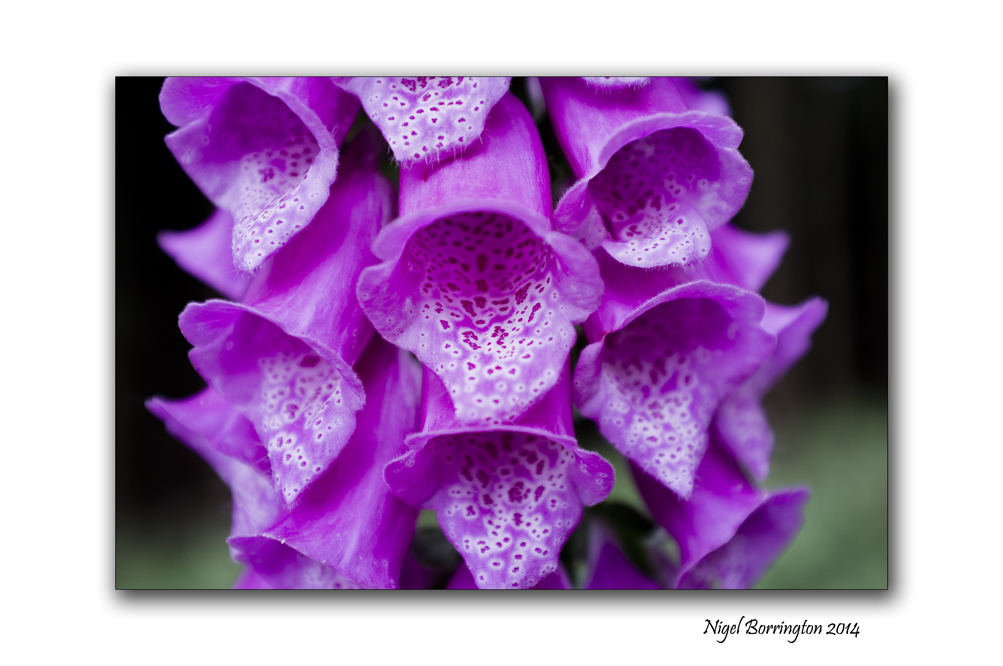
Quite forgotten, in the wood,
Pale, crowded steeples rise;
All the time that they have stood
None has heard their melodies.
Deep, deep in wizardry
All the foxglove belfries stand.
Should they startle over the land,
None would know what bells they be.
Never any wind can ring them,
Nor the great black bees that swing them–
Every crimson bell, down-slanted,
Is so utterly enchanted.

Orchids, A poem By : Cassandra Huller

Early March Orchid
Photography : Nigel Borrington
Orchids
By : Cassandra Huller
Round is the shape,
Pink are the petals.
Stem long and tall,
Leaves fluttered over, bent but not broken.
Roots deep in dirt,
Surrounded by a wall.
Some flowers fall but always rebloom~
The first spring Primrose on the river Lingaun

Primrose along the river Lingaun
Nature Photography : Nigel Borrington
At the end of June 2013 I posted about the “last of the Primrose” , well its hard to believe that its a full year since the first Primrose’s flowered in 2013 but these wonderful little river bank flowers are back again.
These Primrose grow beside the banks of the river Linguan as it works its way down towards the river suir, at Carrick -on-suir. I take Molly our golden retriever here for a swim in the rock pools, its a perfect place on a spring day.
I found the following information about Primrose’s :
Botanical Information
Primrose Flowers
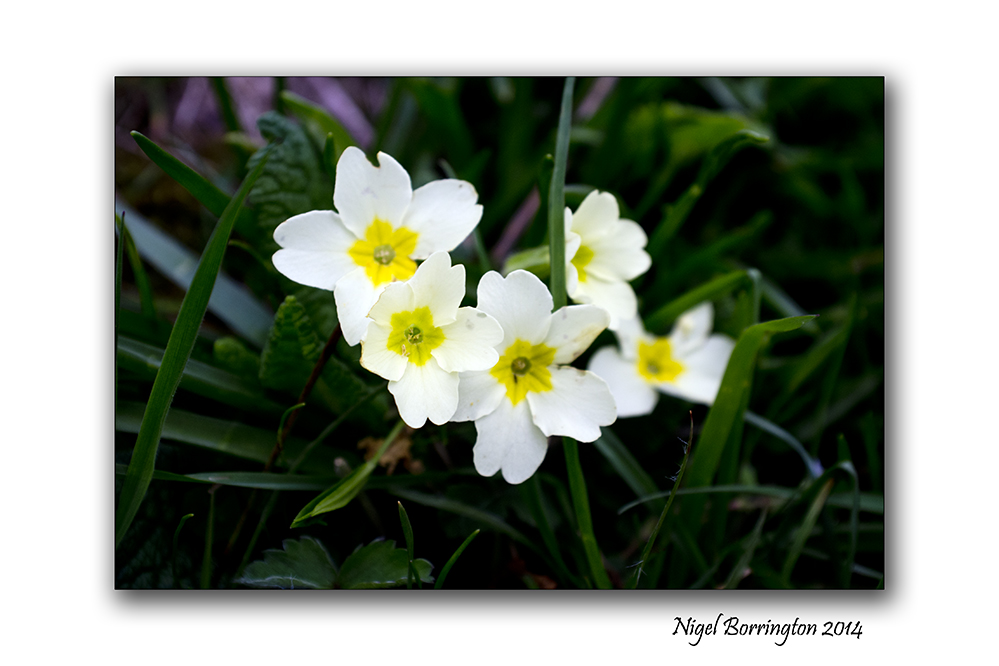
Primroses grow on shady river banks, and in woods and hedges and are common in Ireland. The characteristic rosette of green crinkled leaves appears first in March. The flowers then come up on individual stalks and open in the month of April. The flowers have five pale yellow petals.
In some flowers the stems are very long and the centre is small – these are called thrum flowers. If on the other hand you are looking at a flower with very short stem, it is called a pin flower.
They are perennial flowers, which means that they survive from year to year and grow again every Spring without having to be planted.
Folklore
Primroses were very important to farmers long ago for their cows. The butter-making season began in May and in order to be sure that the cows would produce lots of milk for butter, primroses were rubbed on their udders. In other houses primroses were scattered on the thresholds of houses before dawn on May day to protect the butter from the fairies.
Primroses were also associated with hens and the laying of eggs. It was considered unlucky to bring primroses into the house if eggs were being hatched there.
Primroses were often gathered and given as a gift. However it was considered to be very unlucky to give just a single primrose, whereas a very full bunch would be a protection against evil spirits.
Primroses bloomed in Tír na nÓg and people returning from there in the old Irish legends always brought primroses as proof that they had been there.
In folk medicine, rubbing a toothache with a primrose leaf for two minutes would give relief from the pain. It was also widely used as a cure for jaundice.
Poem
What is a Primrose?
To the question, “what is a primrose?”
There are several valid answers
One person says,
“A primrose by the river´s brim”
A yellow plant was to him, just that.
Nothing more.
Another, a scientist, says,
“A primrose is a delicately balanced
Biochemical mechanism requiring
Potash, phosphates, nitrogen and water
In definite proportions”
A third person says they are,
“Primrose of spring from the gods”
All these statements are true.
Primrose along the river Lingaun, Gallery



In a Sleepy Hollow, Wild Sorrel grows

Wild woodland Sorrel, Glenbower, Owning, county kilkenny
Irish Nature photography Nigel Borrington
In a Sleepy Hollow, Wild Sorrel grows
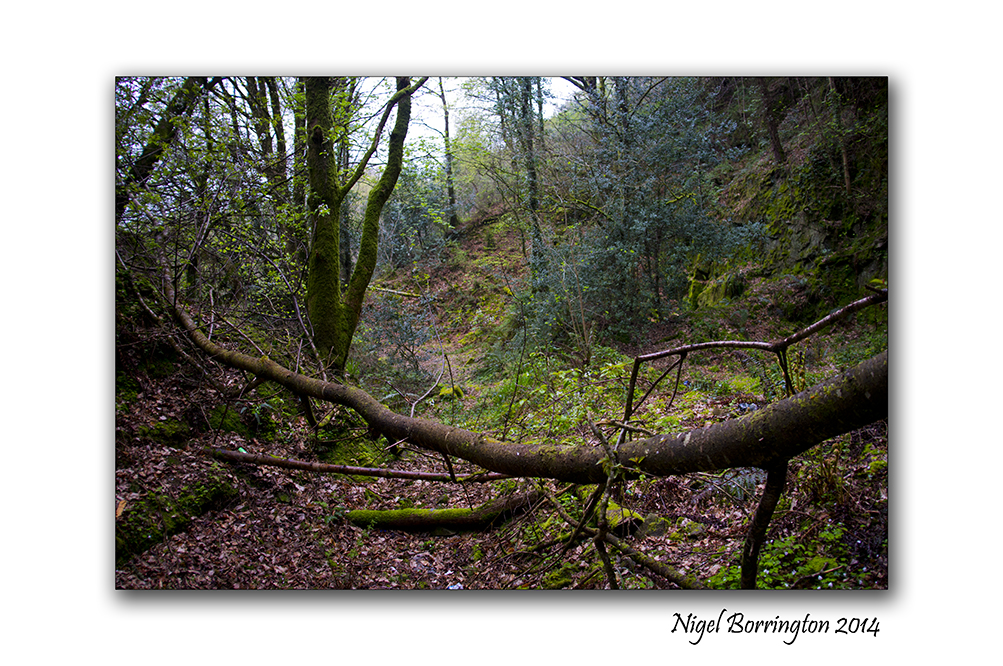
Glenbower woodlands is located near the village of owning in the south of county Kilkenn. In the middle of the wood is located a deep and very sleepy hollow, in winter the hollow is covered in fallen leaves from the trees that are located on the very edges of cliffs above.
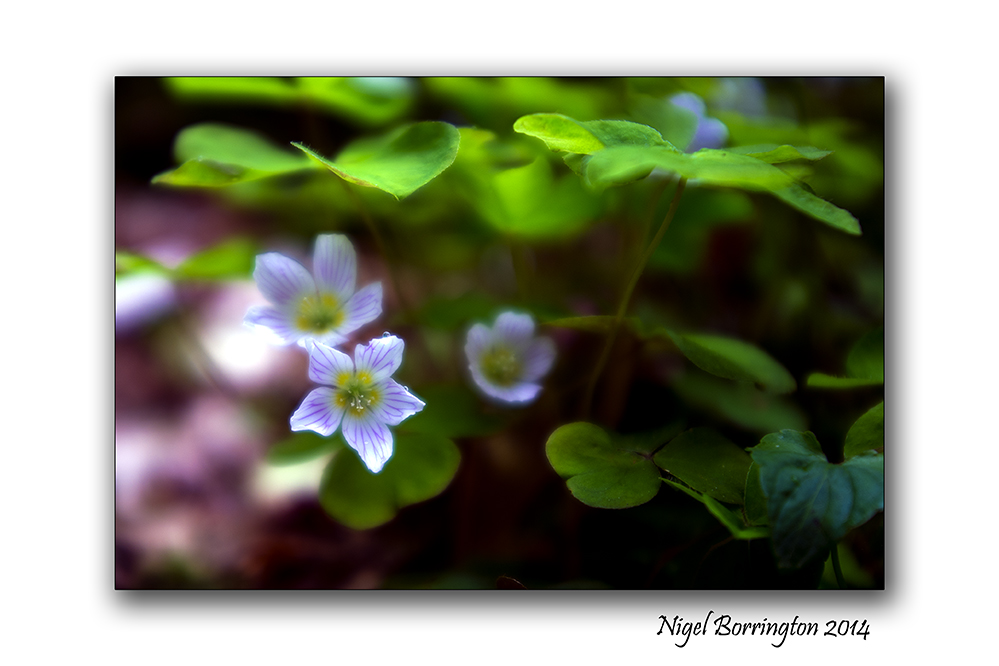
Spring time however brings new life with fox dens located in the cliffs and a carpet of ferns and Wild woodland Sorrel with its many white and purple flowers.
Sorrel is found carpeting many Irish old, undisturbed woodlands in spring, this pretty downy perennial also grows on moss-covered trees and shady stone walls and is widespread throughout the country.
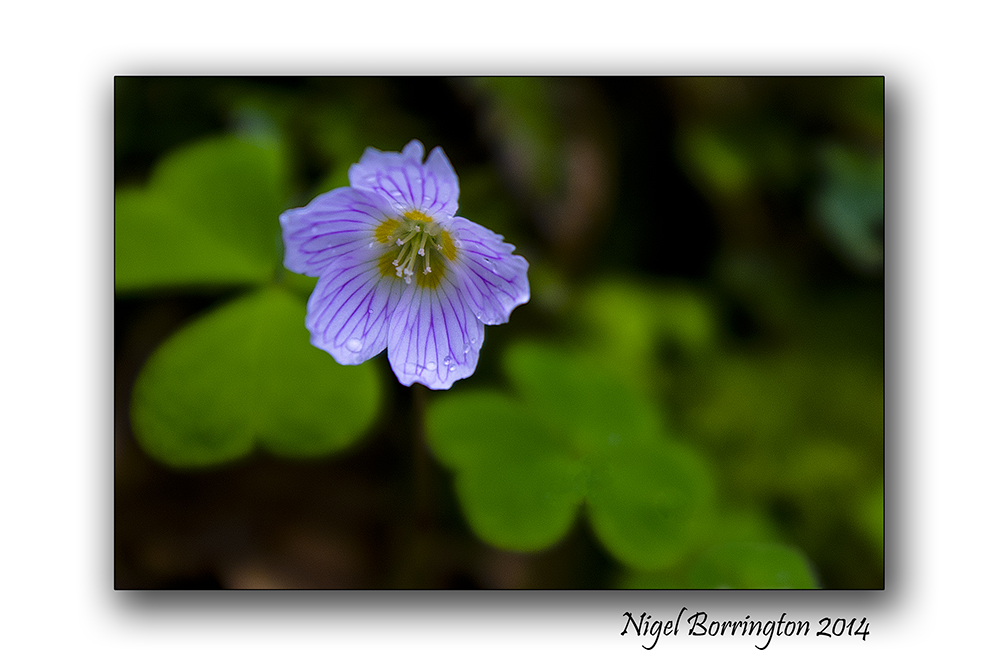
Each pretty white flower has five petals, bell-shaped some (10 – 15 mm), held on a stem which comes directly from the roots. The petals are lined with a tracery of purple veins through to the golden centre of the flower. The three petalled heart-shaped leafs fold up towards late afternoon or in rain as do the fragile flowers.
They Can be eaten and have a sharp taste of oxalic acid, wonderful with salads and as a garnish. The flowers blooms from April to June.
Wild Sorrel is a native plant to Ireland and belongs to the family Oxalidaceae.
Sleepy Hollow Image Gallery



Yellow Tutsan flowers

(hypericum), known as tutsan.
Irish nature and wildlife photography : Nigel Borrington
Hypericum
is a genus of about 400 species of flowering plants in the family Hypericaceae
Some species are used as ornamental plants and have large, showy flowers. Numerous hybrids and cultivars have been developed for use in horticulture, such as H. × moserianum (H. calycinum × H. patulum), H. ‘Hidcote’ and H. ‘Rowallane’. All of the above cultivars have gained the Royal Horticultural Society’s Award of Garden Merit.
St. John’s-worts can occur as nuisance weeds in farmland and gardens. On pastures, some can be more than a nuisance, causing debilitating photosensitivity and sometimes abortion in livestock. The beetles Chrysolina quadrigemina, Chrysolina hyperici and the St. John’s-wort Root Borer (Agrilus hyperici) like to feed on Common St. John’s-wort (H. perforatum) and have been used for biocontrol where the plant has become an invasive weed.
Hypericum species are the only known food plants of the caterpillar of the Treble-bar, a species of moth. Other Lepidoptera species whose larvae sometimes feed on Hypericum include Common Emerald, The Engrailed (recorded on Imperforate St. John’s-wort, H. maculatum), Grey Pug and Setaceous Hebrew Character.
Hypericin
Medical properties
Hyperforin
Hypericum olympicum in Botanic garden Liberec

Common St. John’s-wort (H. perforatum) has long been used in herbalism. It was known to have medical properties in Classical Antiquity and was a standard component of theriacs, from the Mithridate of Aulus Cornelius Celsus’ De Medicina (ca. 30 CE) to the Venice treacle of d’Amsterdammer Apotheek in 1686. Folk usages included oily extract (“St. John’s oil”) and Hypericum snaps.
H. perforatum is the most potent species and it is today grown commercially for use in herbalism and medicine; other St. John’s-worts possess interesting properties and chemical compounds but are not well researched. As these secondary compounds appear to be related to deterring herbivores, they are present in varying and unpredictable quantities: still, a number of high-yield cultivars have been developed.
Two main compounds of interest have been studied in more detail: hyperforin and hypericin. However, the pharmacology of H. perforatum is not resolved, and at least its antidepressant properties are caused by a wide range of factors interacting. As psychiatric medication, it is usually taken as pills, or as tea. Standardised preparations are available, and research has mainly studied alcoholic extracts and isolated compounds. What research data exists supports a noticeable effect in many cases of light and medium depression, but no significant improvement of severe depression and OCD.
The red, oily extract of H. perforatum may help heal wounds. Both hypericin and hyperforin are reported to have antibiotic properties. Justifying this view with the then-current doctrine of signatures, herbalist William Coles (1626–1662) wrote in the 17th century that
“The little holes where of the leaves of Saint Johns wort are full, doe resemble all the pores of the skin and therefore it is profitable for all hurts and wounds that can happen thereunto.”
Hypericum perforatum may also be capable of reducing the physical signs of opiate withdrawal. Caution should be taken, as high-dosage H. perforatum interacts with a wide range of medications due to activation of the Pregnane X receptor detoxification pathway, and it also causes photosensitivity.
Hypericum extract, by inducing both the CYP3A4 and the P-glycoprotein (P-gp), can reduce the plasma concentrations of different antineoplastic agents such as imatinib, irinotecan and docetaxel, thus reducing the clinical efficacy of these drugs.

Irish Burnet Rose, Rosa spinosissima (Briúlán)
Sigma SD15, 15mm-30mm lens, iso 50
Irish Burnet Rose, Rosa spinosissima (Briúlán)
Irish Nature photography by : Nigel Borrington
Rosa spinosissima (Briúlán)
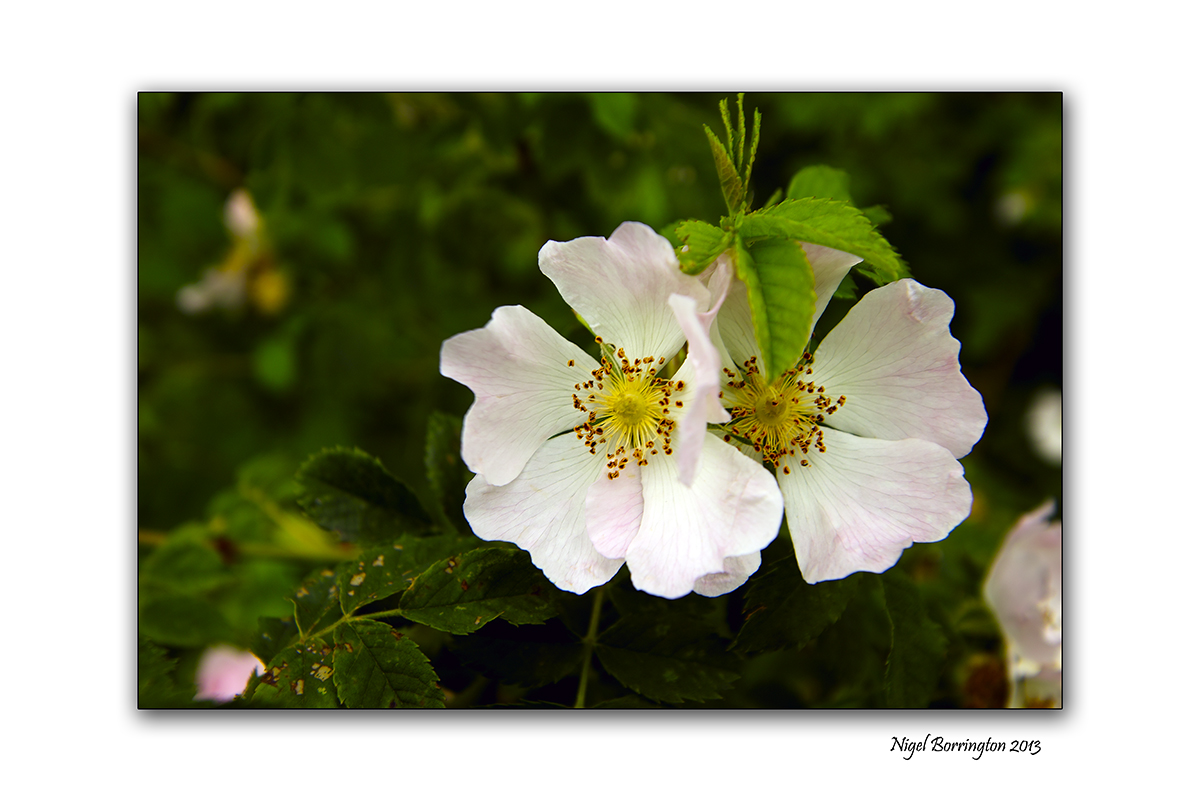
A walk along a woodland path or river bank at this time of year will give you a wonderful view of Ireland wild flowers, yesterday I photographed these wild roses.
“This little rose is such a delight to find, usually on sandy soil, limestone pavements and grassy heaths. It’s an erect, bushy shrub, about 50cm in height with numerous straight thorns and stiff bristles. Its pretty 3-5cm flowers can be white, cream or pink and are comprised of five heart-shaped petals. They flower from May to August after which the bush displays its fruit in spherical, purplish-black hips which still have the remnants of the sepals at their tops. The leaves are 3-5 pairs of small rounded leaflets. This shrub usually sheds its leaves in winter. It is a native plant belonging to the family Rosaceae. There are some microspecies. ”
Ref : Wildflowers of Ireland

Sigma SD15, 15mm-30mm lens, iso 50
Irish Burnet Rose, Rosa spinosissima (Briúlán)
Irish Nature photography by : Nigel Borrington

Sigma SD15, 15mm-30mm lens, iso 50
Irish Burnet Rose, Rosa spinosissima (Briúlán)
Irish Nature photography by : Nigel Borrington
Of woodland places

Fujifilm X100, 35mm lens, f4, iso 500
Irish woodland nature photography
Nigel Borrington
Sometimes its the most simple of things that interest me the most when out with my camera, yesterday evening for example, just taking time to stop and notice springtime in its hight …..

Fujifilm X100, 35mm lens, f4, iso 500
Irish woodland nature photography
Nigel Borrington
This is wild woodland sorrel I describe it here : woodland sorrel
Dandelion
The Dandelion
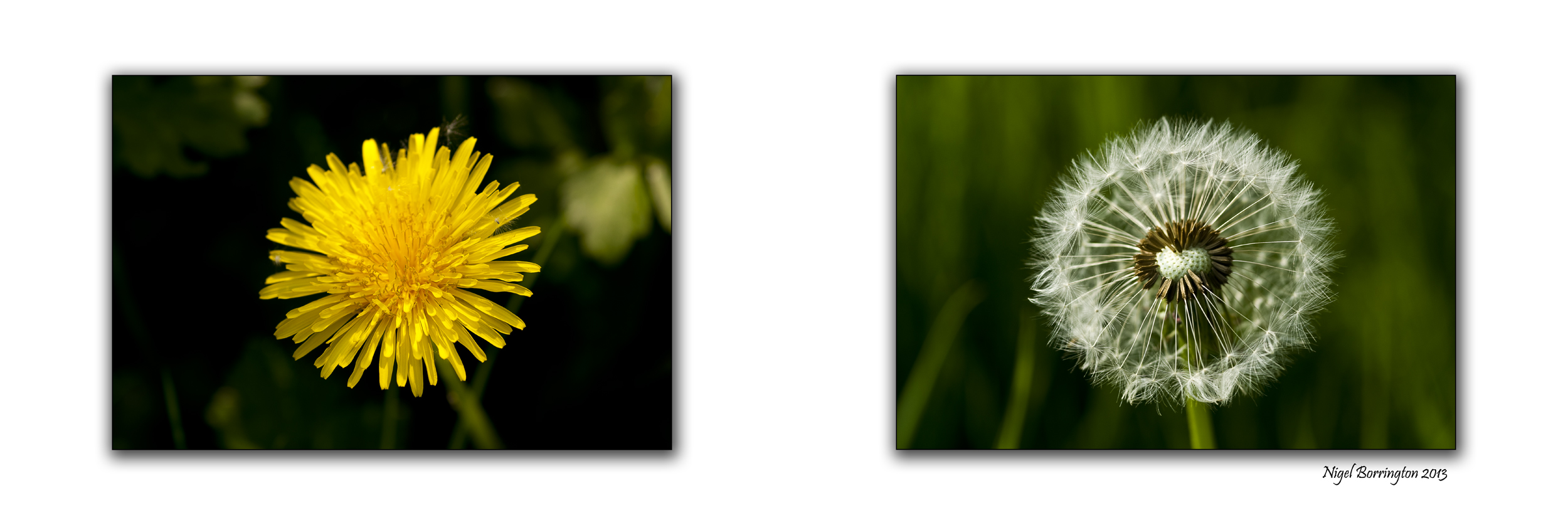
The Dandelion has to be one of the most available of natures plants and flowers during the summer, but according to the following article it can be used as a very effective drug:
By Peter Gail
Suppose your doctor tells you, on your next visit, that he has just discovered a miracle drug which, when eaten as a part of your daily diet or taken as a beverage, could, depending on the peculiarities of your body chemistry: prevent or cure liver diseases, such as hepatitis or jaundice; act as a tonic and gentle diuretic to purify your blood, cleanse your system, dissolve kidney stones, and otherwise improve gastro-intestinal health; assist in weight reduction; cleanse your skin and eliminate acne; improve your bowel function, working equally well to relieve both constipation and diarrhea; prevent or lower high blood pressure; prevent or cure anemia; lower your serum cholesterol by as much as half; eliminate or drastically reduce acid indigestion and gas buildup by cutting the heaviness of fatty foods; prevent or cure various forms of cancer; prevent or control diabetes mellitus; and, at the same time, have no negative side effects and selectively act on only what ails you. If he gave you a prescription for this miracle medicine, would you use it religiously at first to solve whatever the problem is and then consistently for preventative body maintenance?
All the above curative functions, and more, have been attributed to one plant known to everyone, Taraxacum officinale, which means the “Official Remedy for Disorders.” We call it the common dandelion. It is so well respected, in fact, that it appears in the U.S. National Formulatory, and in the Pharmacopeias of Hungary, Poland, Switzerland, and the Soviet Union. It is one of the top 6 herbs in the Chinese herbal medicine chest.
According to the USDA Bulletin #8, “Composition of Foods” (Haytowitz and Matthews 1984), dandelions rank in the top 4 green vegetables in overall nutritional value. Minnich, in “Gardening for Better Nutrition” ranks them, out of all vegetables, including grains, seeds and greens, as tied for 9th best. According to these data, dandelions are nature’s richest green vegetable source of beta-carotene, from which Vitamin A is created, and the third richest source of Vitamin A of all foods, after cod-liver oil and beef liver! They also are particularly rich in fiber, potassium, iron, calcium, magnesium, phosphorus and the B vitamins, thiamine and riboflavin, and are a good source of protein.
These figures represent only those published by the USDA. Studies in Russia and Eastern Europe by Gerasimova, Racz, Vogel, and Marei (Hobbs 1985) indicate that dandelion is also rich in micronutrients such as copper, cobalt, zinc, boron, and molybdenum, as well as Vitamin D.
Much of what dandelions purportedly do in promoting good health could result from nutritional richness alone. Vogel considers the sodium in dandelions important in reducing inflammations of the liver. Gerasimova, the Russian chemist who analyzed the dandelion for, among other things, trace minerals, stated that “dandelion [is] an example of a harmonious combination of trace elements, vitamins and other biologically active substances in ratios optimal for a human organism” (Hobbs 1985).
Recent research, reported in the Natural Healing and Nutritional Annual, 1989 (Bricklin and Ferguson 1989) on the value of vitamins and minerals indicates that:
* Vitamin A is important in fighting cancers of epithelial tissue, including mouth and lung;
* Potassium rich foods, in adequate quantities, and particularly in balance with magnesium, helps keep blood pressure down and reduces risks of strokes;
* Fiber fights diabetes, lowers cholesterol, reduces cancer and heart disease
risks, and assists in weight loss. High fiber vegetables take up lots of room, are low in calories, and slow down digestion so the food stays in the stomach longer and you feel full longer;
* Calcium in high concentrations can build strong bones and can lower blood pressure;
* B vitamins help reduce stress.
Throughout history, dandelions have had a reputation as being effective in promoting weight loss and laboratory research indicates that there is some support for this reputation. Controlled tests on laboratory mice and rats by the same Romanians indicated that a loss of up to 30% of body weight in 30 days was possible when the animals were fed dandelion extract with their food. Those on grass extract lost much less. The control group on plain water actually gained weight.
Beyond nutritional richness, however, are the active chemical constituents contained in dandelions which may have specific therapeutic effects on the body. These include, as reported by Hobbs (1985):
* Inulin, which converts to fructose in the presence of cold or hydrochloric acid in the stomach. Fructose forms glycogen in the liver without requiring insulin, resulting in a slower blood sugar rise, which makes it good for diabetics and hypoglycemics;
* Tof-CFr, a glucose polymer similar to lentinan, which Japanese researchers have found to act against cancer cells in laboratory mice; Lentinan is a yeast glucan (glucose polymer) that increases resistance against protozoal and viral infections.;
* Pectin, which is anti-diarrheal and also forms ionic complexes with metal ions, which probably contributes to dandelion’s reputation as a blood and gastrointestinal detoxifying herb. Pectin is prescribed regularly in Russia to remove heavy metals and radioactive elements from body tissues. Pectin can also lower cholesterol and, combined with Vitamin C, can lower it even more. Dandelion is a good source of both Pectin and Vitamin C;
* Coumestrol, an estrogen mimic which possibly is responsible, at least in part, for stimulating milk flow and altering hormones;
* Apigenin and Luteolin, two flavonoid glycosides which have been demonstrated to have diuretic, anti-spasmodic, anti-oxidant and liver protecting actions and properties, and also to strengthen the heart and blood vessels. They also have anti-bacterial and anti-hypoglycemic properties, and, as estrogen mimics, may also stimulate milk production and alter hormones;
* Gallic Acid, which is anti-diarrheal and anti-bacterial;
* Linoleic and Linolenic Acid, which are essential fatty acids required by the body to produce prostaglandin which regulate blood pressure and such body processes as immune responses which suppress inflammation. These fatty acids can lower chronic inflammation, such as proliferative arthritis, regulate blood pressure and the menstrual cycle, and prevent platelet aggregation;
* Choline, which has been shown to help improve memory;
*Several Sesquiterpene compounds which are what make dandelions bitter. These may partly account for dandelions tonic effects on digestion, liver, spleen and gall bladder, and are highly anti-fungal;
* Several Triterpenes, which may contribute to bile or liver stimulation;
* Taraxasterol, which may contribute to liver and gall bladder health or to hormone altering.
These chemicals, individually, are not unique to dandelions, but the combination of them all in one plant, along with high levels of vitamins, minerals, carbohydrates, proteins and fiber account for the many claims made regarding the plant.
These claims include the following results of clinical and laboratory research, again as reported in Hobbs (1985):
* A doubling of bile output with leaf extracts, and a quadrupling of bile output with root extract. Bile assists with the emulsification, digestion and absorption of fats, in alkalinizing the intestines and in the prevention of putrefaction. This could explain the effectiveness of dandelion in reducing the effects of fatty foods (heartburn and acid indigestion);
* A reduction in serum cholesterol and urine bilirubin levels by as much as half in humans with severe liver imbalances has been demonstrated by Italian researchers;
* Diuretic effects with a strength approaching that of the potent diuretics Furosemide and Lasix, used for congestive heart failure and cirrhosis of the liver, with none of the serious side effects, were found by Romanian scientists. They found that water extract of dandelion leaves, administered orally, because of its high potassium content, replaced serum potassium electrolytes lost in the urine, eliminating such side effects common with the synthetics as severe potassium depletion, hepatic coma in liver patients, circulatory collapse, and transmission through mothers’ milk;
* In 1979 a Japanese patent was filed for a freeze-dried warm water extract of dandelion root for anti-tumor use. It was found that administration of the extract markedly inhibited growth of particular carcinoma cells within one week after treatment;
* Dental researchers at Indiana University in 1982 used dandelion extracts in antiplaque preparations;
* In studies from 1941 to 1952, the French scientist Henri Leclerc demonstrated the effectiveness of dandelion on chronic liver problems related to bile stones. He found that roots gathered in late summer to fall, when they are rich in bitter, white milky latex, should be used for all liver treatments;
* In 1956, Chauvin demonstrated the antibacterial effects of dandelion pollen, which may validate the centuries old use of dandelion flowers in Korean folk medicine to prevent furuncles (boils, skin infections), tuberculosis, and edema and promote blood circulation.
Also, Witt (1983) recommends dandelion tea to alleviate the water buildup in PMS (pre-menstrual syndrome).
There are many testimonials from those who have benefited from the use of dandelions in the treatment of what ailed them.
Robert Stickle, an internationally famous architect, was diagnosed as having a malignant melanoma 21 years ago, and was given, after radical surgery had not halted its spread, less than 2 years to live. He said, in a letter to Jeff Zullo, president of the Society for the Promotion of Dandelions, (June 23, 1986):
” I went on a search for the answer to my mortal problem, and [discovered] that perhaps it was a nutritional dilemma…. To me, cancer is primarily a liver failure manifestation. {Italians are very concerned about problems of the ‘fegato’]. [I discovered that] the cancer rate in native Italians is very low among the farming population (paesanos). When they get affluent and move to the city, its the same as the rest of civilized man. Paesanos eat dandelions, make brew from the roots, and are healthy, often living to over 100 years.”
He states that he began eating dandelion salad every day, and his improvement confounded the doctors. When he wrote the letter in 1986, 18 years had passed and there had been no recurrence of the melanoma.
Wild Garlic

Nikon D7000
I captured these photographs in Glenbawn Woods, Clonmel, Co Tipperary in April 2012, these woods are on the banks of the river Suir.
Wild Garlic grows very well in many Irish woodlands it needs a dark and wet part of the wood, In this wood part of the walk passed along the banks of the river. This area if covered with Garlic and the smell as you walk through the carpet of it is overpowering an wonderful. I took a large bag with me and collected enough to last me sometime.
Wild Garlic has been used throughout history as a health and healing food and it heals many complaints, this year I will be back again and its out very soon!
Ramsons Wild Garlic
(Allium ursinum)
Description:
Tall hairless perennial plant, with erect unbranched stem; usually found growing in large colonies. The leaves, normally 2, are upto 20cm long and are broad, pointed and long-stalked. The flowers are white star-shaped with 6 segments. It is readily identified by its strong scent of garlic, particularly if bruised or crushed.
The glossy green leaves of Ramsons, or Wild Garlic are delicious in sandwiches, used sparingly in salads, or added to sauces and dressings. It also makes splendid pesto. The bulb can also be eaten raw or cooked, and can be harvested all year round, though is best used when the plant is dormant from July to December or January. It has a fairly strong garlic flavour, though it is quite small and fiddly to harvest.
Flowers – raw or cooked. These are somewhat stronger than the leaves, in small quantities they make a decorative and very tasty addition to salads. The flowering heads can still be eaten as the seed pods are forming, though the flavour gets even stronger as the seeds ripen.
“maye very well be eaten in April and Maie with butter, of such as are of a strong constitution, and labouring men” – Gerard
Size: 50cm
Distribution: Throughout UK
Flowering months: April – June
Habitat: Damp woods, hedges, shady damp meadows, streamsides.
Folk Names: Broad-Leaved Garlic, Wild Garlic, Ramsons, Wood Garlic, Roman Garlic
Active ingredients; essential oils, vitamin C, allicin, iron.
Used to treat digestive problems, rheumatism, high blood pressure and asthma. When applied to the skin, this species is rubefacient. Externally, the bruised leaves may be applied to abscesses and boils. It may help the circulation and also be antiviral. A popular cure for the kidney stone and for purifying and strengthening the blood. Alone or with other ingredients it was also used in poultices and as a diuretic.
Ref : Wild Garlic
Wild Sorrel

Wild Sorrel in the irish woodland
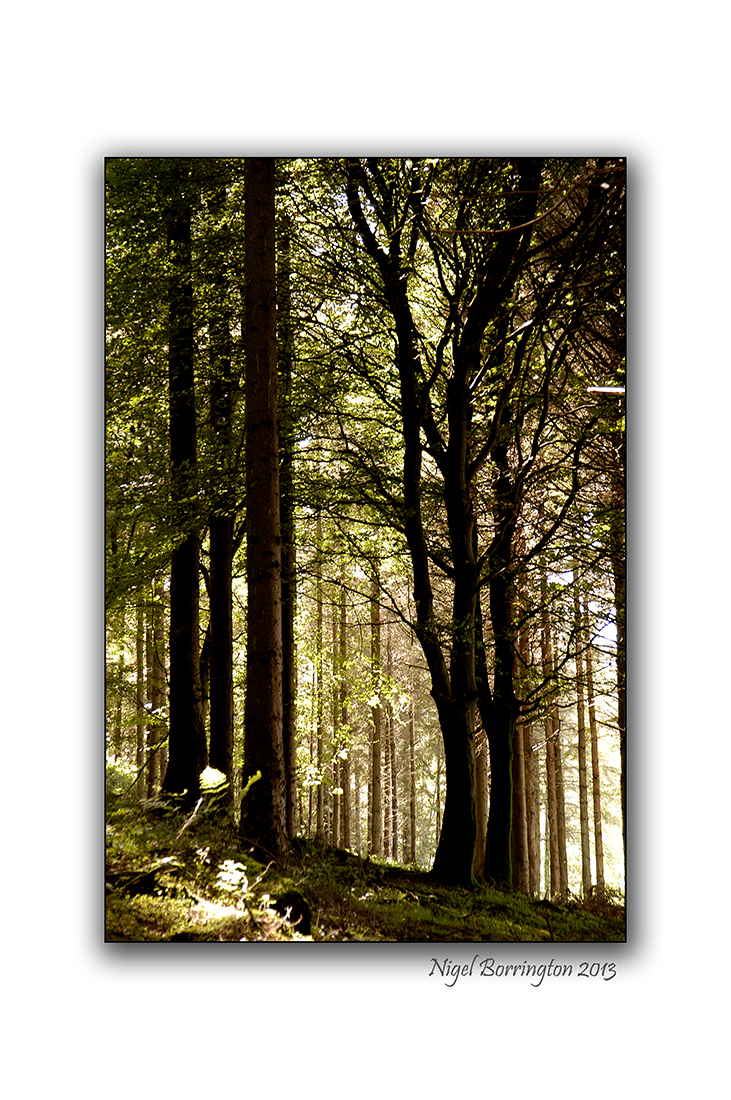
From the Middle of April until the Summer many of Irelands wood-land floors come to life with lots of different plants, Wild Sorrel is one if these that can be fully enjoyed. It can be picked and eaten on your walk or collected and taken home for you fridge.
The leafs of this plant can add to any meal that you are preparing. I love the moment when I first see wild sorrel coming out, its the start of the woodlands bursting into life after a long cold winter.
This web page has a great discription… http://www.wildflowersofireland.net/plant_detail.php?id_flower=243
“Carpeting old, undisturbed woodlands in spring, this pretty downy perennial also grows on moss-covered trees and shady walls and is widespread throughout the country. Each pretty white five-petalled bell-shaped flower (10 – 15 mm) is held solitarily on a stem which comes directly from the roots. The petals are lined with a tracery of pink veins through to the golden centre of the flower. The leaves are trifoliate, each leaflet heart-shaped and these fold up towards late afternoon or in rain as do the fragile flowers. They have a sharp taste of oxalic acid. This flower blooms from April to June, is a native plant and belongs to the family Oxalidaceae.
Also known as Wood Shamrock and Wood Sour, the leaves of this plant were used to make an ointment by early herbalists. Some people eat these leaves in salads or soups but beware, as large doses may cause oxalate poisoning. “
 Nigel Borrington
Irish landscape Images for the week – (Monday) Irish bog lands.
During this week, I just wanted to return to some of my most loved Irish Landscape locations and Monday today’s post I want to share some images I have taken since 2014, these relate to the Irish Bog and Peat lands of the Irish Midlands and the West coast.
Ireland has internationally important peat/bog lands but they are always under serious threat. Over the last few years the Irish government has protected areas of special conservation from historic family rights to cut peat in these areas, a decision that created problems for some but one that was very much needed in order to start the process of returning the bog’s to a point of growth and sustainability.
I love these locations, they are remote and full of life both plant and wild life and I feel like many others that they do need very special care and support.
When you visit locations like the Bog of Allen, you can see a contrast between the areas that are still wild and untouched and the areas that have been harvested for peat, when you see this contrast and its different effects on local bio-diversity you would only hope that one day we can find a less damaging way to heat our homes and produce energy.
Irish Bog-lands Gallery
Share this:
April 25, 2016 | Categories: Comment, Gallery, Landscape, Nature, Nature and Wildlife, Nigel Borrington, Plants and herbs, Travel Locations | Tags: Biodiversity, bog lands, Bog of Allen, Ireland, Irish landscape photography, Nature, nature and wildlife photography, Nigel Borrington, Peat lands, wildlife | 9 Comments