Capturing the world with Photography, Painting and Drawing

Latest

A weekend with colour …….

Colour mixing,
WaterColour and acrylics

A weekend in colour

This week I started an online course in colour mixing for watercolour and acrylic painting, so during this weekend I plan to spend as much time as possible learning colour theory.
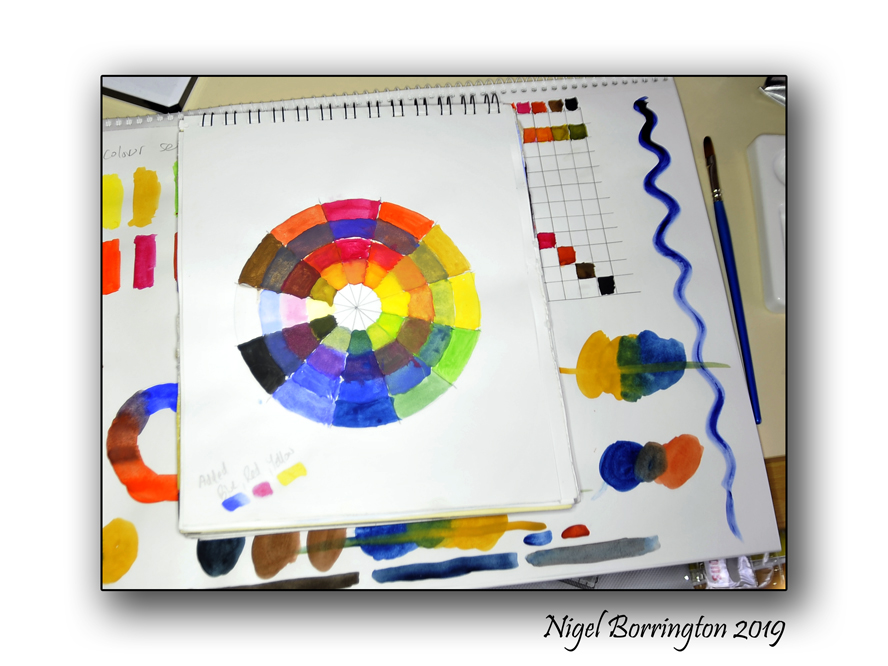
I worked on the course in the evenings and have already used up a few pages of a new sketchbook, including the pages I have posted here.

I feel that one of the most important things I have learned so far, regardless of the type of paint used (Watercolour or Acrylic) is that I am getting to know them very well, how to mix the basic colours included in a sets of paints and what the results look like. Not all colours act the same even when used without mixing them, some colours produce very smooth results others produce a very grainy texture, some colours don’t seem to go into the paper or canvas very deeply others act more like a dye and the moment they touch a painting surface they stain and fix themselves in very quickly and most likely permanently.

The use of colours

When I first stated painting some years back, I would spend a large amount of time trying to match every single colour in a landscape I was painting, however I feel that since these days I have learnt that doing this is not only exhausting it also does not always produce a good painting. Colours can be used much more effectively when limited and balanced so that they are used to compliment each other. When colour is used to highlight areas in a painting or to soften other areas they can make some parts of a painting stand out and others while still included, fall into the background of the finished work.

It’s all these areas and more that I want to study and regain complete understanding again of both in practice and theory, I can then move onto producing colour sketches and full paintings again.


Colour mixing, using just Primary colours

In order to produces all the colours you want to include in a painting you actually only need three , The primary colours (RED,YELLOW and BLUE), what does counts here however is the type of red, yellow or blue you start with in the first place as this will allow you to produces very different final results.

So this weekend I plan to uses as much paper as possible and produce a colour notebook that I can use during the year to help me when producing any paintings I start working on.

If I get time I will post on my progress but if not, I will on Monday post some results and my thoughts on what I worked on.
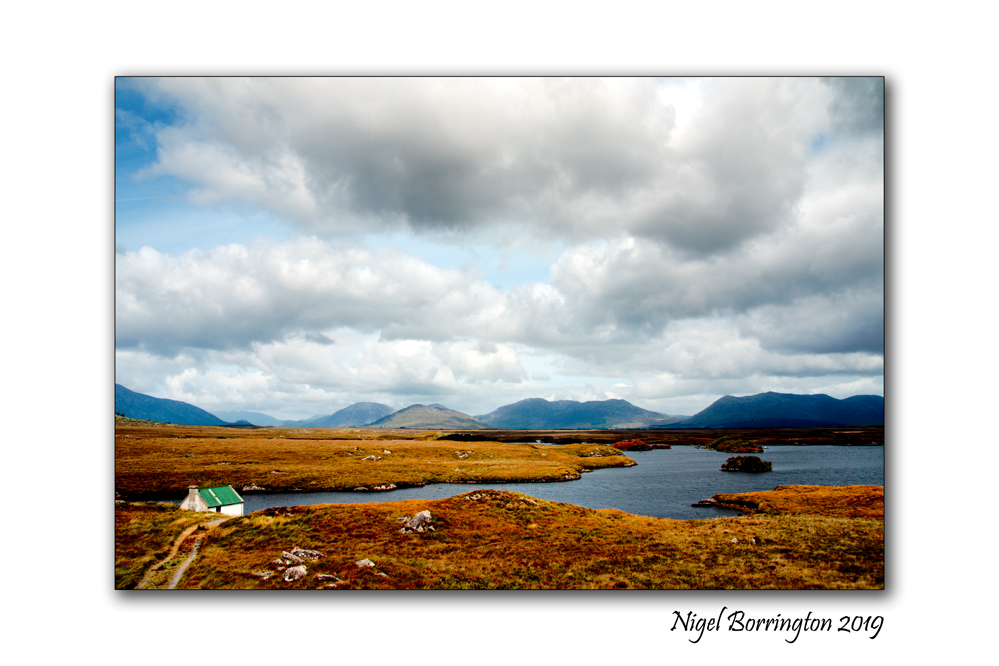
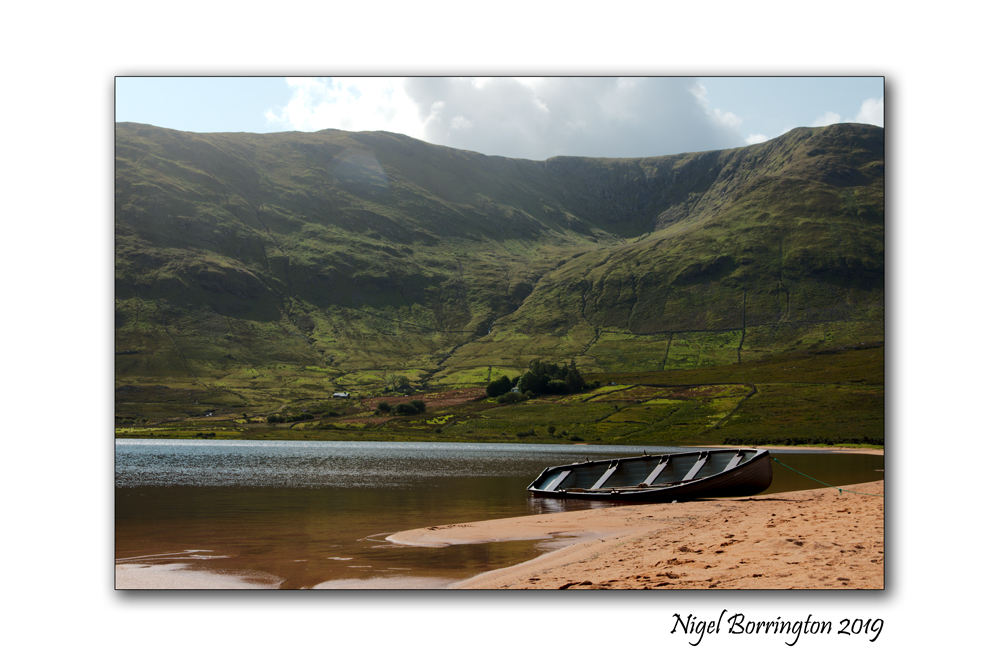
Connemara, Co. Galway, Ireland – The Landscape of Poetry – Poems by Mary O’Malley

Connemara
county Galway
Ireland
Nigel Borrington
2019

Connemara, Co. Galway

Mary O’Malley is truly the person who has written Connemara, her writing laced with the fierce beauty of the landscape, and the sounds of the sea. In ‘Porpoises’ she sends our minds out to sea from the most westerly point of the county:

The sky is close.

Out from the once manned rock

White electric light

Arcs over the Water

Difficult not to agree with her when she states that the sea is “just the place from which all things make sense”.

Pierce Hutchinson, also writing on Connemara, said:

There are chinks between

the neat stones to let the wind through safe,

You can see the blue sun through them.

But coming eastward in the same county,

the walls grow higher, dark grey;

an ugly grey. And the chinks disappear:

through those walls you can see nothing.

Perhaps our poetic landscapes remind us of that – to keep our hearts alert for experiences of water, wind and wonder.

350,000+ WordPress Blog likes and Visits – THANK YOU SO MUCH !!!

I added this thank you message to the post blow but feel that I should also post it by itself !

” I just noticed that the number of likes and visited to my Blog (started in 2011) went well over the 350,000 mark while I was away – I would like to say a massive THANK YOU to you all for this, I don’t post here with such figures in mind , I post to share the things a see and capture around me – That said ! Getting this level of interest and support with so many likes has been a massive boost to me and a huge reason to drive me on in 2019 to keeping sharing my images and a love I have of both Art and Photography!

THANK YOU SO MUCH !!!! “

2019 – A new light , sunrise over Kilkenny’s fields …….

Starting my 2019 Blogging …..

I always like to start my blogging for a new year by changing my site heading image.

This year my first image taken and posted – my new site header image was taken on Sunday Morning at first light, I was on an early morning walk and the weather was cold with a full covering of cloud. I had just about completed the 5km walk I had planned to do and had almost given up on capturing any images as the light was just so unexciting when the sun came bursting through an opening in the clouds and located itself just about some trees in the distance.

I have taken a little time off-line over the Christmas and New-Year period just to give myself an old fashioned way to celebrate and recharge my batteries, I spend some great time with family and friends 🙂 and as a result I feel great and am looking forward with new energy to 2019 and the future 🙂 , my blog and my love of photography still play a massive part in these plans 🙂

I also noticed that the number of likes and visited to my Blog (started in 2011) went well over the 350,000 mark while I was away – I would like to say a massive THANK YOU to you all for this, I don’t post here with such figures in mind , I post to share the things I see and capture around me – That said ! Getting this level of interest and support with so many likes has been a massive boost to me and a huge reason to drive me on in keeping sharing my images and a love of both Art and Photography!

THANK YOU SO MUCH !!!!

Happy Winter solstice 2018 everyone …….

Dec 21 2018
The Winter solstice
Nigel Borrington

The winter solstice (or hibernal solstice), also known as midwinter, is an astronomical phenomenon marking the day with the shortest period of daylight and the longest night of the year. It occurs when one of the Earth’s poles has its maximum tilt away from the Sun. It happens twice yearly, once in each hemisphere. In the Northern Hemisphere this is the December solstice and in the Southern Hemisphere this is the June solstice.

The axial tilt of Earth and gyroscopic effects of its daily rotation mean that the two opposite points in the sky to which the Earth’s axis of rotation points (axial precession) change very slowly (at the current rate it would take just under 26,000 years to make a complete circle). As the Earth follows its orbit around the Sun, the polar hemisphere that faced away from the Sun, experiencing winter, will, in half a year, face towards the Sun and experience summer. This is because the two hemispheres face opposite directions along Earth’s axis, and so as one polar hemisphere experiences winter, the other experiences summer.

More evident from high latitudes, a hemisphere’s winter solstice occurs on the day with the shortest period of daylight and longest night of the year, when the sun’s daily maximum elevation in the sky is at its lowest. Although the winter solstice itself lasts only a moment in time, the term sometimes refers to the day on which it occurs. Other names are “midwinter”, the “extreme of winter” (Dongzhi), or the “shortest day”. In some cultures it is seen as the middle of winter, while in others it is seen as the beginning of winter. In meteorology, winter in the Northern Hemisphere spans the entire period of December through February. The seasonal significance of the winter solstice is in the reversal of the gradual lengthening of nights and shortening hours of daylight during the day. The earliest sunset and latest sunrise dates differ from winter solstice, however, and these depend on latitude, due to the variation in the solar day throughout the year caused by the Earth’s elliptical orbit (see earliest and latest sunrise and sunset).

Worldwide, interpretation of the event has varied across cultures, but many have held a recognition of rebirth, involving holidays, festivals, gatherings, rituals or other celebrations around that time.

Beyond The Door – Poem by Clark Ashton Smith

Beyond The Door – Poem by Clark Ashton Smith

Alas! the evanescence of a dream,
That, like a rose, shall never blossom more!
A glimpse of unguessed things, and then the door
Of waking sense clangs to. Alas! the Gleam,
The visioned Secret and the Light supreme,
That one at moments nears, when, lo! the pall
Of veiling darkness drops and covers all –
The darkness of the daylight’s aureate beam!

Leaving but an elusive memory –
A heavenly cadence, a supernal word,
Never but half-recalled. In dreams are heard
Who knows what tidings from Eternity,
Transcendant, strange! Alas! we may not bring
Aught past the gateway of Awakening!

Clark Ashton Smith

“At the Gate” by Henrik Nordbrandt

AT THE GATE

1.
In the dream
at the gate to your grave
you stopped me
with the same words
I had spoken in a dream
where I died before you

so now I can no longer dream.

2.
Rusty, and on squeaky hinges
all the gates I have ever
seen, heard, or described
closed one by one
under a grey sky.

That is all there was
in my mind, earth.

3.
What can I say about the world
in which your ashes sit in an urn
other than that?

4.
On every trip you stay ahead of me.
On platforms I see your footprints in fresh snow.
When the train starts to move
you jump out of the back carriage

to reach the next station ahead of me.

5.
Outside the small towns with their sleepy street lights:
stadiums bright as capitols.

The lights glinted off your glasses.

Where else should you look for the ring
which, the night the power went out,
rolled under the bed and was gone?

6.
“I miss you, too”
were my last words
on the telephone
when you said you missed me.
I miss you too, Forever!

7.
You are gone.

Three words. And not one
of them
exists now in any other context.

Histories Best Artists – Leonora Carrington

Leonora Carrington
kron-flower-1987

Leonora Carrington

Born 6 April 1917

Clayton-le-Woods, Lancashire, England

For me leonara Carrington is one of histories great Artists, Personally and I feel the best female artists of all time(IMO), although correctly she fought all her life again the label of “Female Artist” and just wanted to be call an ARTIST period !

Her work should be much better known and would be so but for a few facts , she was producing art at the same time as some the now best known European artist, who would later become house hold names but also she lived and worked during the Nazi period of European Art theft and art control, because of this she ended up in the end making her home in Mexico in a period when no one took anyone not working in Europe or America seriously.

In 1936, Leonora saw the work of the German surrealist Max Ernst at the International Surrealist Exhibition in London and was attracted to the Surrealist artist before she even met him. In 1937, Carrington met Ernst at a party held in London. The artists bonded and returned together to Paris, where Ernst promptly separated from his wife. In 1938, leaving Paris, they settled in Saint Martin d’Ardèche in southern France.

The new couple collaborated and supported each other’s artistic development. The two artists created sculptures of guardian animals (Ernst created his birds and Carrington created a plaster horse head) to decorate their home in Saint Martin d’Ardèche.

With the outbreak of World War II Ernst, who was German, was arrested by the French authorities for being a “hostile alien”. With the intercession of Paul Éluard, and other friends, including the American journalist Varian Fry, he was discharged a few weeks later. Soon after the Nazis invaded France, Ernst was arrested again, this time by the Gestapo, because his art was considered by the Nazis to be “degenerate”. He managed to escape and, leaving Carrington behind, fled to America with the help of Peggy Guggenheim, who was a sponsor of the arts.

After Ernst’s arrest, Carrington was devastated and fled to Spain. Paralyzing anxiety and growing delusions culminated in a final breakdown at the British Embassy in Madrid. Her parents intervened and had her hospitalised. She was given “convulsive therapy” and was treated with the drugs cardiazol, a powerful anxiolytic drug (eventually banned by some authorities, including the US Food and Drug Administration (FDA)), and Luminal, a barbiturate. After being released into the care of a nurse who took her to Lisbon, Carrington ran away and sought refuge in the Mexican Embassy. Meanwhile, Ernst had married Peggy Guggenheim in New York in 1941. That marriage ended a few years later. Ernst and Carrington never resumed their relationship.

In 1939, Carrington painted a portrait of Max Ernst, as a tribute to their relationship. The portrait was her first Surrealist work, and it was called The Inn of the Dawn Horse. It is now in the Metropolitan Museum of Art. The person in the painting is a cross between a male and a female, who is seated in a room with a rocking horse on the wall.

She also painting this portrait with him as the main character ..

Portrait of Max Ernst
Leonora Carrington
Oil on canvas
date created: About 1939

From the very first time I viewed Leonara’s art works I was captivated, her paintings are full of mystery and magical subjects, without falling into more traditional and classical mythological stories.

I found myself wanting to understand more about the fantasy world that her painting capture, a world of hidden meanings, I still don’t fully understand and here in this video she tells us not of over analyses art and just to enjoy living in the moment. However just looking at her creations you know she must have held many stories in her mind, I will keep looking and discovering!

Leonora Carrington

(6 April 1917 – 25 May 2011) was an English-born Mexican artist, surrealist painter, and novelist. She lived most of her adult life in Mexico City, and was one of the last surviving participants in the Surrealist movement of the 1930s. Carrington was also a founding member of the Women’s Liberation Movement in Mexico during the 1970s.

Looking at many of her painting you can clearly see that her life and work is the source for the movie Pan’s Labyrinth, Director: Guillermo del Toro, Writer: Guillermo del Toro , set in the falangist Spain of 1944, about a bookish young stepdaughter of a sadistic army officer escapes into an eerie but captivating fantasy world, the very same kind of fantasy worlds Leonora Carrington imagined and reflected on in her work.

The best surrealist movie of all time 🙂

Leonora Carrington – Imagination is everything !!!

Looking at Great painting “The Stour”- John Constable, UK 1776 – 1837


CONSTABLE, John
Great Britain 1776 – 1837
The Stour 27 September 1810
oil on canvas
23.8 h x 23.5 w cm
dated ’27 Sepr. 1810′ upper right
John G. Johnson collection, Philadelphia Museum of Art, bequeathed in 1917

Since I returned to Ireland from a holiday in Germany during November, I have found myself turning to my drawing and painting much more again. This is only natural I feel during the winter months , so far this November and December we have had nearly 200mm of rain here in county Kilkenny, (amazing when you think that this is more than double the about for the entire summer) so its been hard to carry and use a camera as much as in a normal winter.

To help me get inspired and make a start I always find myself looking at my most admired classic painters like John Constable.

To me Constable is one of the most misinterpreted classic artist, mainly due to the fact that today his art work has become Synonymous of twee landscapes used on box’s of chocolates and for jigsaw puzzles. Yet when he was starting his carrier as a painter very few people would take on landscape painting and expect to make a living of any kind. Most of the artists of his day would paint classical works reflecting upon mythical stores or portrait works as commissions for the super-wealthy of his day.

The idea that an artist as good as John Constable was, would spend his time painting open landscapes, farms or rivers made little sense to any of his tutors or his peers, many disowned him for doing so. It is this fact that pulls me so much toward his work, he was one of the first of his kind and cutting edge!, sketching and then painting from life, mostly outside in the surroundings he was painting.

The simple truth is that he was and still is very cutting edge when it come to his abilities to capture people in the landscape, if it were not for the fact he did so and produced so much work, little memory would remain of the places and people he captured.

    The Stour 27 September 1810

The Stour is one of the first of his painting I ever looked at and I still love this painting very much today, I love the loose use of the oil paint and brush work, the limited palette of colours but above all the atmosphere he has captured.

Its also painted in the format I love the most, at 23×23 a Square format. Its not easy to compose an image in a square! but I feel that the results can produces a great painting or photo with great concentration on the subjects you want to capture the most.

Painted Between 1808 and 1816 – the year of his marriage to Maria Bicknell – Constable spent most of his summers at East Bergholt, sketching in the fields and the surrounding countryside. From 1810 he began to paint images of the River Stour, and the activities associated with it, particularly in the area near his father’s mill at Flatford. Indeed, the bulk of his subjects during the first half of his career are images of Suffolk. Many of these are rapidly executed, evocative sketches, painted entirely, or substantially in the open air – often depicting transient atmospheric effects.

Constable painted this view outdoors in the vicinity of Flatford Lock at sunset. He cut his canvas to fit into the paint box he carried, and pinned it to the opened lid while painting.

The landscape around the Stour Valley and Dedham Vale had been admired by poets and artists before Constable (Tate 1991, pp. 53–54), but he made the area particularly his own by painting it over and over again. Constable wrote in later years: ‘I associate my “careless boyhood” to all that lies on the banks of the Stour. They made me a painter (& I am gratefull)‘ (Beckett VI, p. 78).