
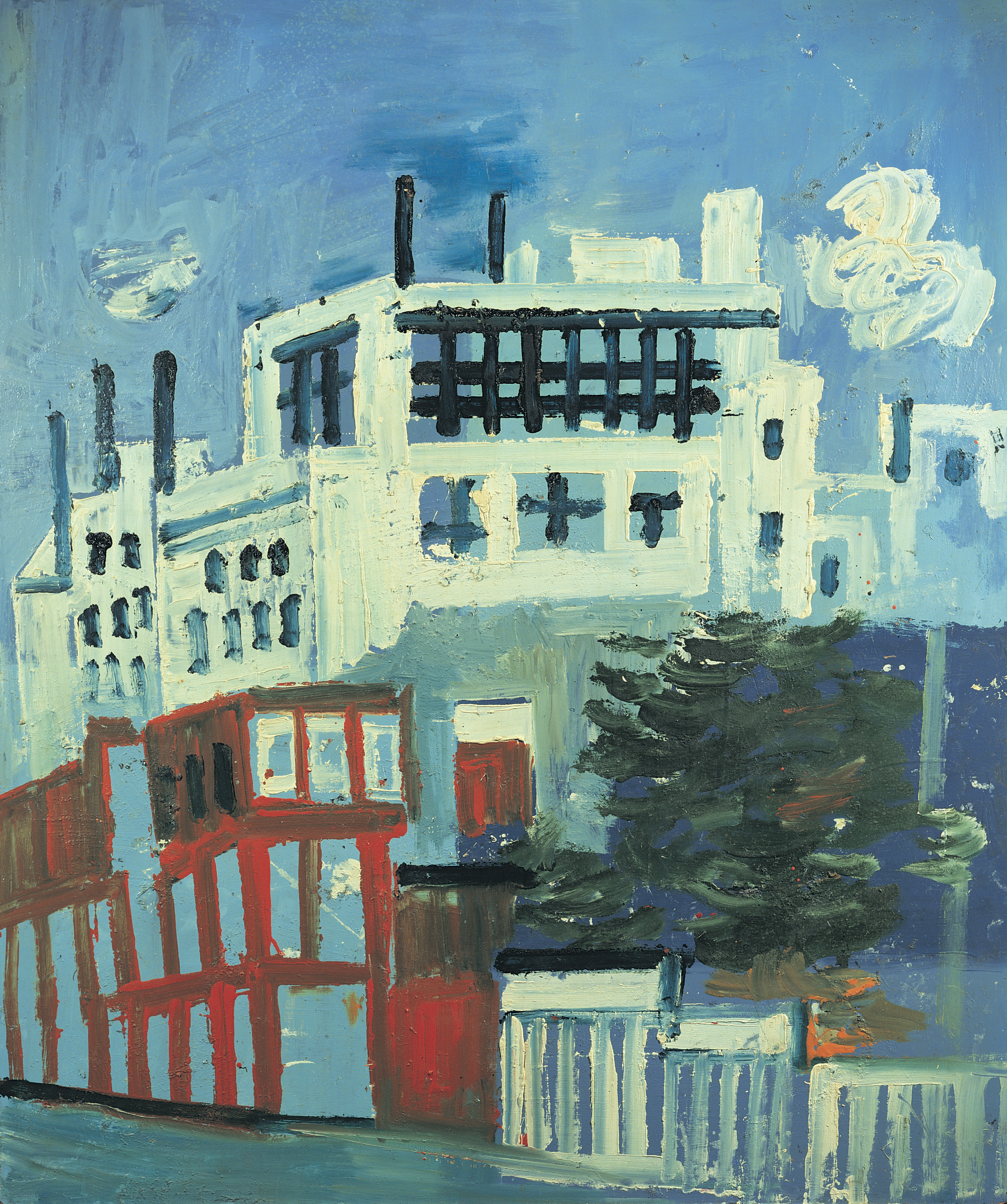
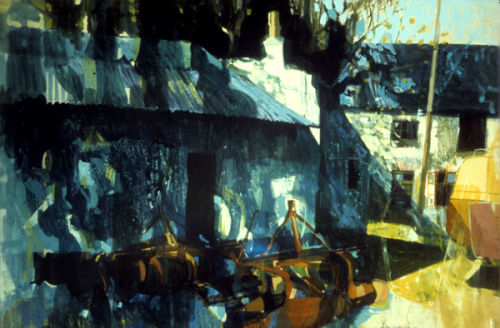
Four Trees, White Fence by Woodrow, Joash (1927-2006);
I first viewed the brilliant art work of Joash Woodrow in 2005 at the Manchester Art Gallery, I was back in Manchester visiting my sister and went into the city centre for the afternoon. I was not intending to visit the Gallery but it was raining so I wondered inside to see what exhibitions where on display, this was a lucky moment and one I will never forget.
I looked around the galleries permanent exhibitions and then took the stairs to the upper floor for a guest exhibition entitled “Retrospective – Joash Woodrow”, from the very first painting I viewed, I just knew I was going to fall in love with Joash’s drawings and paintings and I have been fascinated with his work and life story ever since.
I love Joash’s work for its very honest style, by this I mean that I feel he used his brush’s and paint’s to capture his world as he found it, there is little to praises or note about how perfect his style of painting or drawing is but so much to fall in love with about how he viewed his surroundings and how well he liked and felt for the people he painted.
This is painting in the RAW, produced by someone who, I feel if you were allowed to get close to him then you would truly like him !!!

Joash Woodrow (1927-2006) Mr Woodrow’s Shop, Chapeltown Road, Leeds c
About Joash Woodrow, By :Nicholas Usherwood
Joash Woodrow, Reclusive painter whose work provides a significant link between British and European art
The chance discovery in a Harrogate bookshop in 2001, by the painter Christopher P Wood, of six volumes of an engraved Victorian art history, wildly and exuberantly annotated in a series of Picasso-esque drawings and collages by the then completely forgotten painter Joash Woodrow, led directly to the re-emergence of one of the most significant artistic figures in postwar British art. A visit a few days later by the Harrogate dealer Andrew Stewart to a small, semi-detached house in north Leeds, where Woodrow had lived alone for 20 years, uncovered an extraordinary story. The house was filled with some 750 canvases and around 4,000 works on paper, a lifetime’s achievement which a devoted family was none the less contemplating consigning to a skip.
Joash, who has died aged 78, had recently been taken into sheltered accommodation, having nearly set fire to the house, but his work itself had avoided serious damage. In the months that followed, it became apparent that this was no isolated figure at the margins of art history but an artist of sophisticated interests and training.

Born in Leeds, Woodrow was the seventh of nine children in a poor but cultured Jewish family that had escaped the pogroms in eastern Poland of the early 1900s. His father had run a Jewish bookshop in Chapeltown before working in Montague Burton’s factory to provide for a growing family. Joash trained at Leeds School of Art and, in 1950, won a scholarship to the Royal College of Art.
His intense shyness does not seem to have been suited to the competitive atmosphere there, though his tutors’ reports commented that his work already seemed more European in feeling than most of his contemporaries, among them John Bratby, Leon Kossoff and Frank Auerbach. A year or so after leaving the RCA in 1953, he suffered a nervous breakdown and took himself back to Leeds, where, supported financially by his family, he lived and worked for the rest of his life.
Advertisement
Joash Woodrows – Leeds
With his mother and two brothers also living in the two-up, two-down house, working conditions must have been extremely cramped, which almost certainly explains the comparatively small scale of Woodrow’s early work. Mostly portraits and landscapes, their dark tones illumined by flashes of sonorous colour and intense solemnity, they reveal the beginning of a distinctive style, one that in its understanding of the French fauvist Georges Rouault showed Woodrow already looking to European art for inspiration.
This gathered momentum with a number of visits to the huge Picasso exhibition at the Tate in 1960, the crucial impact of which was to give Woodrow an insight into his Jewish heritage, and the understanding that the roots of his art lay outside this country and were essentially European in character.
Looking to the fierce expressionism of Karel Appel, Asger Jorn and the Cobra group, the harsh, raw surfaces of Jean Dubuffet and the Art Brut circle, and the insistence on the quality of mark-making of Nicolas de Staël and the tachistes, Woodrow began to uncover the source of those artistic energies that were to carry him over the next 30 years of intense activity. With the death of his mother in 1961 – and with more room in which to paint – there was a steady increase in the scale and ambition of the work.
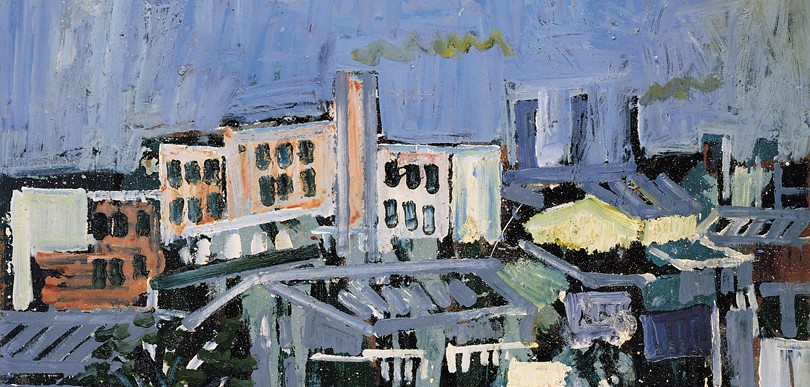
A lack of success in the work he occasionally submitted to large, open competitions like the John Moores, however, encouraged a feeling of isolation, something his reclusiveness only served to emphasise. By the early 1970s, he was living and working with very little thought for anything but the next painting, producing large-scale canvases (anything of up to 5ft x 8ft) with quite extraordinary rapidity. When not painting, he was drawing furiously in the semi-industrial and urban districts of north Leeds those subjects that were to form the basis of some of the most original and experimental works of his later career.
Advertisement
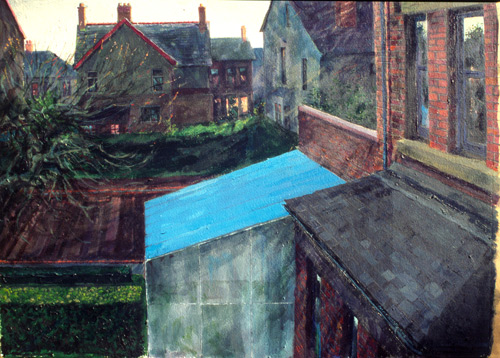
If his personal life was unhappy, there is no sign of it in the power and exuberance of the broad brush strokes, high-pitched colour and boldly flattened picture spaces with which he describes this landscape – an unprepossessing jumble of scruffy allotments, derelict factories and scattered trees.

Gilbert Looking Down, Joash Woodrow
By the early 1990s, Woodrow’s physical and mental health began to decline, and the house was too cluttered with paintings for him to do anything but draw. At the time of the 1999 fire, he seems to have stopped doing even that and, after his removal to sheltered accommodation in Manchester, he lost interest in working altogether.
Nor did he seem very interested in the public recognition that followed, when books and major exhibitions – at Leeds art gallery and then Manchester art gallery, and the Ben Uri and RCA last year – created a wave of interest that looks certain to place him firmly as a significant link between British and European artistic movements in the second half of the 20th century. His brothers Saul, John and Paul survive him.

· Joash Woodrow, artist, born April 7 1927; died February 15 2006




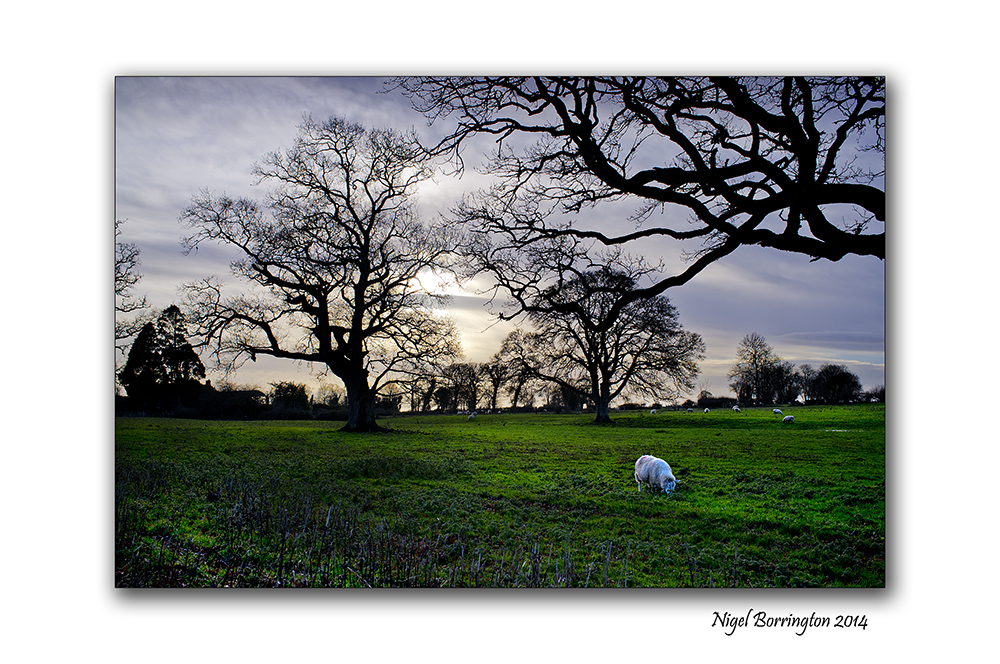


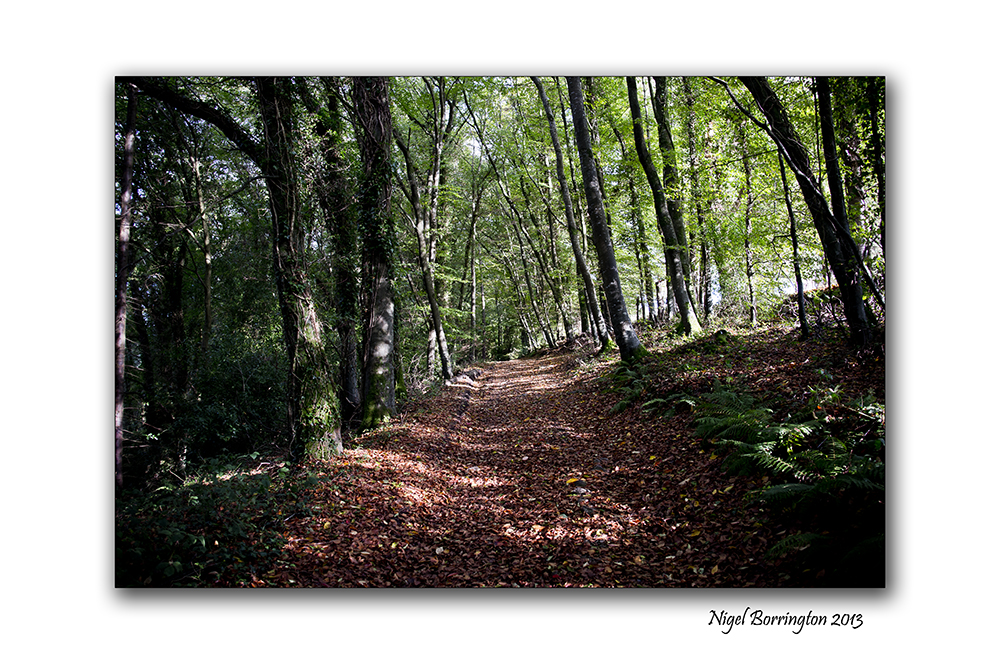


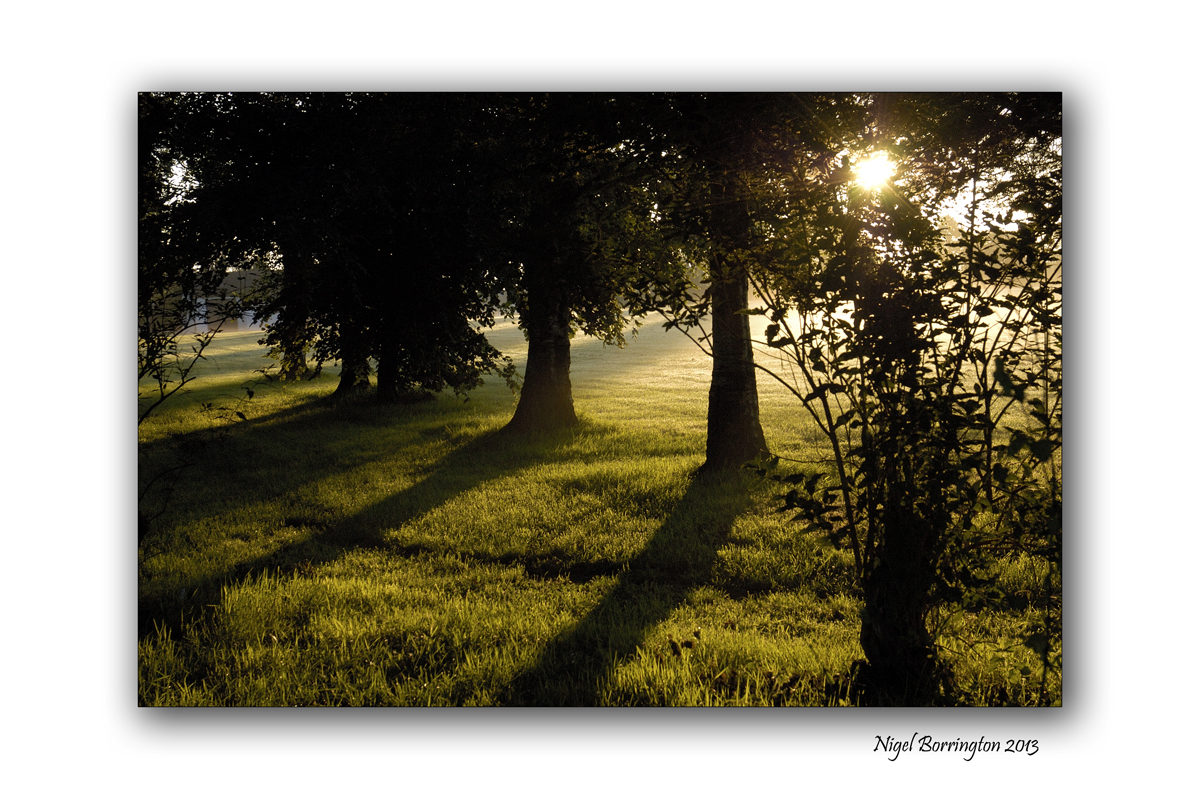


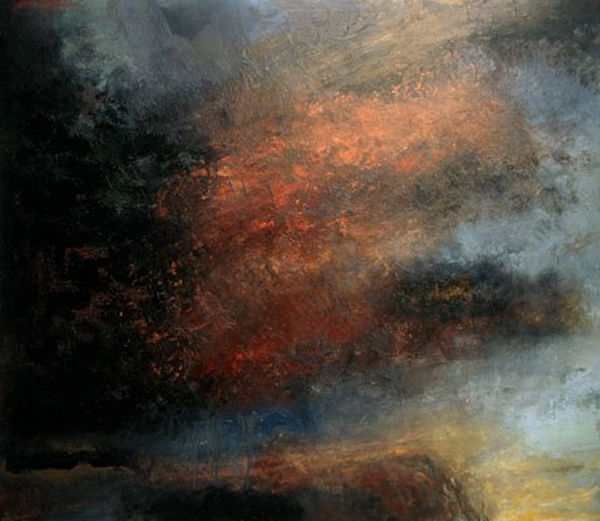







 Nigel Borrington
Fridays Artist : Peter Collis, An Artist who Understands the Irish landscape
Glencrea Valley
by Peter Collis RHA
I started this week in my blog by saying that I was taking sometime each day to study some of my most loved Artists, I feel that the week has been really valuable to me in this respect and I am very pleased with how it has all worked out. At the same time the week has only scratched the surface of my full aims, being to gain an understanding of how so many great artists have used the landscape of Ireland and the UK in their art work and to define how I can take this as some personal inspiration.
While during the last few years I have taken many more photographs than produced paintings, I have been painting as a form of self-expression for many years. Oddly it was not until I decided to attend art school at Waterford(WIT) that I stopped painting so much, I think many experience this odd effect from current formal art study and art schools.
I don’t want my blog to become completely art and artists based and to move away from my own photography posts, although I personally feel that the two are very closely linked in any-case. So next week I will move a little back towards photographic images, I will however still keep posting some reviews of the artists and art work that I find the most interesting.
Has this week helped to inspired me ? , Absolutely! I feel its time to paint again as well as use my camera !!!
One of these very inspiring artists is Peter Collis the artist I have selected for my Friday Post. I remember visiting the Solomon Gallery, Dublin in 2002 , the first time I got to see any of peters paintings and I very much liked them from the start. I liked his style of painting of the landscapes he painted and very clearly loves, using a limited amount of colours like many artists do, I very much liked the way the movement of his brush can be so clearly viewed in his work, each gesture he made forms a feature in the landscapes he paints and each of these gestures are left alone on the canvas from the very moment they have been made.
I found this great review of Peter in the Irish independent dated 2012 – it says much more Than I can myself !!!
A little about Peter Collis by : Eamon Delaney
A lovely, gentle man’ was how veteran sculptor Imogen Stuart recalled the painter Peter Collis who has passed away at the age of 83. Collis, who was born in England and came to Ireland in 1969, was an acclaimed landscape artist and still life painter who had been a stalwart of the Royal Hibernian Academy. His canvasses are characterised by a powerful and dramatic style under the painterly influence of great masters such as Paul Cezanne, whom he adored, and Maurice de Vlaminck. In contrast to the traditional realistic depictions of the Irish countryside, Collis employed a bold brush and brought a strong expressive energy to his outdoor renderings.
He was particularly fond of Killiney, and its bay, and of the topsy turvy Wicklow countryside. The Sugar Loaf mountain became a familiar motif in his work. He also composed striking still lifes, of groups of green pears and vivid red apples, which evoked a distinctive European quality.
The physical appearance of Peter Collis often belied the rugged intensity of his work, with its rain-drenched hills and wind-bent trees. An unfailingly courteous man, who was widely popular, he wore Savile Row suits and was described by painter Mick O’Dea as possibly “the best dressed artist in the entire Irish arts scene”.
Born in London, he studied drawing and painting at the Epsom College of Art in London between 1949 and 1952. After college, he moved to Ireland where he had discovered a profound connect with the Irish landscape which would shape the course of his painting for the next four decades. Working for the Shell Oil company, Collis would paint in the early mornings from sketches and studies made on sales trips across the country, developing his craft and building a reputation as a painter of exquisite fluency. The critic Desmond McAvock wrote of him: “Like Cezanne he is really more interested in the structure of his scenes than in their transitory appearance . . . he can bind his observation into a cohesive, tightly controlled but always sensitive design.”
According to his longtime companion and fellow painter, John Coyle, Collis “saw things in the Irish countryside which the rest of us might never see”. Being something of an outsider, the Englishman was emboldened by bringing a fresh eye to it all. “He didn’t have the historical or territorial baggage that many Irish would have,” said Coyle, “and saw the landscape for what it was along with the physical, and poetic, possibilities it offered. He pursued the simplification and arrangement of shapes, just like Cezanne.”
In Dublin, Collis was most recently represented by the Solomon Gallery and only last month had a retrospective exhibition in the John Martin Gallery in London. In 1990, he was elected to full membership in the Royal Hibernian Academy and was actively involved in the activities of that body. In 2002 he was conferred a senior member of the Academy. He received many awards, including the Royal Trust Co. Lt. Award in 1975, the Maurice MacGonigal Landscape Prize of 1981 and the James Adam Salesroom Award, RHA of 1999. His paintings are represented in many public collections, including those of AIB, Bank of Ireland, Limerick University, University College Dublin, and the Office of Public Works. His paintings are also owned by many private collections including Bono, Christy Moore, and Lord Puttnam, the English film maker.
He will be missed by the artistic establishment, but also in the context of the wider artistic understanding of the Irish landscape, which he did so much to further. Most especially, of course, he will be missed by his wife Anne, and daughters, Vanessa, Mandy and Kate, as well as grandchildren. He was sadly predeceased by the untimely passing of two of his children, David and Gail. His funeral service was held in the Parish Church, Monkstown (Church of Ireland) followed by burial in Deansgrange cemetery.
Sunday Independent
Share this:
Posted by nigel borrington | March 11, 2016 | Categories: Art and craft work, Comment, Landscape, Nigel Borrington | Tags: Aritists, art, art review, art work, irish landscape, Landscape paintings, Nigel Borrington, Peter Collis, review of artists | 2 Comments