
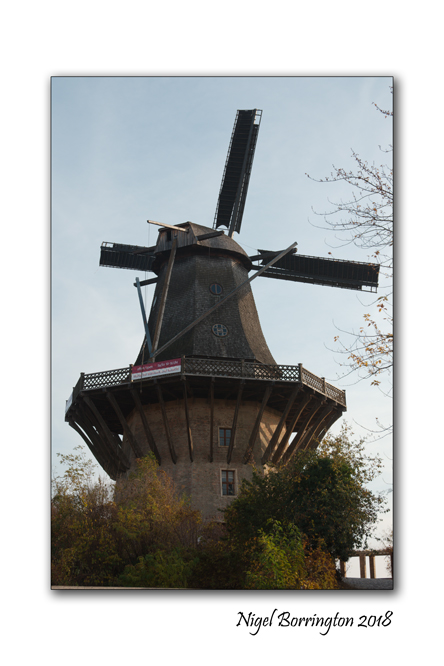
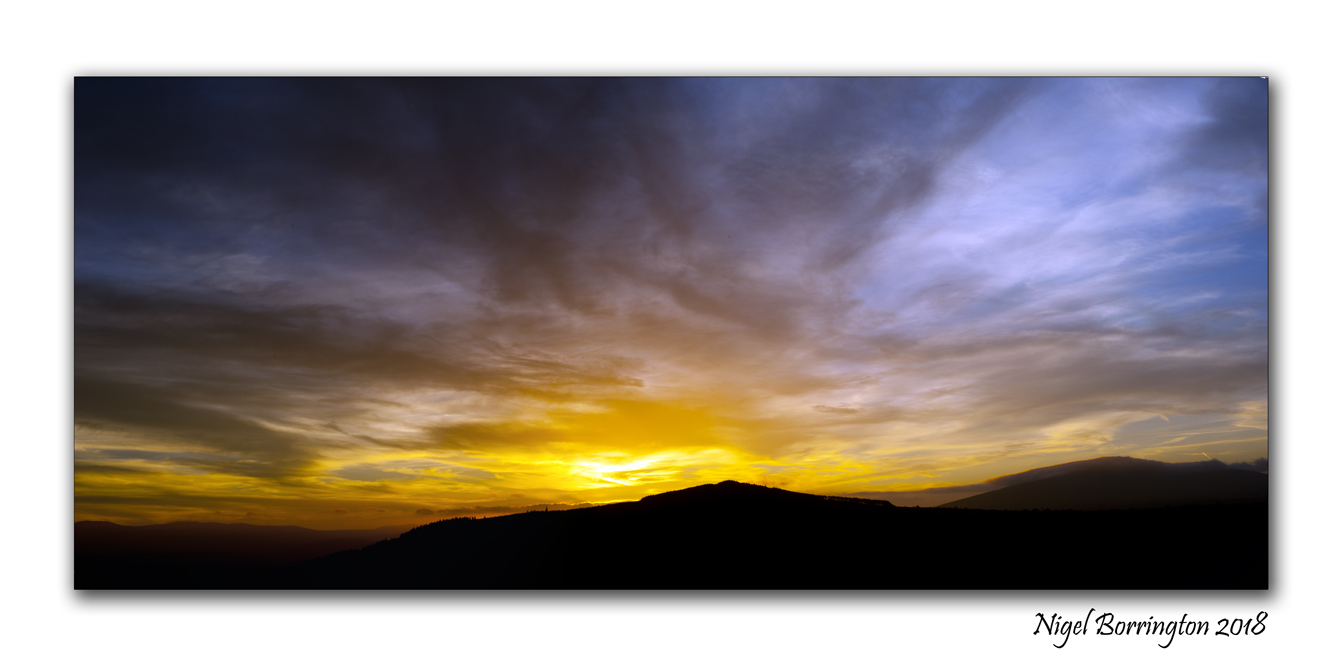
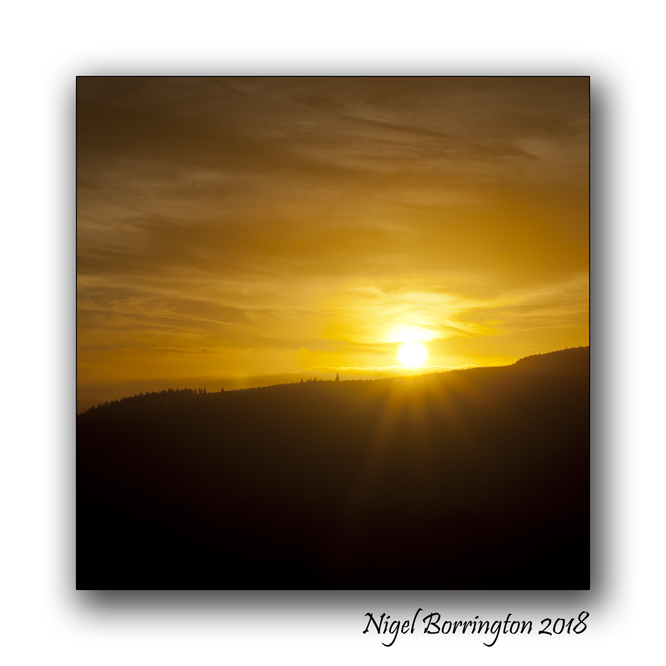
Sunset at the windmill,
Sanssoici,
Potsdam,
Germany
Nigel Borrington 2018
The windmill at Sanssouci, Potsdam is simply one of the best restored windmills in Germany, Potsdam was the home of the Prussian royal family and as such this windmill like many of the buildings located in and around the city are nothing other than the best of examples in German, even the world, architecture.
History of the Wind Mill
In 1736 the soldier king, Frederick William I of Prussia, gave permission for the construction of a windmill, which was started in 1737. This first windmill, completed in 1738, was a post mill, whose entire superstructure, supported on a wooden post, was turned “into the wind” depending on the wind direction. The first mill and actual Historic Mill was thus older than the nearby summer palace, built in the years 1745 to 1747 for Frederick the Great.
The legend of the Miller of Sanssouci
The legend of the Miller of Sanssouci first appeared in 1787 in a French book about the life of Frederick the Great (Vie de Frédéric II by an anonymous author) and in a watered-down form one year later in Germany.
The legend goes that Frederick the Great was being disturbed by the clatter of the mill sails and offered to buy the mill from its miller, Johann William Grävenitz. When he refused, the king is supposed to have threatened: “Does he not know that I can take the mill away from him by virtue of my royal power without paying one groschen for it?” Whereupon the miller is supposed to have replied: “Of course, your majesty, your majesty could easily do that, if – begging your pardon – it were not for the Supreme Court in Berlin.”
The mill in June 2009
This is only a legend. According to Frederick the Great the mill underscored the rural character of his summer palace and said “that, … the mill is an ornament for the palace.” The miller was reportedly a difficult man, who cheated the local farmers over their flour and constantly pestered the king with petitions. At least one of these petitions was heard by Frederick II. Grävenitz pointed to the fact that, as a result of the construction of the palace, the post mill no longer stood in the open, but was partly shielded from the wind. So he demanded that the king let him build the mill in another site and to pay him for it. Frederick II acceded to this, with the result that, shortly thereafter, the wily Grävenitz was the proud possessor of two mills thanks to the king’s grace, until he eventually resold the old mill.
View from the Erlöser Church
In 1768 there was a legal dispute at another location over water rights and the remaining lease between Christian Arnold, the tenant of a mill in Pommerzig in the Neumark, and his landlord, the Count of Schmettau. After the miller was found guilty on two accounts, he appealed to Frederick the Great, who intervened in the ongoing proceedings in favour of the miller. Wrongly, as it turned out later. The king referred the case to the Berlin Court of Appeal, who once again ruled against the miller. Frederick the Great, then demanded a condemnation of the judges and their imprisonment in Spandau Citadel for their unjust judgments and thus precipitated an abuse of his name.
This legal battle and the story of the Sanssouci miller were woven together in the legend and were intended to emphasize the king’s justice towards all his subjects. After the death of Frederick the Great, the case was reopened. His nephew and successor, Frederick William II decided in a compromise that “… the Miller Arnold case … should be viewed as the consequence of a mistake, whereby the praiseworthy judicial zeal of our royal uncle, who rests in God, was misled by incomplete, inadequate reporting of the true situation by badly informed and preoccupied [biased] people.”
In the years that followed there continued to be disputes between the reigning kings and the millers for different reasons.







 Nigel Borrington
In the October woodlands 3 :Lichens, but they aren’t quite what we thought they are !
A little more detailed this post than my usual Friday posts but I found this articular very interesting, if only for the fact that its amazing just how much there is to be found in our local woodlands and just how much study is being carried ou,t even after so many years to revival the hidden secrets to the life that surrounds us on our daily walks along a forest path …..
Lichens aren’t quite what we thought, shocked scientists discover
Most people know lichens, such as this wolf lichen, as those flaky, light green things that grow on tree bark. You probably learned in school that they’re a mutually beneficial partnership or “symbiosis” between fungi and algae, but many lichens have now been found to include a third partner, a yeast. (Tim Wheeler Photography)
Most people know lichens as those flaky, light green things that grow on tree bark, and learned in school that they’re a mutually beneficial partnership or “symbiosis” between fungi and algae.
But lichen scientists have made the shocking new discovery that many lichens are also made up of a previously undiscovered third partner — a new kind of yeast.
Not only does that potentially alter the fundamental definition of what a lichen is, but it “should change expectations about the diversity and ubiquity” of the organisms that form them, says a new study published Thursday in Science.
University of Montana researcher Toby Spribille samples Bryoria or horsehair lichens. He first started studying lichens 15 years ago in British Columbia. His new study was inspired by a mystery flagged by B.C. lichenologist Trevor Goward. (Christoph Rosche)
The new yeast has apparently gone undetected in lichens for more than a century, despite the fact that scientists all over the world have devoted entire careers to studying lichens closely with microscopes and genetic testing.
That seemed so unlikely that the scientists working on the project had trouble believing it themselves.
“It’s so surprising that you kind of doubt yourself for a long time,” said John McCutcheon, a microbiologist at the University of Montana and a research fellow with the Canadian Institute for Advanced Research who co-authored the new study published today in Science.
“We had to check our data more than 10 times,” recalled Toby Spribille, lead author of the paper. “It seemed to me so unlikely that so many people would have missed that.”
Lichen mystery
Spribille, a University of Montana botanist who first started studying lichens in British Columbia 15 years ago, was inspired by a mystery flagged by B.C. lichenologist Trevor Goward in a series of essays.
Wila or edible horsehair lichen, also known by the scientific name Bryoria fremontii, is a brown-coloured lichen that was an important traditional food for many First Nations in northwestern North America. (Toby Spribille)
It concerned two lichens that grow in B.C. and Montana and considered separate species for 100 years. One called wila or edible horsehair lichen, also known by the scientific name Bryoria fremontii, is a brown-coloured lichen that was an important traditional food for many First Nations in northwestern North America.
The other, called tortured horsehair lichen or Bryoria tortuosa, is yellow and poisonous. However, a recent genetic analysis showed that they were genetically identical — they were made up of exactly the same species of fungus and the same species of algae.
“There’s something really weird about that,” Spribille said.
Tortured horsehair lichen or Bryoria tortuosa, is yellow and poisonous. However, a recent genetic analysis showed that its fungus species and algae species are genetically identical to those in edible horsehair lichen. (Tim Wheeler)
He brought the problem up with McCutcheon, an expert in new, sophisticated genetic techniques that he typically uses to study insects.
Traditional DNA analysis relies on probes or lures to fish out certain characteristic regions of genetic material, partly based on what scientists expect to find — like calling out names in a dark room to see who’s there, Spribille said.
Newer techniques instead look for all genes that are in the process of being translated into proteins via “messenger” molecules called RNA. Spribille likens the technique to turning on the lights.
McCutcheon says that gives a sense of what an organism is doing at any given time.
To the researchers’ surprise, the RNA they found came not just from the fungus and the alga known to be associated with the lichens, but a mysterious third organism.
Further analysis showed it to be a new kind of yeast, belonging to the taxonomic group Basidiomycota, the same one that button mushrooms belong to. It was not at all related to the yeasts used to brew beer or bake bread. Yeast cells and DNA were extremely common in the yellow, poisonous lichen, but rare in the edible brown lichen.
A fluorescent microscope image shows the location of different cell types in a bryoria lichen, cut at the ends and lengthwise through the middle. Green are the yeasts, blue are the fungi, red are the algae. (Toby Spribille)
After running the experiment enough times to convince themselves the signal wasn’t due to contamination and pinpointing the yeast cells in the outer skin of the lichen, the researchers decided to see whether other lichens from around the world also contained the yeast. Sure enough, many did.
“Each lichen has a specific strain of the yeast,” McCutcheon said. “These form several new fungal families.”
DNA analysis suggests the yeast has been part of lichens for more than 100 million years — since the end of the Early Cretaceous, when dinosaurs like spinosaurus and allosaurus roamed the Earth, and flowering plants first appeared.
Spribille said the discovery “seriously challenges” a lot of assumptions that have been held by lichenologists for a century.
“At the next level up, it gives us insight into how one of the most fascinating symbioses works.”
‘Really major finding’
Goward, whose essay inspired the research, said he was delighted by the discovery.
“It’s all very exciting to me,” he added. “If Toby’s idea proves to be correct, this is the second really major finding that changes how we see these organisms” — after the 1860s discovery that lichens weren’t one organism, but made of two separate organisms, an alga and a fungus.
Irwin Brodo, an emeritus scientist at the Canadian Museum of Nature in Ottawa who has devoted himself to the study of lichens for decades, said the discovery was “plausible” but “not proven yet.”
Brodo, who first gave the horsehair lichens the name Bryoria, said he was surprised that the new yeast cells were discovered in a part of the lichen that a lot of lichenologists, including himself, have examined carefully.
“I never saw them,” he said.
But he added that the presence of the yeast might also explain other longstanding mysteries about other lichens that look very different but have been found to be genetically identical.
Share this:
Posted by nigel borrington | October 19, 2018 | Categories: Comment, Gallery, Images of Autumn, Irish Landscapes, irish woodlands, Nature and Wildlife | Tags: Autumn, forest life, In the October woodlands, Lichens, Nature, Nigel Borrington, woodlands | Leave a comment