Kilkenny photography
Digital processing
Digiital image processing skills are as much a part of the modern photographer’s job as was the darkroom in the past.
The following images show just how far a single image can be taken from the original.
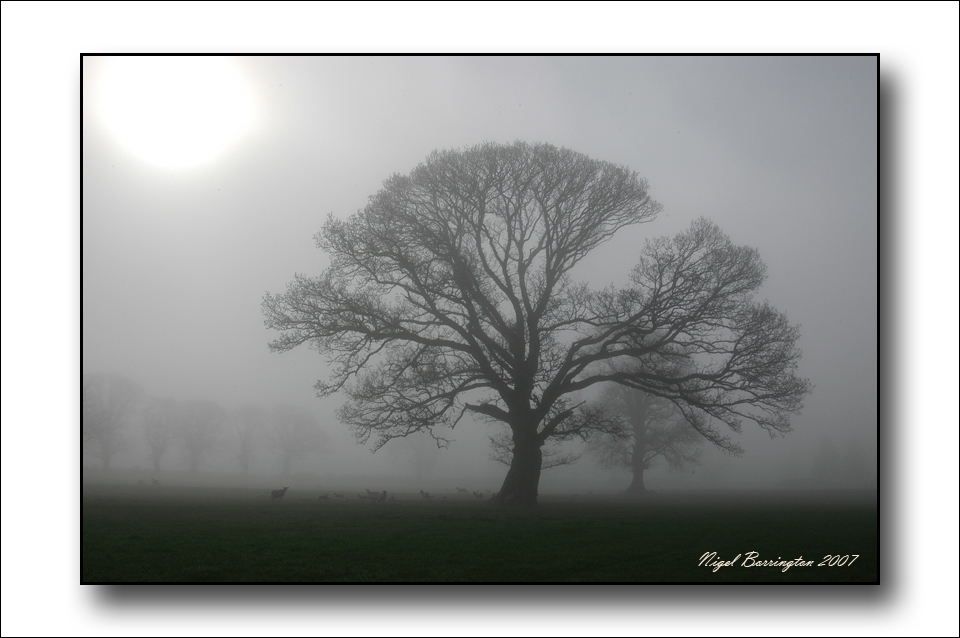
Coolagh, Co.KIlkenny.
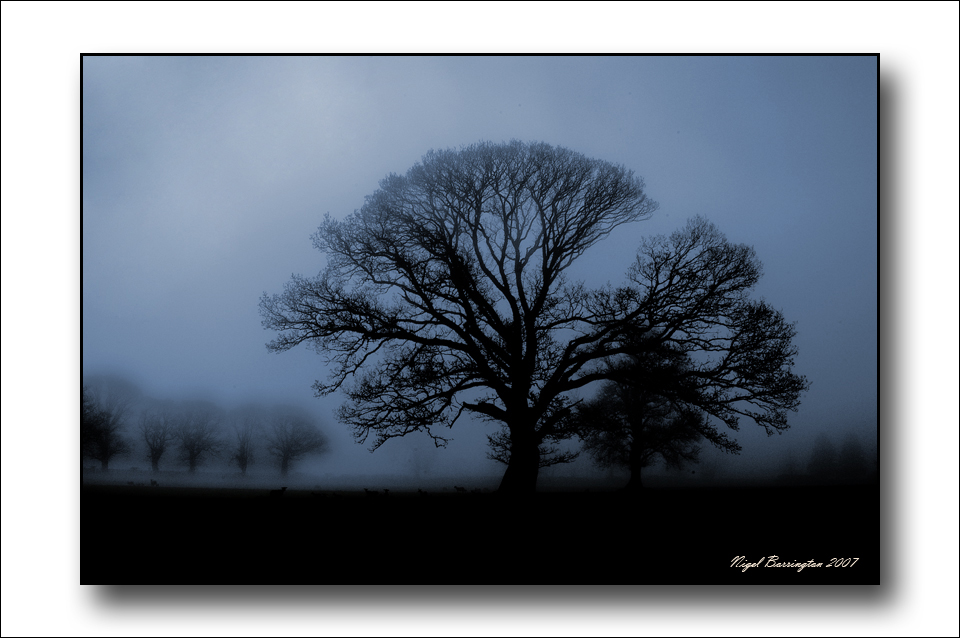
Toned and Bleached second image.
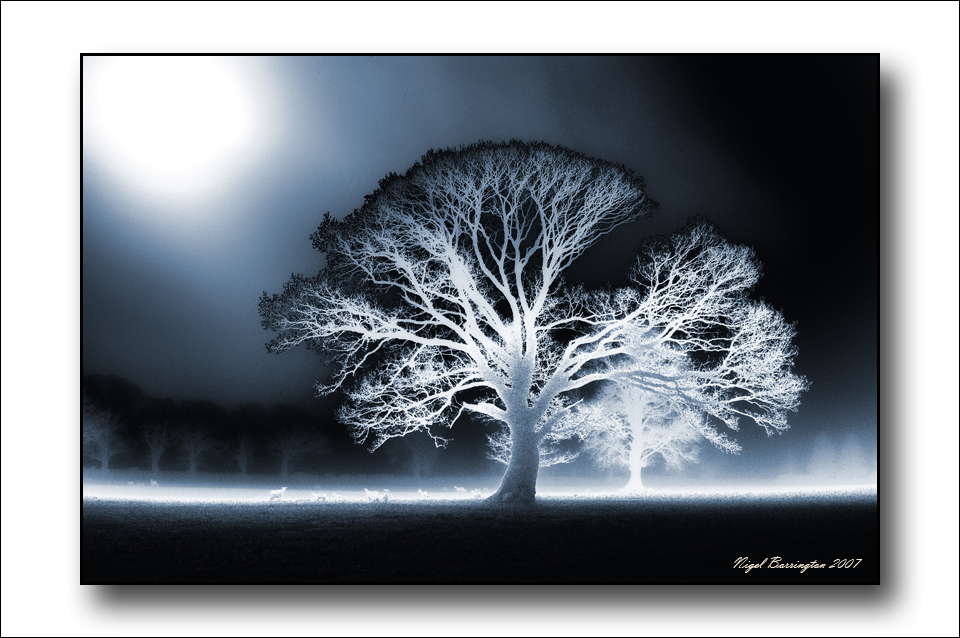
Trees at Coolagh, Co Kilkenny - Processed using image layer processing.

Kilkenny Photography, Trees at Coolagh in lightning ( Photoshop processing)
The original image taken at coolagh, Co Kilkenny, was produced as part of an art and design project back in 2007.
Kilkenny Photography by Nigel Borrington
Kilkenny Photography
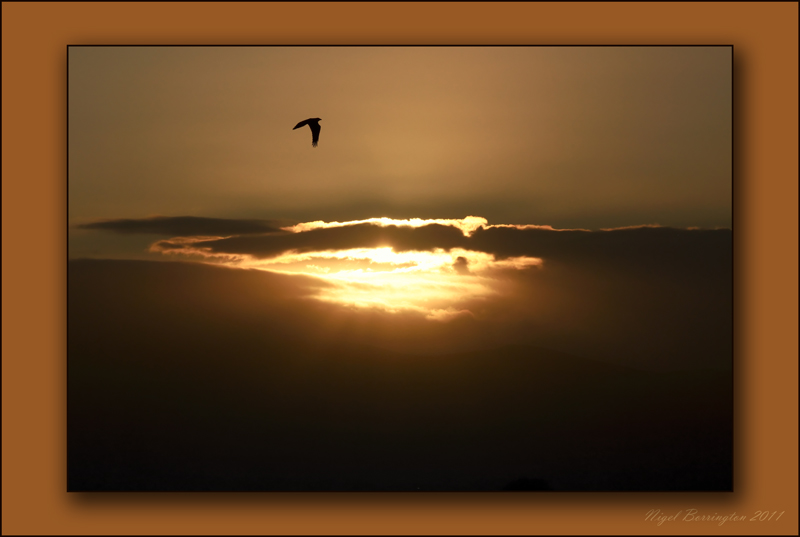
Kilkenny photography 17th Sep 2011
So then its back to Kilkenny and today feels very much like the end of the summer season, 10c this evening and the weather was great for some images. Its my first full weekend home after my summer holidays, these images are posted right out of the camera as I felt like I needed to get some local work covered right away!
Good, I am home and I have some new Landscape work within hours!
Kilkenny Landscape photography,
By Nigel Borrington
Newtown house, Co Kilkenny
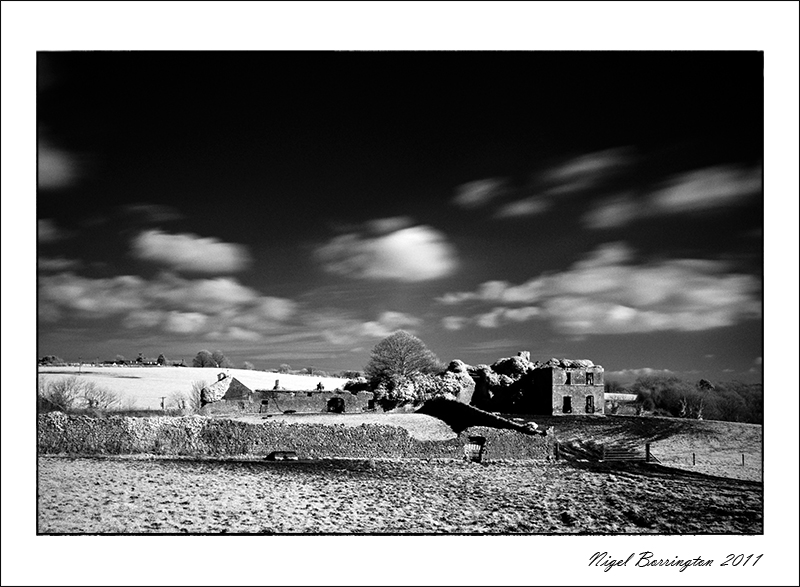
Landscape image of Newtown house, Co Kilkenny
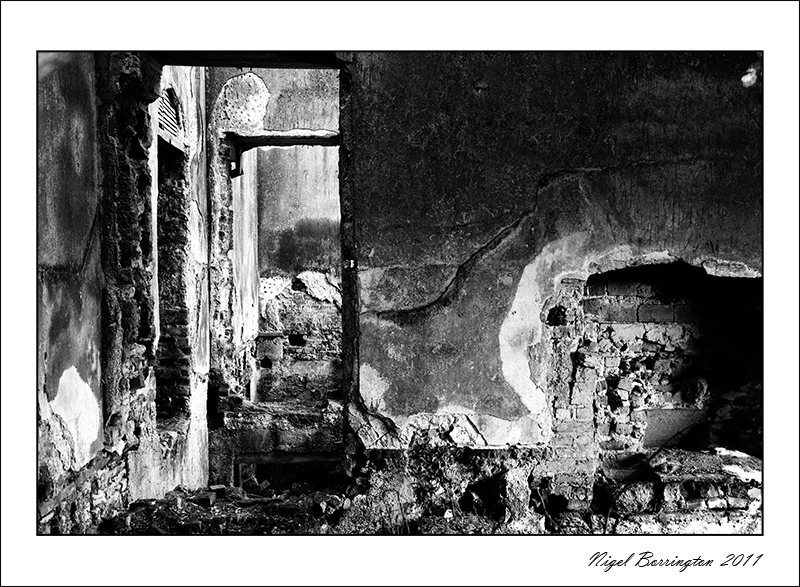
Forgotten spaces, Newtown house, Co.KIlkenny
One of Kilkenny’s Forgotten spaces, Newtown House.
I cannot find that much history on this location, the following web link has records as follows:
http://homepage.eircom.net/~lawekk/HSESN.HTM
Newtown house
NEWTOWN HOUSE, Earlstown parish, Shillelogher barony.
1858 Joseph Greene, Newtown. [Will]
1870 John Newport Greene, Newtown House. [Will]
1873 Newtown House, 6 mile of Kilkenny, Thomastown & Ballyhale, 3 of Callan, 1 of Kells, to let by Lt Col Mollan CB. [Mod 6.9.1873]
1873 Mr Joseph Greene, Newtown House. [Mod 25.10.1873]
1878 Eliza Newport Greene, Newtown. [Will]
1912 Died, Major-General James Benjamin Dennis at Newtown House, Kilkenny, age 95. [St Canices Cathedral grave]
1969 Newtown House now dismantled and a ruins. [O’Kelly]
1993 Newtown, ruins, c1800. 1 mile W of Kells. 18.S.47.44. [KK Dev Plan]
Irish photography series, by kilkenny based photographer : Nigel Borrington
Blanchfieldsland
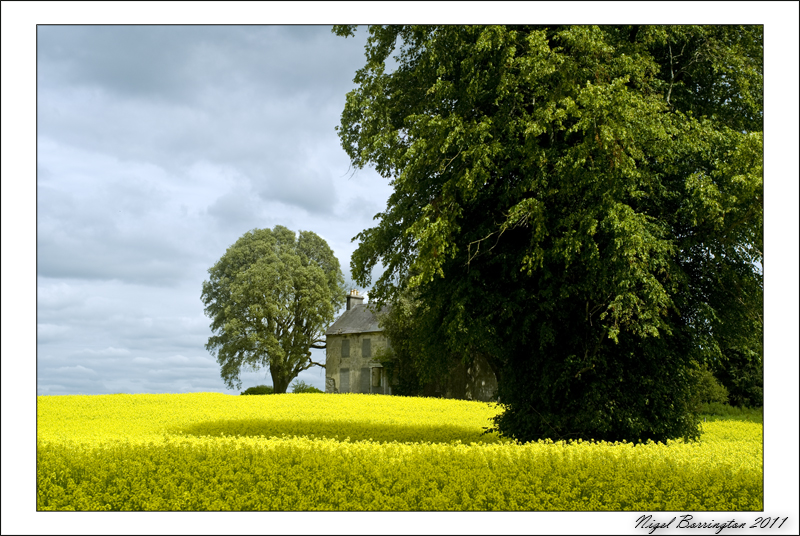
Blanchfieldsland estate, Co Kilkenny
Located At the N10/M9 junction on the Kilkenny bypass, Blanchfieldsland is the remains of an old estate house. These days the house and its walled gardens sit in the middle of rapeseed fields.
A very peaceful picture!
Kilkenny landscapes, by kilkenny based photographer Nigel Borrington .
Downey Emerald

A true Irish Dragonfly
Photographed in the old grounds of Blachfieldsland, Co Kilkenny
Kilkenny wildlife photography by Kilkenny photographer, Nigel Borrington
Slievenamon From the Killemary High Cross

View of Slievenamon from Killamery high Cross
Putting my post on the Killamery High cross in its context, this is the view of slievenamon from the Killamery Church yard.
Kilkenny photography series, by Kilkenny photographer : Nigel Borrington.
Just as a foot note, this shot was taken on mid-summers day 2011 not the 4th of March!
The Killamery High Cross.

Killamery Highcross, Killamery Co.Kilkenny
An Infra-red photograph of the Kilamery grave yard,High cross and old church.
21st June 2011.
Killamery – High Cross
“Situated in an old graveyard in Kilkenny is the High Cross of Killamery one of the western Ossory group of crosses. The cross stands at 3.65 metres high and the west face of the cross bears most of the figure sculpture. The east face pictured right, is decorated with three marigolds on the shaft and has a boss in the centre of the head surrounded by intertwining serpents with an open mouthed dragon above the boss. The cross is known as the Snake-Dragon cross. The cross has a gabled cap-stone and the narrow sides have double mouldings. At the end of the southern arm of the cross there is a panel depicting Noah in the Ark and the end of the northern arm features four scenes centered around John the Baptist. There is also a worn inscription on the base of the western side of the cross which is said to read as ‘OR DO MAELSECHNAILL’ a prayer for Maelsechnaill. Maelsechnaill was the High King of Ireland from 846 to 862.”
The symbol that I find most interesting is that of the sun at the centre of the cross “The sun of God” or the “Sun of the Zodiac”. This sun symbol has five or six arms rotating from its centre, age has made it hard to tell. Five reach the outer edge of the suns circle, the big question though is its placement at the centre of the cross.
I will return after more reading.
Kilkenny landscape photography series, by Kilkenny photographer : Nigel Borrington
Kilkenny Weather, June 2011

Kilkenny Rain

Week starting 20th June 2011
“A poor start but better finish to this week. During Monday, rain will spread up from the south. The rain will become more showery overnight Monday but expect yet more heavy showers for Tuesday and Wednesday. Thursday should be a better day – cool with some sun and the showers will be lighter. On Friday we should get away with a completely dry day. There may be some light rain on Friday night but it looks like there may some pleasant weather over the weekend. The temperatures should improve and it should stay largely dry. At this stage it doesn’t look like this good spell will last very long with the prospect of more light rain arriving early next week.”
Kilkenny photography series, by Kilkenny photographer : Nigel Borrington
Infrared photography, The bridge over the kings river, kells, Co Kilkenny

Infrared Photography, The bridge over the kings river
An infrared shot of the bridge that crosses the kings river at kells, Co.Kilkenny. This images is taken using a camera on a tripod that has an infrared (IR) filter over the lens.
Because these filters block anything but light in the infrared wave length, composing the shot is performed with the filter removed and then put in place, you cannot see anything through the viewfinder with the filter attached. Focusing the shot is not made simple as the focus point of IR light is not the same as visible light so focusing after you attach the filter will not work.
Older lenses such as Nikon Nikkor AIS lenses had a red (R) marking on them so that you could see the focus point for IR light at any given focus length of the lens, if the lens was a zoom lens the marking changed as you moved the zoom position. I still have some AIS lenses so they get used for this purpose.
Another option for IR photography is to purchase a digital camera converted to photograph only IR light, focusing however will still be down to you. The use of a small lens aperture such as f22 will help with focus errors but you must remember to lengthen your exposure time, yes the cameras exposure meter will not work on IR light so you’re into full manual mode.
Because IR light levels are very low you will need to use both a tripod and a slow shutter speed in order to get a sharp and well exposed shot. The use of software such as photoshop is not needed if you can get the correct exposure directly from the camera. One thing that will become clear is that in a colour exposure only red light is recorded, so if you intend to print directly to your printer then change your camera setting to black and white or set your printer for a monotone print.
This type of photography is great fun and can produce some great results, such as the water in this image. It took some 8 seconds to get the correct exposure so the water movement has merged to produce a mirror like effect.
The feeling you get must be the closest thing to the original feeling that Landscape photographers had when they set-up very large format cameras in the field.
James Hoban , Spirit of Place

Photo by Kilkenny photographer: Nigel Borrington, kilkenny photography series.
From the Kilkenny People:
“James Hoban memorial now set in stone
A GROUP of American students and a few locals have spent the past week and a half constructing a memorial to James Hoban at his native Desart, Cuffesgra-nge and it will be celebrated tomorrow (Thursday) with an evening of festivities starting at 6.30pm.
The American group arrived in Callan on the Saturday night and “got our Irish sustenance quota”, then visited the site the next day and got to work at 7am on the Monday morning, explained architect Travis Price, director of the Spirit of Place Competition, which resulted in the design of the memorial to the man who designed the White House in Washington DC. The group then worked through last week, making the most of the long evenings and “working like banshees”, and expect to be putting on the finishing touches today (Wednesday).
Those taking part included the 24 architecture students from the Catholic University in Washington DC who designed the memorial; Kathleen Lane, who works for the American Institute of Architects (AIA) and is president of the Washington DC James Hoban Society; three master masons from the Callan area; neighbouring farmer Ned Brennan who was out helping with his tractor; and seven or eight local craftsmen.
Although not native to the area, the group does have a few Irish connections. Some of the students had visited Ireland previously, and about two-thirds of them are of Irish descent. Ms Lane’s cousin owns Dempsey’s pub in Kilkenny, “and Jennifer Butler kissed the Butler castle when she got here”, Mr Price said.
The structure they have created is 30 metres long and as high as 3 metres, incorporating all local stone except for some Italian marble, and glass panels shooting up into space.
As you walk up, the first section is made of rubble and rough stone, like the stone walls built between fields, early technology where “the stone does all the work”, Mr Price explained. The second section features more refined, cut stone to reflect emotions that were more refined. The third is made of Kilkenny limestone, ending with Italian marble which, like the White House, is “a lot more pure and polished”.
“Hoban’s inspiration was Leinster House originally, that kind of Georgian design – not that we thought much of George ourselves. We had a rough time with the British too,” the architect said in reference to George I, George II and George III, who ruled Britain from the era of America’s 13 colonies through to when it gained its independence. In fact it was under George III’s reign that the White House was set on fire by the British during the War of 1812, which is also referred to as a second war of independence.
This Georgian influence makes it appropriate to incorporate Italian marble into the Hoban memorial, Mr Price said. “The Georgian period had a strong Greco-Roman influence; it’s this classical architecture that Leinster House and the White House are emulating.”
Etched onto the glass panels are also words such as ‘perseverance’, ‘struggle’, ‘triumph’ and ‘rising’, as large as 15 inches and as small as two inches high. Written in English and as Gaeilge, they are a reflection of the bond between Irish and American culture and history.
A design of its time
The design for the James Hoban Memorial was created by the Catholic University students for the annual Spirit of Place Competition, which has also resulted in four projects in Mayo and others in British Columbia, Katmandu, Italy and a star-gazing temple in Machu Picchu. For this annual project the students take a cultural metaphor and create a modern abstract design.
“It’s about, how do you grab the essence and refine it down to something quite minimal,” Mr Price explained. In the case of James Hoban, they incorporated “the struggle and hard work, the perseverance and then that happy moment when George Washington said, ‘I like this Hoban guy. Bring him here to build the president’s home’.”
When the competition was being run to design the White House, Thomas Jefferson had also entered it under a false name, but George Washington was able to spot his design, and preferred Hoban’s work. “Washington was more of a plain soldier,” Mr Price explained, whereas Jefferson was more influenced by the French.”
James Hoban
James Hoban was “something of the stately and the common man, and very much of his time”.
It was this characteristic which shaped the spirit of the memorial to celebrate the architect. During the design phase there was much discussion with the Office of Public Works (OPW), people in Callan and Hoban’s heirs. Some people suggested that it should be a more literal representation, perhaps a copy of the White House.
“That is the last thing Hoban would have done, to copy something that was not of his time,” Mr Price said.
Hoban, James (c.1758–1831). Irish-born, he emigrated to America in 1785. He won the competition to design the President’s House, Washington, DC, with a proposal (1792) originally based on Leinster House, Dublin, but altered at the request of Washington and Jefferson. As built, the White House, (1793–1801, rebuilt 1814–29) was derived from plate 41 of Gibbs’s A Book of Architecture (1728). His other Washington buildings (hotels, houses, and Government buildings) no longer exist.
Bibliography
Architecture, xi (1981), 66–82;
ARe xi (1901), 581–9;
Dictionary of American Biography (1932);
Goode (1979);
Journal of the Society of Architectural Historians, xxviii/2 (May 1969), 135–6;
Maddex (1973);
Reiff (1977);
Ryan & and Guinness (1980)
Kilkenny wildlife

Heron on the kings river, Kells, Co.KIlkenny
With the June bank holiday over, I got moving very early this morning to find this young Heron looking for her first fish of the day.
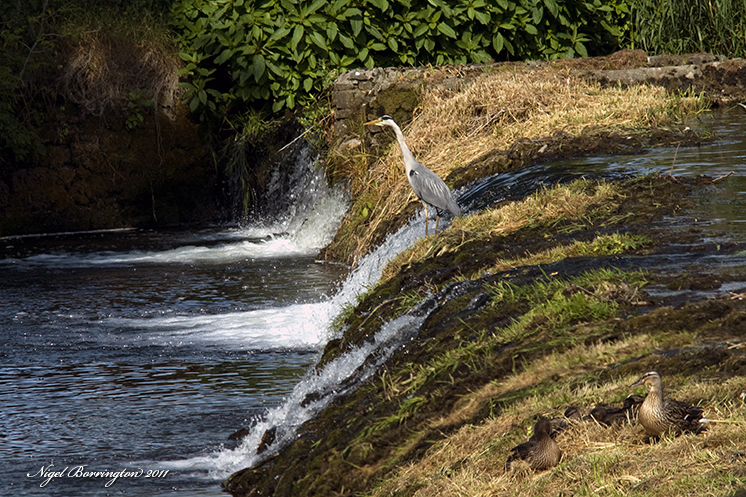
Heron with Mallards, Kings river,Kells, Co KIlkenny
I walked along the Kings river for about half an hour and by the time I returned to the same location as the first photograph she was still looking, the Mallards in the foreground however looked like they had already eaten.
Kilkenny photography by Kilkenny photographer, Nigel Borrington.
Kilkenny rivers

Kings river, Kells, Co.Kilkenny
The Kings river at Kells, Co.Kilkenny.
Kilkenny photography series, by kilkenny photographer Nigel Borrington.
Water is not something Kilkenny or Ireland is short of.
Average Rain fall for Co.KIlkenny :
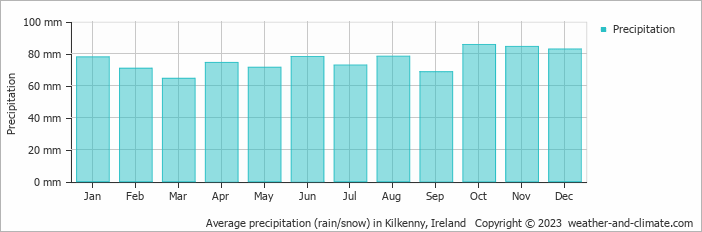
Kilkenny rainfall averages
Studio63 portraits
While the main purpose of this web site is to showcase and detail Nigel’s landscape and nature work it is very much worth detailing some examples of the studio photography images that Nigel produces.

Nigel Borrington (Studio63)
The make-up and beauty studio opened in Callan at the start of 2011 and is owned and run by Karen Maher,
Karen contacted me about three weeks ago, to see if I would be interested in helping her to create a studio portfolio for her, needless to say I was delighted to help.
The following images are from our first studio session.

Nigel Borrington (Studio63)

Nigel Borrington ( Studio63 )
You need and of her services you can contact her as follows.
The Makeup and Beauty studio.
Karen Maher : 086 2597777 or makeupandbeautystudio@hotmail.com
studio63
 Nigel Borrington
You must be logged in to post a comment.