Monday mornings, mist in the woods
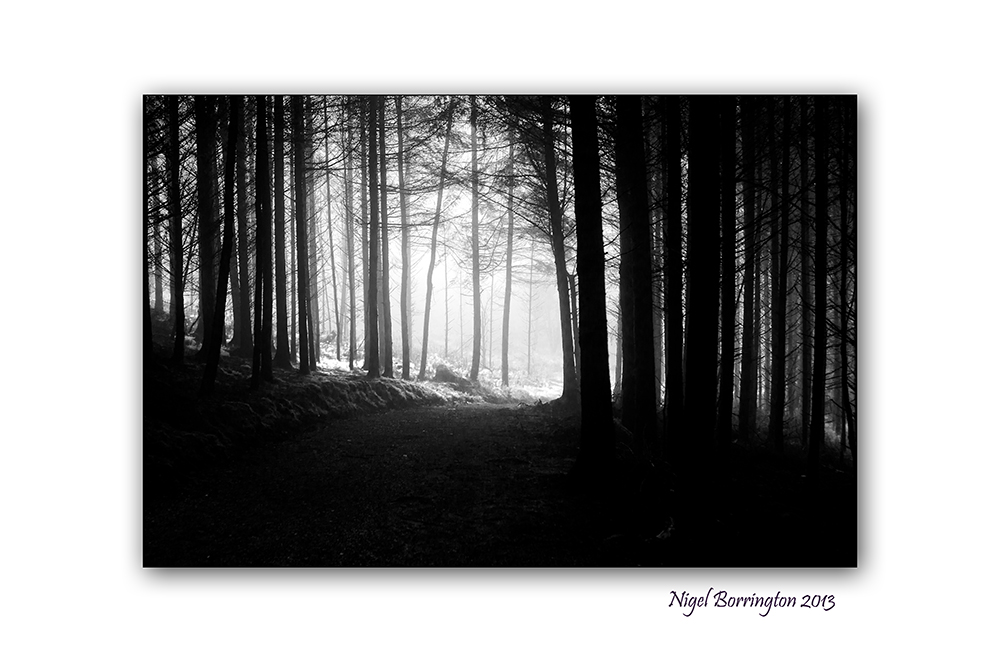
Monday morning mist in the woods
Kilkenny landscape photography : Nigel Borrington
Monday Mornings
Finally breaks the morning light,
ending a long, restful night.
From this place, the sun through the trees,
appears to reveal some misty scene.
Colorless branches contorting the rays of the sun,
light breaking through trees from some place of desolation.
Slowly to the world vision returns,
it becomes apparent that nothing has changed.
So an excuse not to begin the week,
fades into the glimmer of the soft sun rays.
Our tired bodies, hardly able to stir,
begin our long journey to the weeks return.
Castlerigg stone circle, Keswick in Cumbria, September Equinox

Castlerigg stone circle, Keswick in Cumbria
Landscape photography, Nigel Borrington
September Equinox, 22nd of September
There are two equinoxes every year – in September and March – when the sun shines directly on the equator and the length of day and night is nearly equal. Seasons are opposite on either side of the equator, so the equinox in September is also known as the “autumnal (fall) equinox” in the northern hemisphere. However, in the southern hemisphere, it’s known as the “spring (vernal) equinox”.
The Earth’s postion during the September equinox (ill. not to scale).
September Equinox in Kilkenny, Ireland is on the
Sunday, 22 September 2013, 21:44 IST
Castlerigg stone circle
The stone circle at Castlerigg (alt. Keswick Carles, Carles, Carsles or Castle-rig) is situated near Keswick in Cumbria, North West England. One of around 1,300 stone circles in the British Isles and Brittany, it was constructed as a part of a megalithic tradition that lasted from 3,300 to 900 BCE, during the Late Neolithic and Early Bronze Ages.
Various archaeologists have commented positively on the beauty and romance of the Castlerigg ring and its natural environment. In his study of the stone circles of Cumbria, archaeologist John Waterhouse commented that the site was “one of the most visually impressive prehistoric monuments in Britain.”
Every year, thousands of tourists travel to the site, making it the most visited stone circle in Cumbria. This plateau forms the raised centre of a natural amphitheatre created by the surrounding fells and from within the circle it is possible to see some of the highest peaks in Cumbria: Helvellyn, Skiddaw, Grasmoor and Blencathra.


You must be logged in to post a comment.