The bronze crabs of Galway bay

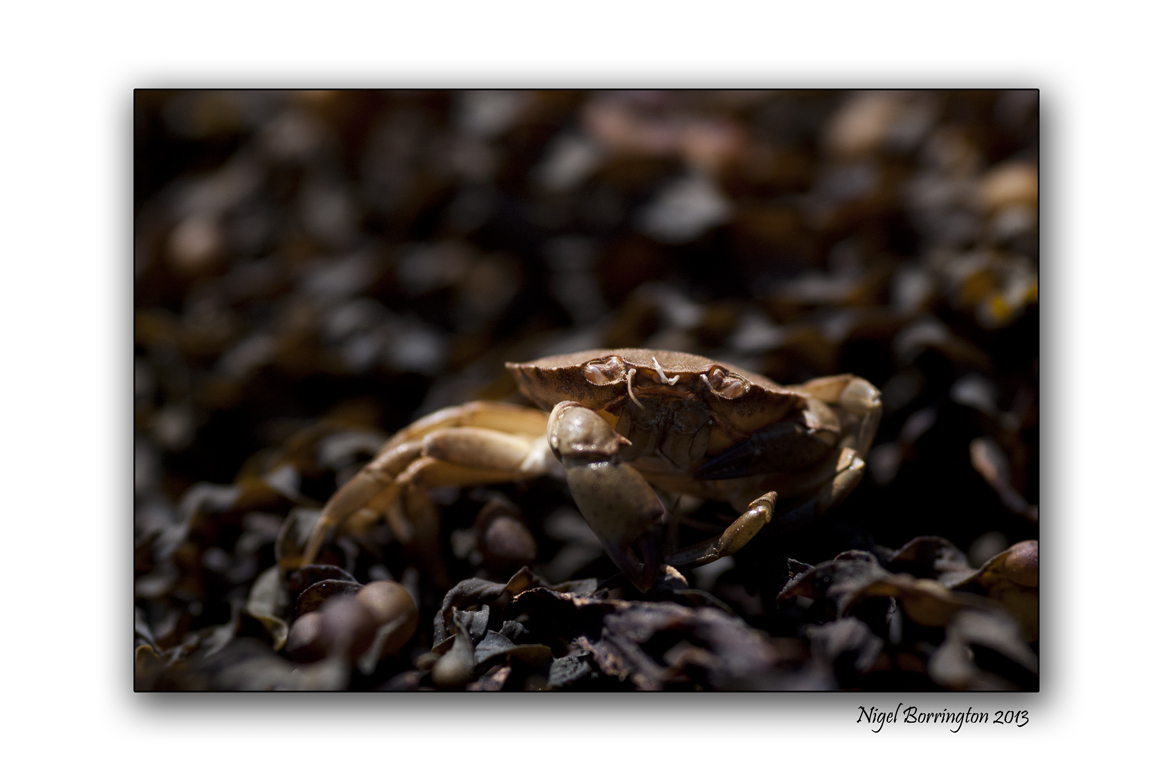
Nikon D700, 105mm macro lens, iso 400
Crab shell at Galway bay
Nature photography, Kilkenny photographer : Nigel Borrington
I came across these grab shells on a beach at the far end of Galway bay last year and there were hundreds of them, crabs molt their shells every time they have out grown them, some people think that this is at the turn of a new moon.
A Poem :
A Green Crab’s Shell
by Mark Doty
Not, exactly, green:
closer to bronze
preserved in kind brine,
something retrieved
from a Greco-Roman wreck,
patinated and oddly
muscular. We cannot
know what his fantastic
legs were like–
though evidence
suggests eight
complexly folded
scuttling works
of armament, crowned
by the foreclaws’
gesture of menace
and power. A gull’s
gobbled the center,
leaving this chamber
–size of a demitasse–
open to reveal
a shocking, Giotto blue.
Though it smells
of seaweed and ruin,
this little traveling case
comes with such lavish lining!
Imagine breathing
surrounded by
the brilliant rinse
of summer’s firmament.
What color is
the underside of skin?
Not so bad, to die,
if we could be opened
into this–
if the smallest chambers
of ourselves,
similarly,
revealed some sky.
Nikon D700, 105mm macro lens, iso 400
Crab shell at Galway bay
Nature photography : Nigel Borrington
Adult Tanner crab mating
Crabs (and other crustaceans) cannot grow in a linear fashion like most animals. Because they have a hard outer shell (the exoskeleton) that does not grow, they must shed their shells, a process called molting. Just as we outgrow our clothing, crabs outgrow their shells. Prior to molting, a crab reabsorbs some of the calcium carbonate from the old exoskeleton, then secretes enzymes to separate the old shell from the underlying skin (or epidermis). Then, the epidermis secretes a new, soft, paper-like shell beneath the old one. This process can take several weeks.
 Nigel Borrington
Great close-ups. I like the colour, light and DOF.
June 11, 2013 at 11:21 am
Hello Victoria 🙂
Thank you, I am very pleased you enjoyed this image 🙂
June 11, 2013 at 11:30 am
Wonderful images, Nigel! Perfect focus arrangement and I especially like the mustard yellow on the rock. Crabs remind me of spiders, I wonder if they’re related somewhere along the evolutionary line. Lovely poem as well. 🙂
June 11, 2013 at 12:34 pm
Hello Sharon 🙂
Thank you 🙂
Very pleased you enjoyed the images and that’s a very interesting point, yes I wonder ?
June 11, 2013 at 1:44 pm
Excellent images Nigel and an interesting post. I’ve just learnt something new 🙂
June 11, 2013 at 12:41 pm
Hello Norma 🙂
Thank you, very pleased you got something from this. It’s amazing what they do and how these shells look so complete 🙂
June 11, 2013 at 1:43 pm
These are great photos! You seem to have captured their characters too.
June 11, 2013 at 1:13 pm
Hello Bc 🙂
Thank you ! I kept having to remind myself that these were just shells 🙂
June 11, 2013 at 11:12 pm
Lovely photos Nigel. I started a draft post ages ago on crabs – I have hundreds of snapshots from Australia and Ireland – we’re big into crab-hunting – especially Monty!! I think I didn’t finish it as I was daunted by the number of photos I had. I must get back onto it – thanxx for the very lovely reminder! : )))
June 11, 2013 at 1:15 pm
Hello Anne, thank you 🙂
Yes you should, would love to see your images and post 🙂
I think you have to just go with the images that hit you the most, that’s probably a very good guide. Just select them quickly and don’t go back to the full folder 🙂
June 11, 2013 at 1:41 pm
Thanks Nigel – that is really helpful advice! : )))
June 12, 2013 at 1:22 am
Awesome closeups and poem selection, Nigel.
June 11, 2013 at 1:43 pm
Hello Scott 🙂
Thank you 🙂 that’s a wonderful and very welcomed comment 🙂
June 11, 2013 at 1:45 pm
Hello Scott 🙂
Thank you !!!!
June 12, 2013 at 1:16 pm
Great photos. I like crabs 🙂
June 11, 2013 at 10:37 pm
Hello Cd 🙂
Thank you !
June 11, 2013 at 11:21 pm
These are amazing and I have never seen one before.
June 12, 2013 at 2:41 am
Hello 🙂
Thank you and pleased you enjoyed the post 🙂
June 12, 2013 at 9:36 am