
Irish Wild-life – Mute swans

Images taken using a Nikin D700/D7000,
Fujifilm x100
Irish wild-life photography , Swans
Landscape and nature photograhy by : Nigel Borrington
The Mute Swan
Mute Swans
Our largest bird, the mute swan is also the most common swan species in Europe. Its widespread distribution is linked in part to its domestication at various periods in history. These elegant, graceful birds can be seen all year round on lakes, rivers and ponds around the country, even in the middle of our cities. Most of the swans we see today are wild birds, although some, particularly in urban areas, are likely descended from domestic lines and remain semi-dependent on human supplements to naturally available food sources.
The mute swan’s graceful appearance belies a somewhat belligerent demeanour. Adults regularly bully smaller species and in the breeding season the male stakes out a large area of water and defends it aggressively against all-comers. While not strictly mute, the mute swan is a much less vocal bird than the other species of swan found in Ireland, the Bewick’s swan and the whooper swan, both scarce winter visitors. Its repertoire consists mainly of soft grunts, snorts and hisses – with the occasionally feeble trumpet. In flight however the swan is anything but silent: it’s wings create a loud, rhythmic throbbing noise as they beat the air, the rhythm of which is said to have inspired Wagner when composing Ride of the Valkyrie.
Take off is a laboured affair with the swans running across the surface of the water to gain momentum while frantically beating their powerful wings in a struggle to get airborne. Once in the air, however, flight is fast and smooth with slow, powerful wing-beats and outstretched neck. Swans land on the water, skiing across the surface to slow their substantial bulk before settling.
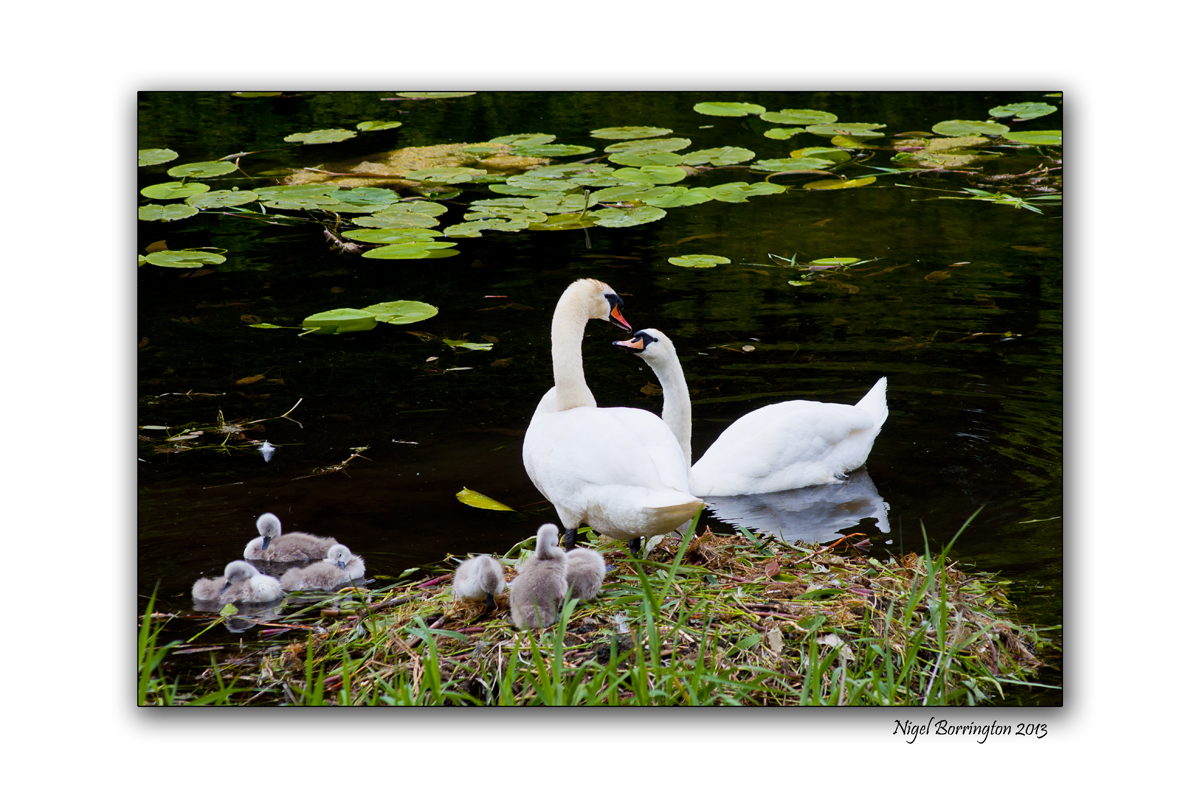
On the water mute swans cruise gracefully, their necks held in a characteristic curve not found in other swan species. The male, or cob, is slightly larger than the female, or pen, with a larger black knob at the base of the orange-red bill. Breeding usually takes place on still inland waterways from late April. The pair builds an enormous nest of water plants, sometimes up to 13 feet (4 metres) across, close to the water. Three to eight large blue-grey eggs are laid and the adults will defend the nest aggresively. The sight of an attacking adult is usually enough to keep most intruders away, including people. Reports of human injury from swan attack are greatly exaggerated, although a bird of this size and power is certainly capable of inflicting damage. As a rule of thumb swans on and around the nest site should be left well alone.
Cygnets hatch in 34-38 days, and the female often carries her downy grey offspring on her back, where they can be seen peeking out from beneath her arched wings. The family usually stay together until the following spring, when the aggressive parents will chase off the younger birds as they start to get their white adult plumage. The young birds will take three to four years to mature and can live for up to twenty years.
There are thought to be 20,000 or so mute swans in Ireland. Unlike the Bewick’s swan and whooper swan, which are migratory, the resident mute swan rarely moves far, although individuals have been recorded travelling over 200 miles. During the post-breeding moult and over the winter mute swans sometimes gather in large flocks on certain bodies of water, like lakes and estuaries, where their incessant foraging can seriously deplete limited stocks of aquatic plant life.
The oft-quoted statement that mute swans pair for life is in fact a myth, although it is not uncommon for the same pair to breed in consecutive years. It is, of course, also untrue that if one of a pair of swans dies that the other will soon die of a broken heart.
by Calvin Jones

 Nigel Borrington
You must be logged in to post a comment.